
Listen to the audio version of this article (generated by AI).
The worst month for stocks opens in the red… fresh attacks in the Middle East… why Louis is rooting for a weak jobs report… the Chinese bots behind the data-center backlash… two questions that Eric Fry asks to find “powerful” stocks
As I write on Tuesday, the first day of September, stocks are solidly in the red as they kick off what is historically the market’s worst month of the year.
Going back decades, September has been the weakest month for U.S. stocks, falling on average 1.2%. And this year, the market has no shortage of reasons to live down to that reputation. Behind today’s selloff are many of them…
U.S. forces struck Iranian Revolutionary Guard targets near the Strait of Hormuz earlier today, following a string of attacks on commercial shipping in the vital waterway – the latest escalation in a conflict that keeps threatening to boil over.
Crude oil spiked on the news, with West Texas Intermediate jumping 4.4%, as I write, to $89.58 a barrel. That’s its highest level since late July.
Bond yields are climbing too – the 10-year Treasury yield just touched its highest level since January 2025.
And beneath all of it runs a deeper fear: that inflation is intensifying and will soon force the Fed’s hand.
So, should we expect market conditions to keep deteriorating?
Let’s go to our technology expert, Luke Lango, editor of Innovation Investor. Here’s his read from yesterday’s Daily Notes:
We do not expect the Iran conflict to escalate into a sustained war that sends oil back above $100-$120.
Our base case remains intermittent strikes and retaliation, enough to hold oil near the mid-$80s and keep inflation sticky, but not enough to force the Fed into a five-hike campaign.
That likely leaves the 10-year in the upper 4% range, with roughly 5% as the level where the market backdrop would become more dangerous.
Luke isn’t bracing for a worst-case oil shock. But “sticky” inflation and a 10-year Treasury yield stuck in the upper 4% range still make for a tense backdrop – and the next few weeks will tell us a lot about whether that base case holds.
An action-packed calendar
It starts with this Friday’s jobs report, which could go a long way toward shaping the Fed’s next move.
Here’s legendary investor Louis Navellier, editor of Growth Investor, from this morning’s Flash Alert:
Friday’s payroll report is going to be a big deal. If we get a weak report, rates will fall. If we get a strong report, rates could go up.
So, we do kind of want to root for a weak payroll report because it would cause the Fed not to raise rates in September. And I don’t think they will, but we’ll have to see where market rates are at that time.
While Louis doesn’t think we’re in for a hike, futures traders aren’t so sure. As you can see below, the CME Group’s FedWatch Tool puts the odds of a quarter-point hike in September at 66.3%.
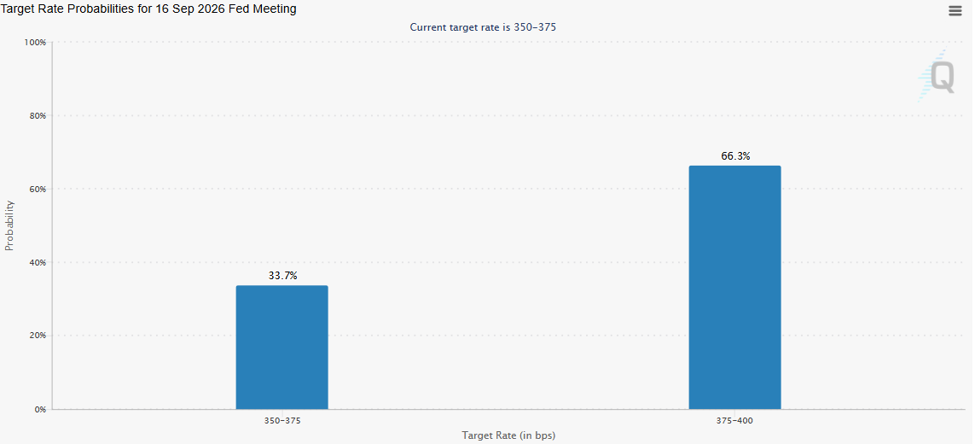
Source: CME Group
We got a fresh reminder of why this morning, when Fed Governor Michael Barr became the latest official to put a rate hike squarely on the table:
If inflation appears not to be moderating sufficiently, then I think we should act decisively to raise rates…
Inflation remains too high — and has been for over five years.
The next major inflation read – the Consumer Price Index, or CPI – arrives the following Friday, Sept. 11. That’s the last one before the Fed’s September FOMC meeting wraps up on Wednesday, Sept. 16, so it could carry outsized influence.
Now, these headwinds land hardest on the market’s biggest engine – the AI trade. Rising rates are especially punishing for the high-growth names that have led this bull market. But rates aren’t the AI trade’s only problem right now. It’s also up against a mounting backlash against data centers.
But is it all real?
Pulling back the mask on the anti-datacenter backlash
Luke flagged the pressure in his Daily Notes, noting that the market entered this stretch already worried about growing pushback against data-center construction. It’s turning into a political issue.
But where’s that worry coming from? Louis offered an interesting take. Back to his Flash Alert:
The anti-data center craze is largely being fueled by China. China is our AI competitor, and they’ve already identified over 200 Chinese bots that were planning false narratives about data centers.
So, you’ll hear in the media, we have an election coming up, how evil data centers are and how they don’t want the billionaires to get richer. A lot of it’s being planted.
China wants to win the AI race. They don’t want us to win it, so they want to interfere at all costs.
That claim isn’t coming out of nowhere. According to X, the platform recently flagged a suspected Chinese bot farm of roughly 200,000 accounts – including about 200 posting content designed to manipulate the U.S. debate over AI and energy policy.
Still, planted or not, the backlash is a real headwind – and Luke thinks it could take a while to clear:
The political fight over data-center construction will take longer to settle, with the midterms likely determining whether today’s restrictions gain momentum or begin to fade.
Timing aside, Louis sees it resolving only one way:
You have to build out the data centers because otherwise AI development is going to stall.
So, it’s coming. We can’t stop it.
So, what does each expert see coming for stocks given all these headwinds?
Luke stays bullish – but he wants investors braced for a market that takes its time getting back into gear:
The backdrop remains uncomfortable but manageable.
Oil near $85, the 10-year around 4.75%, and a few rate hikes priced in can keep the broad market choppy. But the hyperscalers have already shown they can keep spending through those conditions.
The fundamentals remain intact. The market simply needs more time to absorb the risks still hanging over it.
Stay bullish. Stay patient. And be ready when the tape finally catches up.
Louis is similarly cautious on the first half of September but grows more bullish as we look farther out. Back to his Flash Alert:
The first half of September is tough because people have to pay their estimated taxes on September 15. Some people sell stocks to do that, but the second half of September is a lot better.
So, any dip in our powerful stocks is a buying opportunity. Please don’t worry about all the narratives out there.
There’s nowhere to go. The U.S. is an oasis around the world.
But the bigger question isn’t when to buy – it’s what
Louis just noted that any dip in his “powerful” stocks is a buying opportunity. Fair enough – but it raises a question…
How do you know if a stock is powerful in the first place? How do you know that it’s a survivor, and not a casualty of the very AI boom driving much this volatility?
Our global macro expert Eric Fry, editor of Fry’s Investment Report, just tackled that exact question. He starts with a hard truth: the same force lifting the AI trade is also a wrecking ball:
AI is spawning thousands of such companies, many of which will conquer and replace established companies that may seem indomitable today, if not immortal.
As investors, therefore, we cannot afford to bemoan new technologies like AI; we must embrace them… our mission is to cozy up to the up-and-comers, and steer clear of the down-and-outers.
So, how do you tell the creators from the casualties?
Eric’s test comes down to a single word – efficiency. He poses two questions:
1. Is this company introducing a significant efficiency boost, relative to the established, market-leading product or service?
2. Is this company applying new technologies to boost the efficiency of its operations?
Eric writes that if the answer to either question is “Yes,” congratulations – you’ve probably got a creative winner on your hands. If the answer to both questions is “Yes,” you’ve definitely got one.
What’s today’s takeaway?
While the headlines fixate on Iran, oil, the Fed, interest rates, and the AI backlash, it’s worth stepping back for some perspective. Both Luke and Louis see better conditions waiting on the other side of this historically weak month.
And history backs them up. More often than not, pullbacks like this one have proven to be some of the best buying opportunities in powerful, well-positioned stocks. The catch is knowing which stocks are truly powerful – and that’s the very test Eric just handed us.
So, if September lives up to its ugly reputation, don’t look away, but consider leaning in. The investors who keep a level head and take advantage of the chaos are usually the ones who come out ahead once the smoke clears.
Have a good evening,
Jeff Remsburg


