Listen to the audio version of this article (generated by AI).
Kashkari goes full hawk… the ADP jobs report comes in soft… the FedWatch Tool says hike, but what will Warsh say?… why 3 analysts are backing up the truck on AI
This morning, Minneapolis Federal Reserve President Neel Kashkari went full hawk:
Corporate earnings are through the roof. They’re doing great. The consumer is hanging in there. The labor market is hanging in there.
I look at this constellation and I say, what evidence do I have that monetary policy is particularly restrictive right now?
So, I argued now is the time to start slowly moving up as we get more data in.
Apparently, Kashkari missed the other news this morning – the weakest ADP jobs report since January.
The data showed private companies adding just 44,000 positions in July, well below the expectation for 75,000. It’s a sharp deceleration in hiring momentum and the slowest pace of job growth since the start of the year.
Plus, if we dig into the data, there’s more reason to be skeptical about Kashkari’s confidence…
Goods-producing sectors shrank, shedding a net 3,000 jobs. And in service-providing companies, just two sectors – education and health services – generated 36,000 of the 47,000 new positions.
Does this sound like a red-hot jobs market crying out for higher rates?
Now, the ADP report is an imperfect gauge. The Main Event is Friday, when we get the official nonfarm payroll employment report from the Bureau of Labor Statistics. The forecast is for about 80,000 jobs, which – again – would be on the weaker side relative to historical averages and healthy economic growth.
But that would be good news for legendary investor Louis Navellier. In yesterday’s Growth Investor Flash Alert, after pointing toward estimates for how the number will come in, Louis said:
We kind of want a weak payroll report because we don’t want the Fed to raise rates. We want them to be worried about the labor market.
I don’t sense any worry in Kashkari – or in Cleveland Fed President Beth Hammack or Dallas Fed President Lorie Logan, who were the three FOMC members who just voted for a rate hike at the July meeting.
Still, I’d caution against reading too much into Friday’s payroll report, even if it comes in hotter than expected.
It is really the dawn of a rate-hike cycle?
As I write on Wednesday, the CME Group’s FedWatch Tool shows traders putting nearly 57% odds on a quarter-point interest rate hike in September.
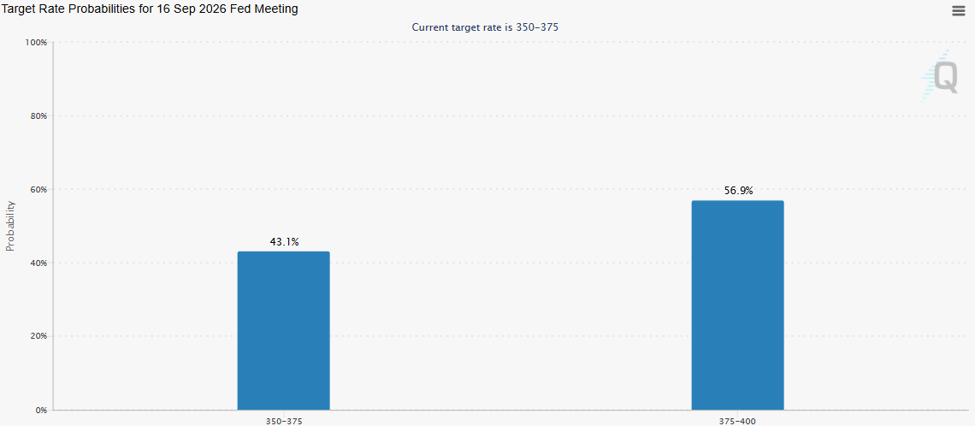
I’m not convinced.
While Kashkari is increasingly hawkish, let’s not forget that new Fed Chair Kevin Warsh has repeatedly emphasized how monetary policy should respond to durable trends rather than monthly noise.
This is also why Warsh places greater weight on inflation measures like the Dallas Fed’s Trimmed Mean PCE inflation gauge, which filters out short-term volatility to better identify the underlying inflation trend.
That philosophy has been applied publicly to inflation, not payrolls. But if Warsh truly prioritizes underlying trends over monthly noise, it’s highly unlikely that one jobs report – strong or weak – will dramatically alter his thinking.
Instead, he’ll pay more attention to the trend in jobs this year, which is uneven, slightly cooling growth.
Another reason why Warsh will push back on a rate hike
The bond market is already doing some of the Fed’s work.
Below, we look at the 10-year Treasury yield – arguably the single most important number in the financial world, as it affects borrowing costs throughout the economy.
Since late June, it has been climbing.
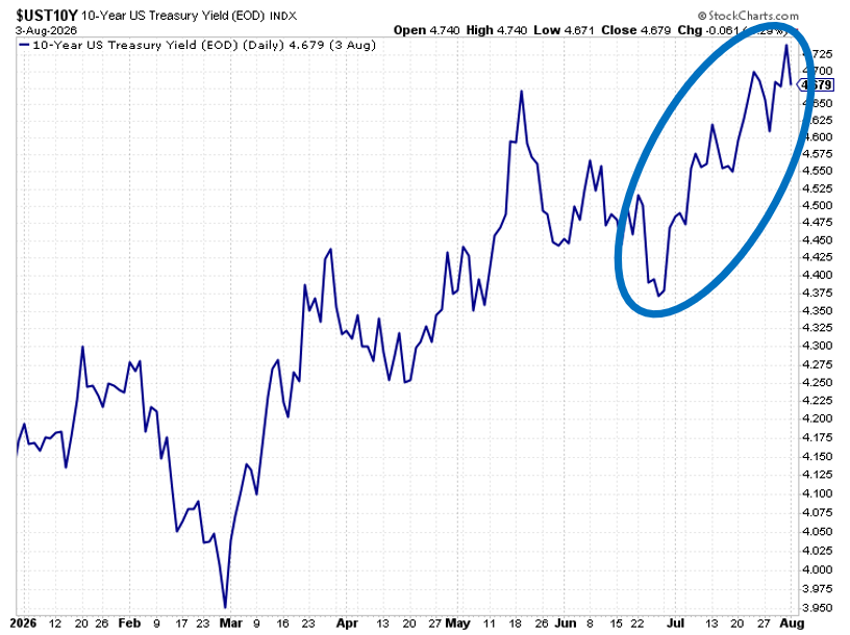
That rise has pushed mortgage rates, corporate borrowing costs, and other longer-term interest rates higher. And tighter financial conditions naturally slow economic activity, reducing the need for the Fed to deliver another increase in its overnight policy rate.
This is precisely the kind of market response Warsh praised after last week’s FOMC meeting.
At his press conference, the new Fed Chair went out of his way to shift the media’s focus from the Fed’s projections to the market’s reaction to incoming information.
From Warsh:
I was comforted that markets in the inter-meeting period weren’t reacting to us. They weren’t reacting to [the Fed’s quarterly dot plot) or to speeches].
They appeared more than ever to be reacting to real-time events, so they’re gauging themselves how restrictive the Treasury curve should be, and that I think has been a useful development.
Warsh appears comfortable with letting the bond market determine how much restraint the economy needs, rather than assuming every strong data point requires another Fed hike.
And according to veteran trader Jonathan Rose of Masters in Trading (MIT) Live, the bond market appears to be doing exactly what Warsh described.
In yesterday’s free MIT episode, Jonathan highlighted that beginning on July 29, shorter-term yields began falling relative to longer-term yields, causing the yield curve to steepen.
Here’s Jonathan:
The Fed didn’t do anything, but the bond market is now trying to force the hand of the Fed.
In other words, in the absence of interest rate changes from Warsh and the Fed, the Treasury market is repricing conditions on its own.
But Jonathan believes investors are viewing this as a constructive development rather than a reason to sell stocks.
Higher long-term yields still raise mortgage rates, corporate borrowing costs, and the discount rate applied to stocks. But the decline at the front end of the yield curve suggests traders are becoming less convinced that the Fed itself must deliver another near-term hike.
In other words, the bond market may be applying restraint where it is needed – through higher long-term borrowing costs – without demanding that Warsh tighten policy further.
So, coming full circle to this Friday’s jobs data, yes, it could move markets in the short run. But between Warsh’s preference for underlying trends and the bond market’s own tightening work, I’m less convinced that the hawkish coalition will win in September.
We’ll report back.
Three experts say it’s time to buy
If Warsh is right that markets – not just the Fed – are determining how restrictive financial conditions should be, then the next question becomes:
What does that mean for investors?
Three of our experts are reading today’s market through three different lenses – technicals, fundamentals, and investor positioning – yet arriving at essentially the same conclusion…
It’s time to buy.
Jonathan is looking at the bond market and the Nasdaq’s price action.
In yesterday’s MIT Live episode, he noted that the Invesco QQQ ETF that tracks the performance of the Nasdaq-100 Index bottomed on July 29 – the same day the yield curve began steepening. He also identified roughly 702 on QQQ as a key support level that now needs to hold, but described the market as firmly positioned on the “long side.”
Here’s Jonathan’s takeaway:
The NASDAQ bottomed the exact same day… And now we are off to the races.
Now, I wouldn’t take one coincidental market turn as proof that the bond market caused the Nasdaq rebound. But Jonathan’s broader message is clear: from a technical perspective, he believes the recent low was meaningful and that the market’s momentum has turned bullish.
Our technology expert Luke Lango is reaching the same conclusion from a fundamental perspective.
Last week, Luke told his readers that he was watching for two things before getting aggressive with new AI infrastructure buys: confirmation from the hyperscalers that AI spending is strengthening, not merely continuing, and an end to the technical selling pressure whipsawing the group.
We’ve now gotten both.
Here’s Luke with what it means:
We’re doing something we have not done since the depths of the Iran War saga, and before that, the Liberation Day crisis back in April 2025.
We’re backing up the truck.
In Luke’s Early Stage Investor newsletter, he issued two new “Buys” on Monday. In Innovation Investor, he issued five. They’re all concentrated in AI infrastructure; the physical buildout of chips, power, cooling, and networking gear that the entire AI boom runs on.
Here’s Luke with more on his buying rationale:
A meaningful chunk of the recent weakness in AI infrastructure names was not about the businesses getting worse.
It was about one enormous, over-leveraged trader forced to sell stocks it still believed in, simply because it had borrowed too aggressively to hold them comfortably.
That risk is now gone.
To make sure we’re all on the same page, Luke is referring to Leopold Aschenbrenner, manager of the AI hedge fund Situational Awareness.
In recent weeks, as Aschenbrenner’s overleveraged AI bets came under pressure, leading to margin calls, he had to liquidate his entire $45 billion portfolio. This was a major contributor to the recent AI trade drawdown.
Luke believes the removal of that forced seller changes the near-term supply-and-demand picture for the entire group.
Back to Luke:
Markets tend to price in the fear of continued forced selling before it happens, which means some of the recent softness in our target names likely reflected worry about more Situational Awareness selling that will now never come.
Finally, Louis is looking at the market through the lens of investor positioning and sentiment.
He believes the forced selling didn’t merely pressure AI stocks – it may have produced the kind of capitulation that frequently marks an important market low.
From his Accelerated Profits issue yesterday:
The fund ultimately sold a large part of its public equity portfolio to Citadel. That fire sale was what pushed the NASDAQ to the edge of correction territory on Wednesday.
This action can be best described as “capitulation.”
The good news is that the Wednesday low may not need to be retested. Typically, capitulation selling does not have to be retested.
So, we can now look forward to what’s in store for us in August, and I think August will be a big rebound month.
Bottom line: three of our experts studied the same market, beginning in different places.
Jonathan with the charts… Luke with the AI fundamentals… and Louis with investor psychology.
But they all arrived at the same destination – this looks like a buying opportunity.
If you’ve been waiting on the sidelines for the dust to settle in the AI trade, all three are telling you that the opportunity may be here.
Have a good evening,
Jeff Remsburg


