Listen to the audio version of this article (generated by AI).
Warsh’s hawkish Jackson Hole comments… why the AI trade may take it in stride… a new flareup in the Middle East… the Canada trade-war headlines to look past… and the plays underneath them
Two weeks ago, we told you not to expect Fed Chair Kevin Warsh to tip his hand on rates when speaking at the Jackson Hole Symposium. Expect “a whole lot of nothing” on policy. But we told you to watch one thing closely – his tone on inflation.
Would he call the trend “favorable,” or reach for words like “vigilant” and “unfinished” that echo the hawks?
We got our answer last Friday – and it wasn’t subtle.
On policy, Warsh gave us exactly the “nothing” we expected – no forward guidance, no “reaction function,” none of the signposts his predecessors leaned on. But on inflation, he wasn’t afraid to let out his inner hawk:
While this summer’s readings were better than expected, they do not tell me that underlying trends have meaningfully improved.
So, the Fed’s predominant focus right now should be on prices.
And the line that did the most damage to anyone still hoping for a cut:
We must be confident that underlying inflation is moving to our objective, clearly and at sufficient speed. Otherwise, we have work to do.
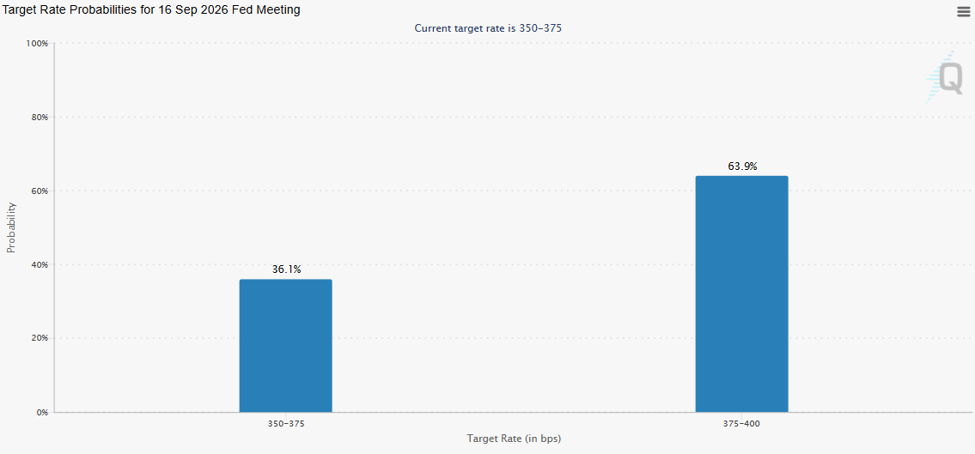
Translation: a hike in September or shortly thereafter is clearly on the table. As I write on Monday, the CME Group’s FedWatch Tool puts the odds of a quarter-point hike in September at 63.9%.
But what about the whole “trimmed mean PCE” gauge we’ve covered in the Digest?
Regular Digest readers know that Warsh leans on the Dallas Fed’s “trimmed mean” PCE, the inflation gauge that tosses out the most extreme price swings to expose the underlying trend.
As we covered last Wednesday, the latest trimmed mean PCE figure came in at 2.3% – clearly not far from the Fed’s 2% goal. It’s also remained steady in the low- to mid-2s for six months. I saw this as the doves’ best case for standing pat.
But last Friday, Warsh took the same number that I saw as dovish and turned it against the doves. None of the gauges, including the trimmed mean, has made it back to 2%, he noted. And they all tell the same story…
Stuck above the target.
So, a trimmed mean at 2.3% isn’t a dovish “close enough!” It’s a hawkish “failure to reach the goal.” Stable, but stalled. And by Warsh’s “sufficient speed” test, stalled doesn’t count.
But this isn’t necessarily an AI-killer
The knee-jerk read is that a hawkish Fed is cold water on the AI trade – higher-for-longer rates, squeezed growth valuations, sell your infrastructure names.
But look at how the bond market responded last Friday. Yields on the two-year Treasury jumped about eight basis points as traders priced in the risk of that hike. Meanwhile, the 10-year yield added just four basis points, and the long end barely flinched – the 30-year yield stayed flat.
Our hypergrowth expert Luke Lango, editor of Innovation Investor, called this back in May. When discussing why he thought Warsh should hike rates – which would be counterintuitively bullish for AI – he said:
You bring up the short end to save the long end.
If Warsh can convince the market he’s serious about inflation, he removes the bond vigilantes’ reason to keep dumping long bonds. The long end settles. And the number that actually matters for the AI trade – the 10-year yield – remains at a safe distance away from Luke’s line in the sand at 5%.
So, Friday’s hawkish Warsh didn’t necessarily threaten the AI trade. By Luke’s framework, it’s the distasteful but effective medicine that keeps it alive.
The next domino arrives in two weeks at the September FOMC meeting. We’ll finally see whether Warsh’s tough words translate into an actual hike, or whether last Friday was “all squawk, no hawk.”
Meanwhile, keep an eye on that 10-year. Below 5%, the AI bull survives. Above it, we start getting defensive. As I write on Monday, it sits at about 4.76%.
The weekend’s other potential interest rate story
Over the weekend, another driver of higher prices – and, by extension, potentially higher interest rates – flared up again.
Yesterday, U.S. forces struck two Iranian rocket launchers on Larak Island, near the mouth of the Strait of Hormuz. According to U.S. Central Command, Revolutionary Guard forces had been spotted preparing to fire rockets carrying sea mines into the strait. It was the first American strike on Iran in more than a month, and Tehran quickly vowed to retaliate.
As I write on Monday, West Texas Intermediate is trading near $86 per barrel, and Brent has pushed back above $90 per barrel, extending Sunday’s jump. Higher crude prices translate into gas prices, shipping costs, and food – precisely the sticky, broad-based inflation Warsh doesn’t want to see.
So, the weekend handed the doves one more reason to worry – a fresh oil shock, reinforcing everything we laid out above.
Which brings us to yet another potential driver of higher prices – tariffs with our neighbor to the north.
The latest on the Canadian trade war spat – and the opportunity it’s hiding
I try not to react to every geopolitical headline. After all, today’s “breaking news” has a way of reversing tomorrow. But the recent resurgence of the trade war between the U.S. and Canada is worth your attention – but not for the reason the headlines suggest.
Here’s the quick recap. Trade talks collapsed on August 21, and 50% U.S. tariffs on roughly $20 billion of Canadian goods – about 5% of the country’s exports – took effect at 12:01 a.m. the next day. Notably, the White House reached for Section 338 of the Tariff Act of 1930, a provision that hadn’t been used since 1949.
Canada answered the following Tuesday with its own list: more than 700 U.S. products, matched “dollar for dollar” at rates from 15% to 50% – including a 50% duty on American steel and aluminum – all set to take effect September 8.
The rhetoric has escalated to match. President Trump told Canada to “fall in line” or face consequences “far WORSE.”
Canadian Prime Minister Mark Carney hasn’t backed down, saying:
You’re at war when you get attacked. We got attacked…
The new U.S. tariffs are designed to hurt and divide us. They’re a miscalculation…
By rejecting a bad deal, by standing up for Canada, by focusing on what we can control, we will build Canada strong for all.
At face value, that’s ugly. And there are real pain points.
Legendary investor Louis Navellier, editor of Growth Investor, flagged one of them last week in a Special Market Update podcast – aluminum, which carries a 50% tariff of its own.
Here’s Louis:
Canada has a huge edge over America because they have that cheap hydroelectric power. So, for energy-intensive industries like aluminum, it’s important that it stays up there.
I mean, can we make aluminum? Of course we can. But Canada can make it cheaper because of their cheap electricity.
Notice what Louis is really saying, though. Even in aluminum – a product that is being tariffed – Canada holds an edge Washington can’t tariff away. Smelting aluminum is essentially buying electricity in solid form, and Canada’s cheap hydro makes it the low-cost producer, no matter what the trade negotiators do.
But beyond aluminum, here’s the part the scary headlines gloss over: when you look at what the new tariffs cover, Canada’s most important exports are deliberately left out.
Per the White House’s own fact sheet, the duties will not apply to energy, potash, products subject to tariffs under Section 232, and certain other goods, such as fish or critical minerals.
What gets hit is finished and consumer goods – wine, hockey sticks, and cement, along with autos, dairy and alcohol. But oil, natural gas, potash and critical minerals? Carved out.
That sharply limits the real economic fallout from this spat.
This dovetails into something senior analyst Brian Hunt recently covered – and it’s the reason investors who let these headlines scare them out of Canada may be making a mistake.
Why Canada deserves a home in your portfolio
Brian, who writes the free daily letter Money & Megatrends, has been making the case for months that we’re in a powerful environment for critical resources – and that Canada is one of the best places in the world to own them.
Here’s Brian with why those resources matter so much:
Critical resources are the building blocks of the economy. Think raw materials like crude oil, natural gas, iron ore, copper, uranium, corn, and cotton.
Even today’s high-tech world of AI, apps, email, and Zoom calls is built on a “low-tech” foundation of steel, concrete, copper, lumber, and aluminum.
That’s the whole point. Even the AI boom runs on a physical base of copper, power, and raw materials – demand that isn’t going anywhere. And Canada is a powerhouse in exactly these categories: a top-five global producer of both oil and natural gas, and a world leader in fertilizer, uranium, gold and lumber.
Now connect that to the tariff list…
The resources underpinning Brian’s thesis – energy, potash, critical minerals – are precisely the ones carved out of the new duties. So, the Canadian plays with the strongest fundamental tailwinds are the ones the trade war doesn’t even touch.
Here’s Brian with some specific investments that are on his radar:
The bullish factors above are driving a steady uptrend in the iShares MSCI Canada ETF (EWC). [Two weeks ago], this Canada-focused ETF reached a new all-time high.
Canadian oil and gas giants Cenovus (CVE) and Canadian Natural Resources (CNQ) also reached new all-time highs…
Canadian fertilizer giant Nutrien (NTR) – which will benefit from a bull market in agriculture – is poised to reach a new one-year high.
It’s just a reminder to look through the fearmongering headlines to the real opportunities underneath.
For more from Brian, you can sign up for his Money & Megatrends newsletter right here. Every day the market is open, he delivers actionable insights loaded with specific stock tickers – and it’s 100% free.
Credit where credit is due
A big “congratulations’ to Jonathan Rose’s Advanced Notice subscribers.
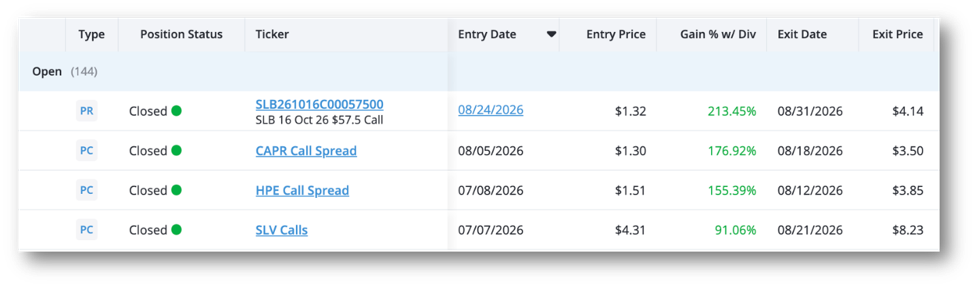
Here are the results of their last four closed trades: +91%, +155%, +177 %, and +213%.
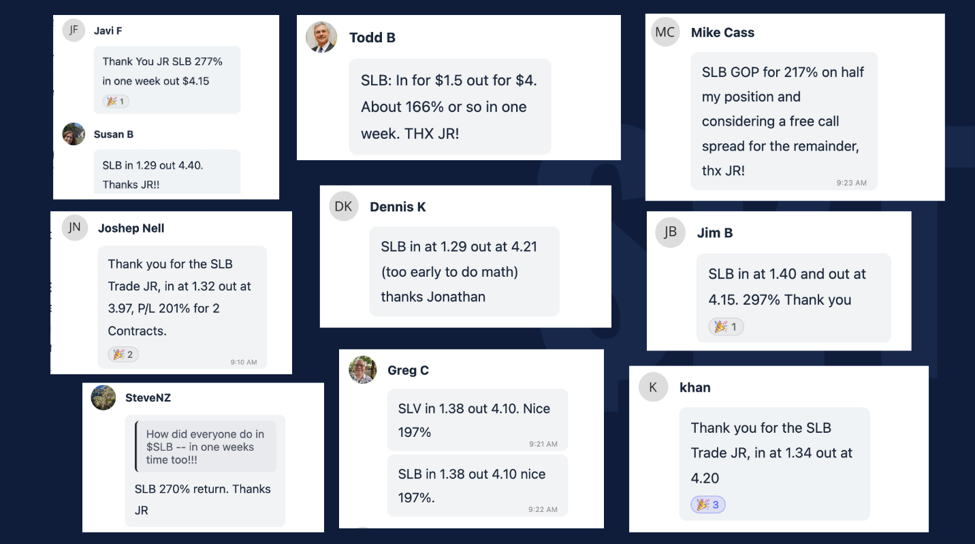
I have a compilation of feedback from Jonathan’s subscribers in front of me, thanking him for the trade and guidance, and sharing their respective win sizes. As you can see below, one trader made 277% in just a week.
If you want to learn how to do this yourself, Jonathan has you covered.
In his Masters in Trading Challenge course, you’ll learn how to spot unusual options activity, structure defined-risk trades, and separate meaningful signals from market noise. You can learn more right here.
If you’d prefer to join Jonathan in Advanced Notice so he can curate and guide you through all the trades himself, click here.
In any case, congrats to all of Jonathan’s subscribers who have been cleaning up recently.
By the way, in Jonathan’s free Masters in Trading Live episode today, he covers Anthropic’s coming IPO. Here he is with more:
I’m not just diving the headlines and predictions around Anthropic. I’m telling you exactly how we trade around the Anthropic IPO before the S1 drops.
I’ll show you the names to watch, how we can trade the IPO once it happens – and why we always let the money show us where it’s going before we decide anything.
To join Jonathan in Masters in Trading Live and watch these free daily market updates, click here.
We’ll keep tracking all these stories here in the Digest.
Have a good evening,
Jeff Remsburg


