


Listen to the audio version of this article (generated by AI).
Hello, Reader.
A motorcycle helmet might not be as safe as you think.
Now, obviously, helmets can and do save the lives of riders who get into serious accidents. And they should be worn.
But, although it sounds counterintuitive, wearing a helmet can also contribute directly to a fatal accident that a helmetless rider might have avoided. For reckless riders, the protective measure can turn into a false sense of invincibility.
After California passed its 1992 helmet law, motorcycle fatalities per 10,000 registered motorcycles fell for a few years, then leveled off and rose.
From 1997 to 2007, the annual number of motorcycle fatalities per registered bike nearly doubled… and returned to where it was before the helmet law was passed. It was as if the law never changed.
The data shows a simple human truth: We tend to convert potential safety benefits into performance benefits.
Helmeted riders may feel more invincible, encouraging risky habits such as speeding or “splitting traffic.” These behaviors, combined with helmets’ sensory impairments, could explain why motorcycle deaths returned to pre-helmet levels.
There is a similar false sense of security on Wall Street.
U.S. stocks have delivered consistent, world-beating results for nearly two decades. That success has made American stocks feel like the safer choice – while foreign stocks, by comparison, can seem riskier.
Just as helmets can make reckless riders feel invincible, years of strong U.S. stock returns can make investors feel safer than they are. They may stick with what has worked, overlooking foreign markets that could offer better value and help diversify their portfolios.
So, in today’s Smart Money, I’ll explain why this overconfidence can lead investors to favor U.S. stocks even when foreign markets offer compelling alternatives.
Then, I’ll walk you through the hidden risks of sticking with the status quo, and point you toward several overseas opportunities I’m backing that most U.S. investors overlook.
The Real Reason U.S. Stocks Soared
Before assuming U.S. stocks are inherently better investments, we need to first understand what has driven their outperformance – and whether that can continue.
From the lows of 2009, the S&P 500 has delivered a total return of roughly 1,340%, nearly triple the MSCI EAFE Index’s 468% return over the same period. The EAFE Index tracks developed markets in Europe, Australasia, and the Far East.
From a self-congratulatory perspective, we might assume that American technological prowess and economic dynamism have been powering the massive outperformance of U.S. stocks. But upon closer examination, we find a much more pedestrian explanation:
Multiple expansion.
That’s the term Wall Street analysts use to describe the boost a stock receives when its valuation increases from low levels to higher levels. In other words, a big chunk of the S&P 500’s gains came not from stronger businesses, but from investors simply paying more for them.
Currently, the S&P 500 trades for about 26 times earnings, compared with under 18 for the EAFE. Multiple expansion can’t continue forever. And when valuations stretch this far, even good news can struggle to push prices higher, while bad news can send them sharply lower.
Plus, market leadership never lasts forever.
The chart below shows the difference between the EAFE Index’s rolling five-year net returns and the S&P 500’s returns.
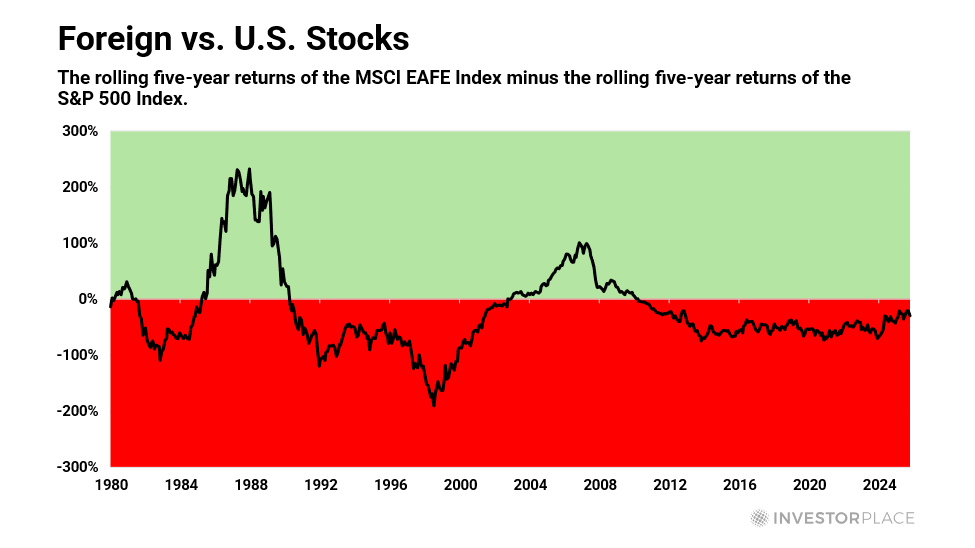
When the black line is in the green space, the EAFE has been outperforming the S&P 500 over the preceding five years. When it’s in the red, EAFE has been underperforming.
The first major period of outperformance ran from March 1986 to March 1991. In 1986 alone, the EAFE Index returned nearly 67%, more than triple the S&P 500’s 18.7% gain.
The second ran from November 2003 to February 2011. In November 2006, the EAFE had returned 13.79% per year over the prior five years, while the S&P 500 had returned just 6.09% per year.
The black line’s slight upturn on the right-hand side reflects that the EAFE and S&P have delivered nearly identical returns over the last two years.
Now, I want to be clear: This recent trend only suggests, not proves, that U.S. momentum may be fading relative to foreign stocks. Still, as we’ve seen, history shows that a shift is possible.
Yesterday’s winners aren’t guaranteed to lead tomorrow – which is why investors must strengthen their portfolios today. Here’s how…
Familiar Isn’t Safe
No matter what happens next, we American investors should never remain “overweight” in U.S. stocks and bonds, simply because they are familiar. We must remember that, as investors, the world truly is our oyster.
In times like these – when the U.S. markets are featuring more uncertainty than average and U.S. stock valuations are much higher than average – select foreign markets deserve a closer look.
In other words, if a new cycle of outperformance by foreign stock markets is underway, we should try to maximize that opportunity by diversifying some of our capital into select foreign investments.
That doesn’t mean U.S. stocks are a bad investment. Far from it. But holding them isn’t the risk. Assuming they’ll always lead is. I’m not predicting U.S. stocks will crash or that foreign stocks will soar. I’m saying the safest assumption is that leadership changes, and that diversification protects you either way.
That’s why, at Fry’s Investment Report, we’ve already begun cautiously diversifying into select foreign markets. One of our recommendations is a South American ETF that has soared 81% since we added it last year, while the S&P 500 gained only 48% over the same timeframe.
Another recommendation is an Asian ETF that has been benefiting from rising demand for robotics and other AI technologies. That one has advanced a solid 51% since joining the portfolio, compared to a gain of only 34% for the S&P 500.
I believe both still have plenty of runway ahead.
It’s understandable that a U.S.-heavy portfolio feels safe after years of strong returns. But that’s also what makes it dangerous, like the helmeted rider who starts splitting traffic.
My advice: Wear your investing helmet; don’t abandon U.S. stocks. But, at the same time, don’t be afraid to change lanes.
Regards
Eric Fry
P.S. If you had $10,000 to invest right now, where would you put it? In the debut episode of The Investor Place podcast, I – along with my colleagues Louis Navellier and Jonathan Rose – share where to find the next big opportunities in the AI trade and name specific stocks to watch. I also share my thoughts on the AI buildout as a whole, as well as other overlooked ways to hedge your portfolio today. Click here to watch now.


