
Apollo 13 and the Iron Law of the Stock Market
The disaster had begun before they ever left the launchpad.
On April 13, 1970, three American astronauts were headed toward the Moon on Apollo 13 when an explosion ripped through their spacecraft.

Credit: iStock/Carmen K Sisson
More than 200,000 miles from Earth, they were suddenly fighting for their lives.
You probably remember this story from the movie “Apollo 13,” starring Tom Hanks.
It’s a tremendous tale, full of real-life courage and intelligence. Most of the story focuses on what happened after the explosion.
What’s less discussed … the cause of the trouble wasn’t anything the astronauts had done.
Instead, it was something that happened weeks earlier. Technicians had encountered trouble draining an oxygen tank during preparations for the mission.
They used the tank’s internal heaters to help empty it. But they hadn’t anticipated that the heaters could damage the insulation on electrical wiring inside the tank.
So, with no obvious sign of trouble, the astronauts climbed aboard, and Apollo 13 launched into space.
Everything appeared to be going according to plan … then came the explosion.
A system can appear to be working perfectly even after the conditions responsible for its success have begun to deteriorate.
That lesson applies to more than spacecraft.
The Signs of a Failing Stock
Every year, investors lose money on companies that once seemed unstoppable.
Their products are popular. Their executives are celebrated. Their stocks have delivered extraordinary returns.
But beneath the surface, something has changed.
Sales growth is slowing. Profit margins are shrinking. Earnings are falling short of expectations.
What appears “to be working perfectly” is in fact deteriorating.
And by the time the problems become obvious to everyone, the stock may already have suffered enormous losses.
This brings me to something legendary growth investor Louis Navellier calls the Iron Law of the stock market:
Stock price trends can diverge from earnings trends for a short time, but over the long term, share prices inevitably follow a company’s underlying earnings and cash flow growth.
When earnings are growing rapidly, they can help propel a stock to extraordinary heights.
But that works in reverse, too.
When earnings deteriorate, even the most celebrated companies can suffer devastating declines.
And this is where Louis has an advantage.
For nearly five decades, he’s studied the fundamental characteristics that separate the market’s strongest companies from its weakest.
His proprietary Stock Grader system evaluates thousands of stocks, looking for changes in earnings growth, profitability, and buying pressure.
And sometimes, those changes reveal trouble long before the rest of Wall Street recognizes what’s happening.
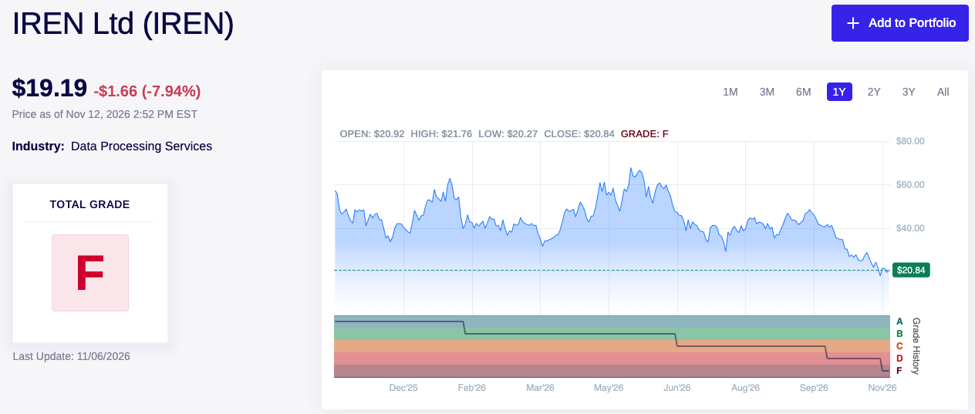
Consider what happened with IREN Ltd. (IREN). The company owns data centers powered by renewable energy. It has been closely associated with the AI infrastructure buildout, having worked closely with Microsoft (MSFT).
On November 5, the AI neocloud company reported strong top-line growth, with revenue jumping 66% to $228.3 million as AI cloud sales nearly tripled. However, it also posted a steep $263 million net loss – missing earnings estimates – while warning of rising costs and a delay to its $4 billion annual recurring revenue target.
Meanwhile, in 2026, its Stock Grader rating has plunged from an A to an F. You can see the progression of the downgrade under the stock price chart.
The Stocks Primed for Gains
Now, here’s the important part.
The same system that pinpoints IREN’s deteriorating fundamentals is also constantly searching for companies moving in the opposite direction – companies with accelerating earnings growth, improving profit margins, and the kind of buying pressure that can help propel their shares higher.
That’s the other side of Louis’s Iron Law. And it’s where some of the stock market’s greatest opportunities are found.
In fact, Louis believes we’re entering a period in which the market is becoming even narrower, and the gap between the market’s strongest and weakest companies could become even more pronounced.
That’s why he just launched an entirely new investment research service.
It’s called Prime Portfolio, and it brings together 25 of his highest-rated stock recommendations from across his existing research services.
What hasn’t changed is Louis’ focus on fundamental superiority. As always, he starts with eight core criteria: sales growth, operating margin growth, earnings growth, earnings momentum, earnings surprises, analyst earnings revisions, cash flow and return on equity.
Next, Louis adds what he calls his “secret sauce”: a Quantitative Grade that tracks institutional buying pressure, or where the big money on Wall Street is flowing.
Both are critical in identifying early signs of weakness. For example, take a company with outstanding sales growth, expanding profit margins, and a rock-solid balance sheet. On paper, everything looks wonderful – the Apollo 13 blasting off without any obvious problem – but here’s Louis’ warning:
If institutional investors are dumping its shares, that stock can still fall, even while the underlying business remains strong.
What’s different about the Prime Portfolio is the new hold period. Every month, Louis will review each holding, looking for companies that may be losing momentum and new opportunities that deserve a place in the portfolio.
Here’s Louis:
If a company continues delivering exceptional earnings growth and attracting strong institutional buying pressure, I’m perfectly happy to let it run. Some of our best stocks could remain in the portfolio for a year or longer.
But when a holding starts losing its edge, or I identify an even more attractive opportunity, I may recommend making a change. That could mean locking in gains on a stock that’s enjoyed a terrific run or cutting our losses before they become more painful.
Earlier this week, Louis held a live presentation where he dove deeper into his approach and this new portfolio.
The signs of success or failure aren’t always obvious. But Louis’ Stock Grader can help you see the warning signs, or the potential profit signs, ahead.
Enjoy your weekend,
Luis Hernandez
Editor in Chief, InvestorPlace


