


Listen to the audio version of this article (generated by AI).
Editor’s Note: Sometimes the biggest investment opportunities emerge when demand outpaces supply. And you don’t always need a brand-new technology to find them.
My colleague Louis Navellier has spent decades studying the market for signs of this kind of shift. In his latest presentation, he explains how he’s using his Stock Grader system to identify companies with accelerating sales, rising earnings, and growing Wall Street interest – before those trends become obvious to everyone else.
With 2027 approaching, Louis believes some of the market’s next big winners may already be revealing themselves. Here’s what he’s watching, including one stock to buy now and another to avoid.
In 1940, Hitler’s armies were sweeping across Europe, and German bombers were pounding British cities.
Back in the United States, military leaders were already considering what would happen if we entered the war and concluded that victory would depend heavily on air power.
But that presented a significant problem.
America couldn’t build the airplanes it needed.
Not because we didn’t have enough engineers or factories. But because we lacked an adequate supply of a critical material.
Aluminum.
Without it, the engineers, factories, or workers didn’t matter.
And President Franklin D. Roosevelt made the shortage felt more acutely when, in 1940, he called for American factories to produce 50,000 military airplanes a year.

Credit: iStock/csfotoimages
Where would all the aluminum come from?
At the time, American smelters produced roughly 206,000 short tons of primary aluminum annually. The industry simply wasn’t equipped to meet the demands of a massive military buildup.
So, the country embarked on an extraordinary industrial expansion.
New smelters were built. Rolling mills sprang up. Production lines accelerated. The government committed enormous resources to expanding aluminum capacity.
By 1943, American aluminum production had reached approximately 900,000 short tons annually.
Production had more than quadrupled.
Now, here’s what that story has to tell us about today.
Aluminum wasn’t a new invention. It hadn’t suddenly become stronger, lighter, or more useful.
What changed was the demand.
An industry that had spent decades supplying a relatively predictable market suddenly found itself at the center of an unprecedented industrial expansion.
Economists call this a demand shock.
And as a growth investor, I pay very close attention when demand for an essential product begins accelerating faster than manufacturers can increase supply.
Because that imbalance can create the conditions for extraordinary earnings growth.
In fact, we witnessed a remarkably similar phenomenon in 2026.
Only this time, the driving force wasn’t a world war.
It was artificial intelligence.
A great example is Micron Technology Inc. (MU). The company has manufactured memory chips for years. And for years, they felt the booms and busts of the notoriously cyclical memory-chip industry. In fact, as 2025 began, the stock was relatively flat.
But the AI megatrend changed all that.
The reality is AI systems and data centers need immediate access to data, and all that data must be stored on chips. This, in turn, creates increasing demand for the types of chips that MU manufactures. So, Micron Technology’s vast range of memory and storage solutions is a critical component of data centers.
That demand shock was reflected in my Stock Grader late last year.
As you can see in the chart below, in May 2025, Micron held a D-rating. By November it had been upgraded to an A-rating. Then in January 2026, I recommended it to my subscribers. Since then, the stock has soared more than 180%.
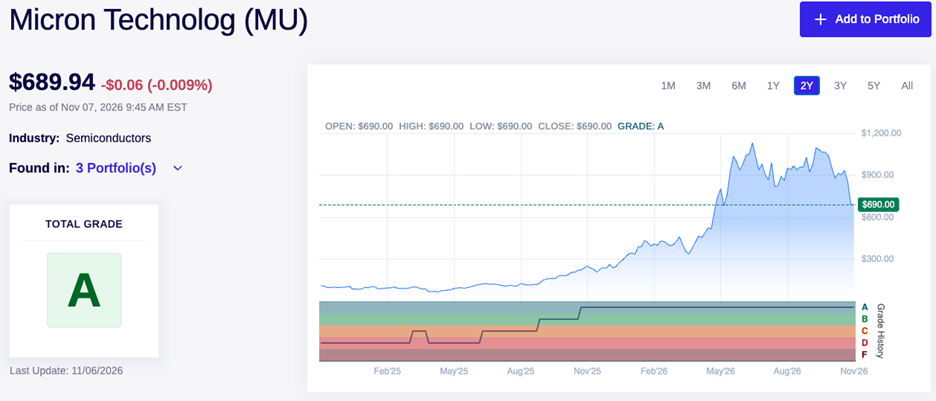
Now, the stock’s strength isn’t surprising given the company’s superior fundamentals.
Case in point: During Micron’s fourth quarter in fiscal year 2026, earnings surged 1,078% year-over-year to $37.7 billion, or $32.87 per share, up from $3.2 billion, or $2.83 per share, in the same quarter a year ago. Adjusted earnings came in at $33.42 per share. Analysts were calling for earnings of $31.71 per share, so the company topped estimates by 5.4%.
Fourth-quarter revenue soared 379% year-over-year to $54.23 billion, compared to $11.32 billion last year. The consensus estimate called for revenue of $51.33 billion – a 5.6% revenue beat.
The fourth quarter ultimately capped off what was a record year for Micron Technology. The company reported full-year adjusted earnings of $86.76 billion, or $75.52 per share, and revenue of $133.198 billion. That represented 811% annual earnings growth and 256.3% annual revenue growth.
Looking forward, company management expects “an even stronger fiscal 2027.”
The bottom line: The demand shock is still alive and well.
But here’s what I want you to understand as we are about to enter 2027…
Micron isn’t the only company benefiting from this extraordinary surge in demand.
Across the economy, select businesses find themselves in the same position America’s aluminum producers were in during World War II.
Demand for their products is accelerating. Supply is struggling to keep pace. And in some cases, earnings are growing far faster than Wall Street anticipated.
But the truth of the matter is that not every company will benefit equally.
That’s why I focus on the companies where growing demand is translating into stronger earnings and sales, positive earnings surprises, and persistent institutional buying pressure.
Those are the kinds of signals my Stock Grader system is designed to identify.
That’s important as we prepare for 2027. The $64,000 question isn’t which stocks delivered the biggest gains in 2026…
It’s which companies are positioning themselves to become the next big winners.
That’s why I explore in my latest, special presentation. I explain…
- What I see coming for the stock market in 2027
- The warning signs investors need to watch
- And how I’m approaching the search for tomorrow’s market leaders.
I also reveal one stock I believe investors should consider buying right now — and another I believe they should avoid.
Most importantly, I reveal a brand-new way I’m putting Stock Grader to work to identify what I believe could be the market’s next big winners.
Click here to watch my free broadcast now.
Remember, America’s aluminum producers didn’t need to invent a revolutionary new metal to experience extraordinary growth.
They simply needed to be in the right place when demand exploded.
I believe we’re seeing similar opportunities emerge today.
And I want to help you recognize the signs before the next wave of potential winners becomes obvious to everyone else.
Sincerely,
Louis Navellier
Senior Investment Analyst, InvestorPlace


