

Most people come to the market just looking for answers to what seem like simple questions — “what should I buy,” “where’s the S&P going,” “what’s the next trade.”
After enough time — and enough scars — you realize the market doesn’t reward answers by themselves. It rewards understanding how to find those answers.
For me, that means learning how to think through volatility, structure, and risk before you ever worry about anything else. That’s the process I built over the better part of three decades as a professional trader, and that’s the framework I built Masters in Trading around in 2015.
Before I joined InvestorPlace, most education I’d see out in the wild was either incomplete, incompetent, or both.
If you’ve been around markets long enough, you’ve seen the pattern: a lot of confidence, a lot of hindsight, and not nearly enough process.
I don’t want readers to come here to simply outsource their thinking. I’m not the kind of person who’s content to simply hand you a list of trades to copy.
I want everyday traders to understand how professionals actually see the market — and why that perspective is a completely different game than what most retail traders are playing.
Transparency Comes First
For me, transparency is the standard.
Every performance number we publish reflects closed trades only, shown since inception, calculated by a verified third-party platform. No hindsight, no cherry-picking, no cropped timeframes.
| Portfolio | Avg Gain / Position | Annualized Gain | Avg Days Held | Closed Positions | Winning % |
| Advanced Notice | 101.44% | 104.41% | 45 | 100 | 55.00% |
| Earnings Advantage | 31.50% | 278.99% | 32 | 55 | 65.45% |
| Divergence Trader | 96.26% | 112.75% | 56 | 36 | 66.67% |
| All Access | 63.68% | 171.52% | 58 | 24 | 70.83% |
That matters because trading is hard enough without being asked to trust someone else’s math. When you’re evaluating a process, you should be able to see exactly what happened when it mattered.
This is how I think about it: if you’re asking someone to take you seriously, they should be willing to show you their work.
Masters in Trading placed its first live trade on May 4, 2024. Everything you see reflects the complete trading record from day one.
That matters because it eliminates survivorship bias. You’re not being shown a curated history assembled after the fact. You’re seeing every closed trade — wins and losses — exactly as they occurred.
Beyond the Percentages
The performance matters, but it only matters when you pair it with process.
One of the things I said in my morning livestreams that I’ll repeat here is that the win rate alone can mislead you, especially when you’re buying options.
When you buy options, you’re paying premium and premium can go to zero.
That’s the tradeoff: fixed risk, but you need to let winners breathe because the losers are defined and the winners are where the expectancy comes from.
If a trade turns south, we don’t have the luxury of holding onto the trade for months or years until it turns profitable. We have fixed risk and a ticking clock.
That’s why a portfolio like Advanced Notice can have a win rate in the mid-50s and still produce strong results. These numbers reflect real closed trades — and they come from a consistent approach.
No one can be right every single trade. The goal is to pinpoint potential catalysts, get positioned early and make money when the volume finally catches up.
The Importance of Process and Discipline
We don’t rely on traditional technical analysis in isolation. We’re not drawing lines and hoping price behaves.
Every trade needs a reason. When we’re looking at an options chain, the conversation is never “wouldn’t it be cool if this went up?”
The conversation should be: what would have to happen for this to work, in this timeframe, and is there a catalyst that makes that move plausible?
That’s how professionals think. It all begins with structure: volatility, positioning, catalysts, relative value, risk and reward.
Only when you have those locked down do you even begin to decide if the trade deserves your hard-earned money.
And we’re not done just yet. We have one more step that a lot of traders like to skip: we try to disprove the trade.
The real test of a good idea is to see if you can talk yourself out of it.
If you can’t disprove it, you’re probably looking at something worth doing.
This habit alone can save people from a lot of “try-to-get-lucky” and fear-of-missing-out (FOMO) trades.
Like any new skill, there’s a learning curve. After a few weeks of repetition, the confusion tends to fade and the process starts to click.
That’s by design — the goal isn’t to copy trades, but to understand how professionals think.
The Four Elements of Our Process
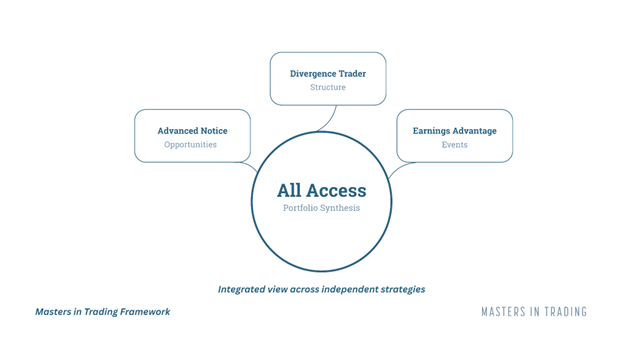
Masters in Trading isn’t a menu of disconnected products. Each program focuses on a different part of the same decision-making process — how opportunity is identified, how it’s evaluated, and how it’s ultimately expressed.
Taken together, they reflect a single way of looking at markets. The tools and timeframes change, but the underlying framework does not. Ideas often move between programs as more information becomes available, because that’s how real trading works — not in silos, but as part of a larger process.
Advanced Notice: The First Mover’s Edge
Advanced Notice focuses on unusual options activity — not because options are exotic, but because they are often the first place institutional intent becomes visible.
The market always reveals opportunity in structure first, not price. That’s when risk is most clearly defined and optionality is most attractive.
Large, directional options positions require planning, capital, and conviction. When a single name sees concentrated call or put buying that is disproportionate to its normal activity, it’s rarely random. The goal is not to guess why the trade exists, but to recognize that informed capital is positioning before the broader market reacts.
The work begins by filtering out noise. A lot of options activity is irrelevant.
Advanced Notice looks for size, duration, and structure that suggest institutional involvement rather than short-term speculation.
Once that footprint is identified, the next step is context: where price sits relative to its expected range, what volatility is implying, and whether the risk/reward is asymmetric at current levels.
Win rate is not the objective here. Expectancy is. Options trades have defined downside, so the edge comes from allowing winners to develop when positioning proves correct. This is why patience matters and why not every trade is expected to work. The framework is designed to benefit when opportunity is early and mispriced.
Earnings Advantage: Leveraging Catalysts
Earnings Advantage treats earnings as a repeatable market event, not a narrative exercise.
Earnings are known in advance. The timing is fixed. The uncertainty is measurable. That makes them ideal for a structured approach built around volatility rather than opinion. Instead of guessing whether results will be “good” or “bad,” the focus is on how much movement the market is pricing in — and whether that pricing is justified.
The process begins with understanding how the stock historically behaves around earnings. Some names routinely overshoot expectations; others rarely move enough to justify aggressive premium. From there, the structure of the trade is chosen to define risk explicitly and avoid overpaying for optionality.
Discipline matters most here. Options decay is real, and premium can go to zero. Trades are sized accordingly, entered deliberately, and held long enough for volatility to resolve — but not so long that time decay overwhelms the thesis. The goal is consistency, not excitement.
This approach removes emotion from earnings and replaces it with math, history, and structure.
Divergence Trader: Relationship Breakdowns
Divergence Trader is built on a simple but widely ignored principle: nothing is cheap or expensive in isolation.
Markets are relationships. Stocks move relative to peers. Commodities move relative to substitutes. Asset classes move relative to currencies, rates, and risk appetite. When those relationships become stretched, opportunity emerges — not because something “has to” move, but because the imbalance itself creates risk for one side of the trade.
A classic example is relative value in metals. Instead of asking whether silver is going up or down, the more useful question is how silver is behaving relative to gold. When that relationship becomes extreme, the opportunity isn’t a guess — it’s a structural imbalance that tends to normalize over time.
Trades in Divergence Trader are often longer-dated and may be expressed through stock, options, or paired positions. Timing is less about precision and more about context. These trades require patience, because dislocations can persist longer than expected. The edge comes from understanding why the imbalance exists and waiting for the market to resolve it.
This service builds context, discipline, and the ability to think in relationships rather than headlines.
All Access: Thinking Bigger
All Access is where we incorporate all of these ideas into a portfolio-level decision making.
Opportunities rarely arrive neatly labeled. A single thesis might begin with unusual options activity, gain confirmation through relative value analysis, and ultimately require judgment about the best way to express it.
Sometimes that expression is options. Sometimes it’s stock. Sometimes it’s income or protection.
All Access focuses on these decisions at the portfolio level.
Trade frequency is lower. Position sizing matters more. Risk is managed across exposures rather than in isolation.
Covered calls, hedges, and defensive positioning are used when appropriate — not because activity is required, but because portfolio balance demands it.
This is also where tools and analysis are most sophisticated. The goal isn’t to trade more. It’s to make fewer, better decisions that fit together coherently.
All Access reflects how a professional trading desk actually operates.
What Matters Most
There’s an old saying that you become the average of the people you spend the most time around. In markets, the same idea applies to how you learn.
What tends to matter most over time isn’t alerts or promises. It’s exposure to the insights and experience that only 28 years of professional trading can bring. How decisions are made, what gets questioned, and what gets ruled out entirely ends up shaping how you think long before it shows up in your results.
That access shows up in how ideas are handled before they ever become trades. You see which information is given weight, which details are ignored, and which factors disqualify an idea outright. Direction is rarely the starting point. Volatility, pricing, and structure come first.
You see why some setups are passed on even when they look obvious, and why others are sized conservatively or given more time to develop. Not every idea deserves capital, and not every trade deserves urgency.
You also see how expression changes with context. Some ideas are best expressed through options, others through stock, and some not at all. Liquidity, risk, and environment determine the vehicle, not preference.
Restraint is part of that picture. There are periods with fewer trades — not because nothing is happening, but because the risk/reward isn’t there yet. Waiting is treated as a decision, not a failure to act.
Over time, that exposure changes how you think. You start framing better questions, noticing structure before headlines, and recognizing when doing nothing is the correct choice.
How to Get Started
If this resonates but you want to experience it before committing, that’s exactly why the Masters in Trading Options Challenge was created.
It’s the lowest-risk, highest-clarity way to get exposure to the process. You get time to learn without pressure, and you can paper trade or trade small while you build understanding.
That’s important, because the right way to do this isn’t to swing harder. It’s to get better.
Trades will come and go, but the markets will always be there.
What’s rare is the opportunity to see the market early, transparently, and through the eyes of someone who has survived and thrived for nearly three decades — by respecting structure, volatility, and risk.
Give the Masters in Trading Challenge a try and join our Discord community. It’s the easiest way in, the lowest risk, and the clearest path to understanding whether this is right for you.
You’ll be surrounded by people who are working through the same concepts at the same time, asking thoughtful questions, and comparing how they’re thinking about risk and structure.
That shared context matters. Trading can be isolating, and progress comes faster when you’re learning alongside others who take the process seriously.
I’ll see you inside.
The creative trader wins.
P.S., A strong market can still be dangerous. When growth becomes more selective — as it is now — investors who rely on broad index exposure risk getting trapped in what my InvestorPlace colleague Louis Navellier calls a “hidden crash.” It’s not a sudden selloff, but a slow grind where capital goes nowhere for years while a small group of stocks does all the work. We’ve seen this before during the Lost Decade, and the setup today looks uncomfortably familiar. In his Hidden Crash 2026 briefing, Louis lays out where this risk is forming, why many portfolios aren’t nearly as diversified as they appear, and how institutional money is already rotating beneath the surface. This may be an important window to reassess positioning before those shifts become obvious in the averages. Click here to find out more.


