

Listen to the audio version of this article (generated by AI).
Fortune called it “America’s Most Innovative Company” for six years in a row, from 1996 to 2001.
The magazine praised it elsewhere as one of the nation’s “Most Admired Companies” and “100 Best Companies to Work For.”
The Financial Times awarded it “energy company of the year” in 2000.
Forbes and Business Week sang its praises, too.
The company the media was head over heels for? Enron.
And for good reason.
On paper, Enron had grown sales from $13.3 billion in 1996 to $100.8 billion by 2000.
But come 2001, Enron hit Wall Street with a nasty “October surprise.”
- On October 16, 2001, Enron reported a $618 million quarterly loss and a $1.01 billion charge.
- As investors soon learned, shareholder equity got cut by $1.2 billion.
- Then on October 22, the SEC opened a formal inquiry into Enron’s accounting.
Less than seven weeks later, Enron filed for bankruptcy and investors who held on got wiped out.
While most investors know the story of Enron, what many folks might not know is that I recommended it, too. But my readers didn’t lose any money on the stock – just the opposite. We walked away with a 37% profit.
So, in today’s Market 360, I’ll explain why I recommended the stock and share the details on how my proprietary quantitative system knew it was time to sell – even though Wall Street was still singing its praises. Plus, I’ll share what my system is alerting me to now.
How My System Detected the Biggest Financial Fraud of All Time
Now, before Enron became one of the most infamous stocks ever, it was a great growth play.
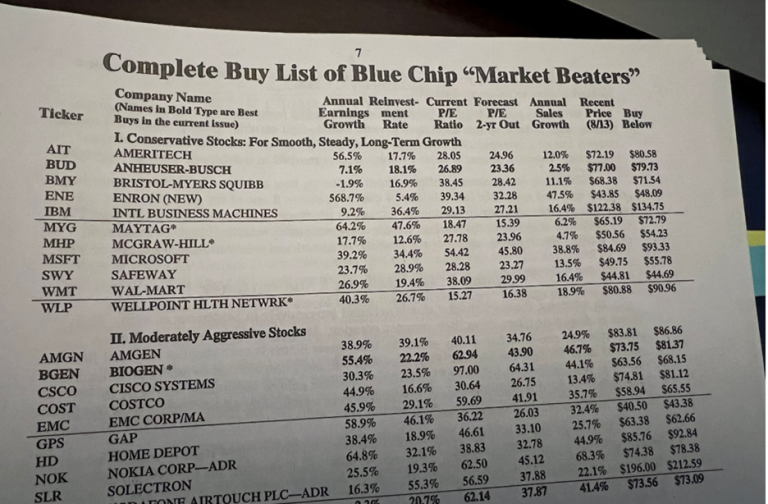
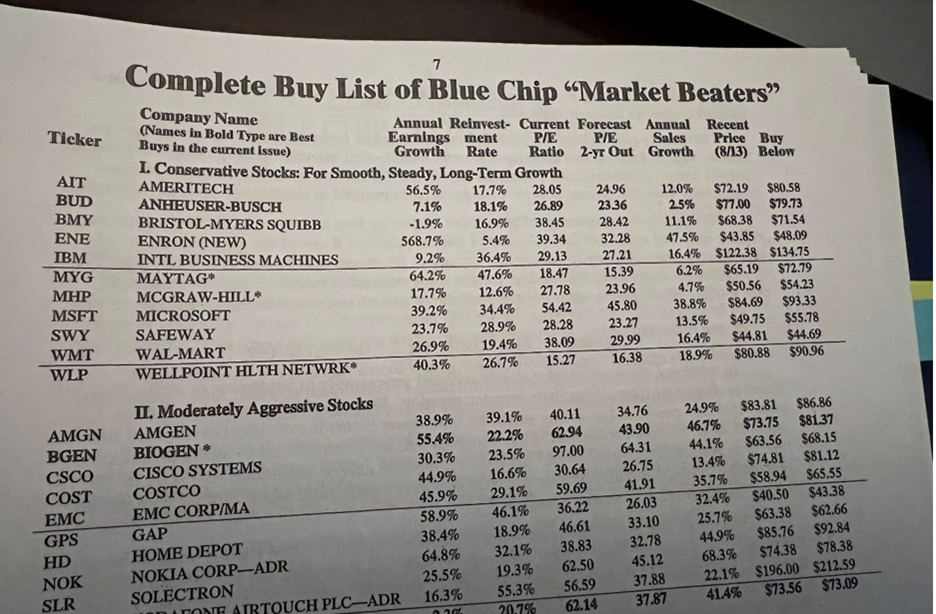
In fact, I recommended it to my subscribers in August 1999. Here’s what I said at the time…
Enron’s business spans the world of energy production. Enron explores, produces, transports and markets natural gas and related products. They also produce and sell electricity both wholesale and retail. Enron’s natural gas transmission system is the largest in the Western Hemisphere and the second largest in the world.
The system runs from Texas through Canada, and from Florida to California. Internationally, Enron has a presence in the Caribbean and Europe. An aggressive growth policy includes acquiring existing companies and building new business units as well as expanding current operations.
This growth has been reflected in Enron’s sales, up over 30% for the last two years, and margins have also been expanding. Earnings surprise and revised earnings numbers also look strong. As the world economy continues to recover, I expect Enron will continue to rise for the foreseeable future.
As you can see in my portfolio below, margins were expanding, annual earnings growth was 568.7%, and annual sales were up 47.5%.
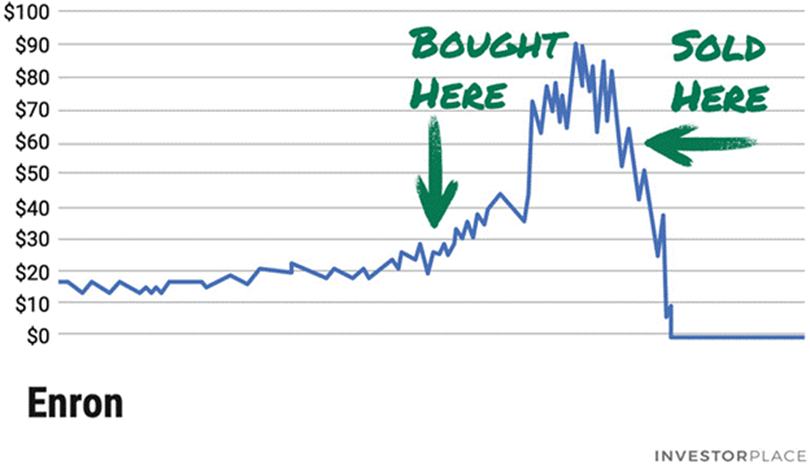
But in May 2001, I cut the stock loose.
My decision to sell was well before Newsweek declared “Lights out for Enron,” in December 2001. The corruption at the firm was yet to be discovered – but my Stock Grader system had detected deterioration beneath the glowing headlines. Earnings momentum was slowing, and the fundamentals no longer justified the hype.
In short, the situation had become too risky and the stock had grown too hot to handle. We got out at around $60 per share for a 37% gain, while others were later forced to sell as low as $0.25 per share.
Incredibly, one week before Enron collapsed and its accounting shenanigans became the big story on Wall Street, 11 of the 13 analysts following the firm still rated it a “Buy,” one a “Hold,” and only one a “Sell.”
How Stock Grader Helps Avoid Disaster
There was something else that was flagging Enron as a “Very Weak” stock: My Stock Grader.
Essentially, Stock Grader works by identifying strong fundamentals like sales growth, operating margin growth, earnings growth, earnings momentum, earnings surprises, analyst earnings revisions, free cash flow and return on equity.
It also monitors institutional buying pressure (the “smart money”) and grades it based on how much money is flowing in or out of a stock. That’s why I call it my Quantitative Grade.
So, when both the fundamentals and institutional buying pressure is strong, my Stock Grader will give it a high grade – a sign it might be worth buying. But the opposite is also true. If the fundamentals are weaking and institutional investors are fleeing the stock, the stock’s grade will drop. This is my signal that it’s time to sell, which is why I sold Enron… even though Wall Street and the financial media were still in love with the company.
Bottom line: When my Stock Grader flags something, I pay attention. And now it’s alerting me to something that could begin separating the market into a very different group of winners and losers.
What’s Coming Next – for Stock Grader AND the Markets
This event is so big that my friend and legendary investor Marc Chaikin has noticed it, too, thanks to his Power Gauge system. It analyzes a separate set of signals tied to price action, money flow and market behavior.
Together, our research shows a 92% historical chance of this event occurring, based on data going back to 1925.
And it could hit before the November 3 midterm elections.
Which is why on Tuesday, September 29, at 10 a.m. Eastern, Marc Chaikin and I will be joining forces for our special Midterm Mayhem event to explain what’s going on. (You can click here to reserve your spot now.)
Marc and I are convinced we’re about to witness the most dramatic midterm-year market event in more than 30 years.
And we want to make sure investors are positioned accordingly…
Go here to reserve your free spot now.
Once you sign up, you’ll be able to visit a private event site and use the Mayhem Monitor to check stocks with my Stock Grader for free.
Click here to give my Stock Grader a spin. You never know what Enrons could be lurking in your portfolio…
Sincerely,

Louis Navellier
Editor, Market 360


