
Listen to the audio version of this article (generated by AI).
114% gains on POET from Jonathan Rose… where he’s looking now… the electricity grid that can’t keep up… how Brian Hunt is investing… Nvidia’s quantum reversal… how do you invest?
As I write on Wednesday, stocks are rallying on last night’s news that President Donald Trump has extended the U.S.-Iran ceasefire that was set to expire today.
Trump said the move was warranted because Tehran’s government is “seriously fractured.” The truce will now continue until Iran’s leaders submit a unified proposal to end the war with the U.S. and Israel.
The extension came after a planned second round of peace talks in Islamabad fell apart. Vice President J.D. Vance had been set to travel to Pakistan for negotiations, but Iranian officials refused to attend, citing what they called unreasonable American demands.
Trump said Pakistan’s leadership – specifically Prime Minister Shehbaz Sharif and Field Marshal Asim Munir – asked the U.S. to hold off on resuming strikes while Iran works toward a unified position.
In the meantime, Iranian gunboats have fired on three ships in the Strait of Hormuz today, seizing two and escorting them into Iranian waters – so, travel through the world’s most critical oil chokepoint remains limited. Iran says it won’t reopen the Strait or resume talks until the U.S. naval blockade ends. Yet the blockade stays in place.
Despite the lingering Hormuz drama, U.S. stocks are focusing on the indefinite ceasefire as I write – all three indexes are up. We’ll keep tracking the latest developments.
Shifting from geopolitics, one trade that Digest readers had a chance to act on back in February has turned into a triple-digit winner…
Jonathan Rose’s POET trade has exploded
114%.
That’s roughly what you’d be sitting on if you’d acted on our February 12th Digest when we profiled a trade on POET Technologies Inc. (POET) – a small semiconductor company positioned at the center of the AI infrastructure boom.
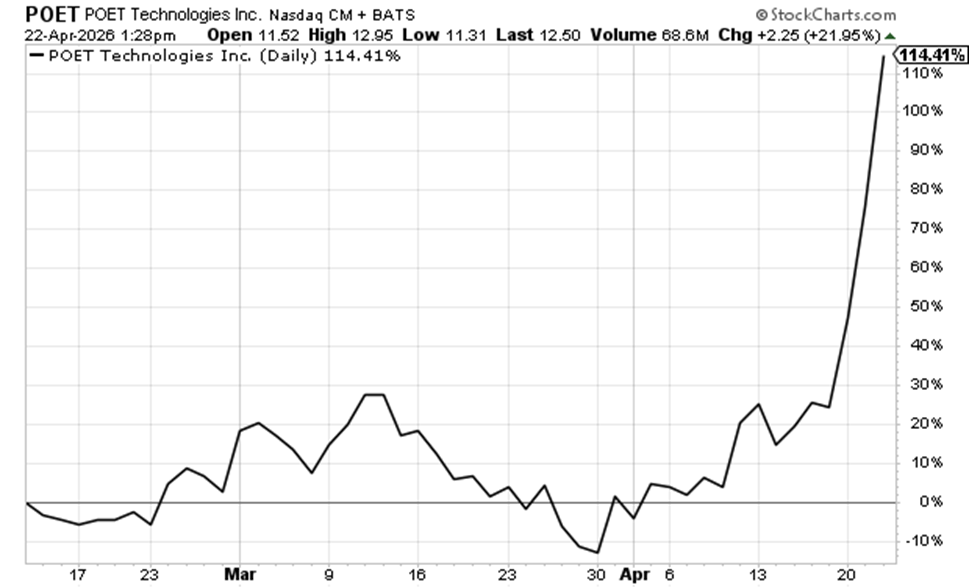
It came courtesy of veteran Jonathan Rose, who recommended it to his Masters in Trading: All Access subscribers.
Here’s Jonathan with a quick recap of the trade’s rationale:
Copper creates heat. Heat demands power. Power is becoming the constraint inside modern data centers.
The solution the industry is racing toward is optical interconnect — moving information with light instead of electricity. Faster, dramatically more efficient, and far cheaper at scale.
That’s where POET Technologies Inc. (POET) comes in.
POET designs optical engines that move data using light rather than traditional electrical signals. As AI clusters grow larger and faster, the connections linking thousands of processors together are becoming a bottleneck. POET provides a solution.
Now, as you can see in the chart above, most of the gains have come in recent days.
Here’s Jonathan from earlier this week to explain:
Shares of POET Technologies are ripping higher again…
The recent move is being fueled by social media chatter linking POET’s photonics platform into the Nvidia-Marvell AI supply chain, along with commentary from a former Sivers Semiconductor executive suggesting a deeper role in that ecosystem.
If you missed this move, Jonathan remains very bullish on POET – it’s one of his favorite stocks – but for the moment, taking profits is the play, not adding more exposure.
Here’s his note to subscribers:
Sentiment has rallied sharply after the company pushed back on a short-seller report, with the stock now one of the most actively discussed names in the media and momentum building quickly.
This is exactly the kind of environment where we want to get on prints and take risk off the table.
The move here is being driven more by narrative expansion than fundamentals, and with shares now extended after their strongest run in months.
We’ll keep tracking this trade, but for now, a big congratulations to all of Jonathan’s subscribers who are taking profits this week, as well as any Digest readers who jumped into this trade.
The next potential triple-digit winner that Jonathan is eyeing
In Monday’s Masters in Trading: Live video, Jonathan dug into the AI water economy. This is a $1 trillion investment ecosystem that no one is taking about yet.
Here’s Jonathan from the video:
Every hyperscaler needs water to cool AI chips. That creates demand not just for the machines doing the cooling, but also for the infrastructure that moves, treats, and recycles that water.
There are two key categories here: the cooling systems themselves — things like heat exchangers, chillers, and immersion tanks — and the water infrastructure that feeds those systems.
Jonathan has been building a watchlist to trade both opportunities.
On the infrastructure side, one stock he likes is Modine Manufacturing Company (MOD). It’s a global leader in thermal management, engineering, and manufacturing heating, cooling, and ventilation solutions.
But it’s the water side that’s more interesting…
Morgan Stanley is projecting AI data center water usage to grow 16x by 2028. Back to Jonathan:
When you see a new industry scaling like that, the opportunity is getting positioned early — before it’s fully priced in.
We’ve already seen strong performance in the cooling names. Some of those stocks are up significantly. But the water infrastructure side hasn’t moved as much yet — and that’s where I think opportunity still exists.
In Monday’s Masters in Trading: Live video, Jonathan flagged one of his favorite stocks related to this opportunity:
It’s a smaller-cap name — around $600 million — which means it can be volatile, but it also has significant upside potential if the theme plays out.
For the name of the stock and additional details, you can check out the free episode right here.
Bottom line: If you’re looking for an opportunity that Wall Street hasn’t yet bid up, give the AI water economy a look.
You can get Jonathan’s latest trade ideas – totally free – every day the market is open at 11 a.m. ET in his Masters in Trading: Live broadcasts. You can sign up right here.
The wiring that powers the AI age
Let’s turn to another electricity-driven opportunity – one that runs parallel to everything Jonathan just laid out but plays it from a different angle.
While the AI water economy focuses on cooling the machines, there’s an equally urgent problem on the other side…
Getting enough power to them in the first place.
And that problem runs straight into one of the most neglected pieces of infrastructure in America.
Brian Hunt, editor of Money & Megatrends, has been urging readers to get in position on this opportunity for months. Here’s how he frames it:
All the electric power generation in the world isn’t worth much if you can’t get it to consumers.
The U.S. power grid is often called the world’s largest machine — a giant network of power stations, transmission lines, substations, and underground wires.
Most people barely know it’s there. But without it, your lights don’t turn on, there’s no Netflix, and your iPhone doesn’t charge.
The problem?
That “machine” is aging – badly. Brian points out that the American Society of Civil Engineers gave the energy sector a D+ in its 2025 Infrastructure Report Card, citing surging electricity demand, crumbling infrastructure and a dangerous lack of transmission capacity.
And atop that crumbling grid, we’re now layering on AI and next-gen technologies with their unprecedented electricity demands.
It’s like connecting a fire hose to a garden spigot. The pressure is coming. The pipe isn’t ready.
Every hyperscale data center that gets built, every EV that gets plugged in, every semiconductor fab that comes online – all of it runs on electricity.
Here’s Tech Insider to give you a sense for how big this problem is:
The International Energy Agency now projects that global data center electricity consumption will exceed 1,000 TWh by the end of 2026, an amount equivalent to Japan’s entire annual electricity usage.
The AI economy doesn’t just need more electricity. It needs a whole Japan’s worth more.
But for investors who recognize the problem, this is an enormous opportunity. Back to Brian:
Soaring electricity demand… a grid badly in need of an upgrade… the global race for AI supremacy… and trillions of dollars of economic output on the line. This is a recipe for a bull market in companies that build, repair, and upgrade our power grid.
So, how do you play it?
Here are two of Brian’s ideas:
Monolithic Power Systems (MPWR) – a power management semiconductor company whose chips sit at the heart of efficient energy delivery inside data centers. It’s up 58% since Brian’s original analysis.
Quanta Services (PWR) – the largest specialty contractor in North America, doing the boots-on-the-ground work of actually building and upgrading the grid. It’s climbed 41% since the original note as well.
You can get the rest in Brian’s picks in his issue here.
Here’s his bottom line:
Big business and technology trends that change the world tend to play out over years, not months. The Power Grid Upgrade is one such trend. Money & Megatrends is still bullish.
You can access Brian’s full Power Grid Upgrade analysis – including his complete buy list – for free by signing up for Money & Megatrends right here.
We’ll keep you updated on all these stories here in the Digest.
Have a good evening,
Jeff Remsburg
P.S. Want to know how to turn $100,000 into $1.3 million?
Then you’ll want to catch a free replay of this morning’s AI Signals Trading Event with Keith Kaplan, CEO of TradeSmith.
Keith walked through how a new form of AI could double your portfolio by detecting the most profitable trades, 90 minutes before they occur – including how it turned $100,000 into $1.3 million in its 5-year backtest through bull and bear markets. Last year alone, it booked a 124% total gain.
It could crush conventional investing this year by spotting the best place to put your cash each morning, with 90% historical accuracy.
All it takes is just 10 minutes a week, Keith says.


