

Listen to the audio version of this article (generated by AI).
Hello, Reader.
92,000.
That’s the staggering number of tech workers that have been laid off so far this year, according to Layoffs.fyi.
AI is a large contributor to this number, as Big Tech companies shift money toward AI investments – and make steep cuts in the process.
For example…
- Oracle Corp. (ORCL) laid off 30,000 workers in the first quarter as it pivots toward AI. CTO Larry Ellison admitted as much at Oracle’s development conference last month: “The code that Oracle is writing, Oracle isn’t writing. Our AI models are writing,” he said.
- According to TD Cowen analysts, cutting 20,000 to 30,000 employees could lead to $8 billion to $10 billion in incremental free cash flow for Oracle.
- Amazon.com Inc. (AMZN) confirmed plans to cut 16,000 corporate jobs back in January, following a 14,000 layoff in October.
- Meta Platform’s Inc. (META) recently said it will be cutting 10% of its workforce, about 8,000 job, beginning on May 20. And Microsoft Corp. (MSFT) just announced that it will offer voluntary buyouts for the first time in its 51-year history. With about 125,000 U.S. employees, that could add up to 8,750 cuts.
This trend will only worsen. That’s because for the past three years, AI has essentially been a very smart assistant. You ask it a question, and it gives you an answer. Or you give it a task, and it helps you do it more quickly.
But what’s rolling out now is fundamentally different.
There is a new type of AI making its debut that doesn’t answer questions or wait for instructions. It goes out into the world, makes decisions, takes actions, and completes entire jobs – from start to finish – without a human being involved.
Step by step. On its own.
I call this new technology “A-AI.”
And A-AI will be “employed” in the U.S. workforce, working alongside people, managing other AI systems, and running entire business operations from end to end.
Erik Brynjolfsson, a major economist from Stanford predicted that soon private individuals in the workforce will command fleets of A-AI “employees” bigger than the biggest multinational corporations do today.
But here’s the overlooked threat: A-AI’s earliest impact on the job market isn’t who gets fired; it’s who never gets hired.
The Federal Reserve’s Beige Book has noted repeatedly that firms are using AI tools to reduce the need for entry-level hiring, customer support staff, junior analysts, and back-office roles. Existing employees, augmented by software, are doing more work. Positions that would normally be backfilled are quietly left open.
That alone is enough to stall job growth.
Recent productivity data reinforce the point: Output per hour has risen faster than total hours worked. In plain English, the economy is producing more output without needing more labor.
If that dynamic persists – or accelerates – employment growth can turn negative, even if GDP remains positive.
Perhaps the most underappreciated signal is coming from a group that rarely worries about employment: recent college graduates.
According to data tracked by the Federal Reserve Bank of New York, unemployment among recent college graduates has risen, and underemployment has climbed to levels last seen during the pandemic disruption. More than 40% of recent grads are now working in jobs that do not require a degree.
That is not a coincidence. Entry-level hiring is exactly where AI-driven efficiency shows up first. When firms can automate basic research, coding assistance, customer support, and routine analysis, junior roles become optional… or obsolete.
But April layoffs bring May trade-offs.
Main jobs will become vulnerable to the threat of A-AI, as will the companies that provide them. You’ll want to steer clear of these firms.
But certain companies will get stronger because of this technology. You’ll want to incorporate these into your portfolio.
I’ll share this trade-off below. But first, here are other ways you can protect against – and profitably play – the A-AI revolution…
Smart Money Roundup
May 3, 2026
Missed the Mag 7 Gains? Here’s Your Second Chance

The first wave of AI gains went to the Mag 7, but the next opportunity may be forming in a very different part of the market. What lies ahead is the single greatest second chance I’ve seen in my decades-long career.
May 2, 2026
Don’t Let These 3 AI Investing Mistakes Destroy Your Gains

Market shifts tend to trigger three common mistakes every time a breakthrough technology emerges. Millions of portfolios will suffer losses because of them. I’ll break down each costly mistake and show you how to stay on the right side of this technology transition. Then, I’ll share the action you need to take now.
April 30, 2026
Don’t Buy the Railroads. Buy the Campbell’s

Every technological boom begins the same way. Investors applaud these visionaries, but then optimistic vision collides with reality. Then, a follow-on group emerges and capitalizes on those failures. They don’t build the new technology. They use it. This shift is already beginning to play out in the AI sector.
April 29, 2026
The Software Crash That’s Creating the Next 1,000% Winners
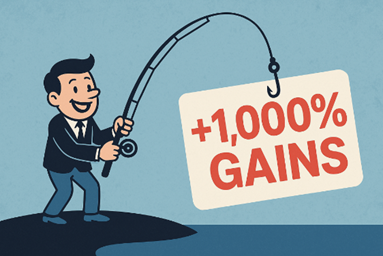
Anthropic’s Mythos isn’t just a better chatbot; it’s a signal that AI has crossed an important threshold, moving from a tool that responds to instructions… to one that can act, adapt, and solve problems on its own. And that changes everything for your portfolio…
How to Ride Out the A-AI Revolution
One stock I suggest selling is a global staffing and recruitment firm that could suffer multiple blows from A-AI.
For starters, the technology can now perform some of the tasks that temporary workers and contractors currently perform. Job categories from customer service agents to computer programmers could be at risk.
Second, A-AI will boost the efficiency of existing workers to such a meaningful extent that employers would need fewer part-time employees.
As demand for both temporary staff and skilled full-time workers falls, demand for the company’s recruitment and placement services will also fall.
As I see it, this company sits directly in the crosshairs of the A-AI threat. There are better places to park your money.
For instance, one of my newest “Buy” recommendations is a company that will thrive in the new era of A-AI. It designs and sells most of the essential components of modern automated factories – including the factories that make semiconductors.
I reveal the name of this company – for free – here.
Regards,
Eric Fry


