Listen to the audio version of this article (generated by AI).
A bot farm 200,000 strong… the fear campaign Louis says to tune out… why tomorrow’s rate hike isn’t the bull-killer it looks like… and last call for Luke’s workshop
You can choose to be manipulated. Or you can choose to follow the earnings and the fundamentals.
That’s legendary investor Louis Navellier, from yesterday’s Growth Investor Flash Alert podcast.
As I write on Tuesday, we’re still cleaning up after yesterday’s AI panic – the selloff touched off by last week’s viral warning from an Anthropic researcher who believes AI could pose existential risks to humanity.
We need to handle this topic carefully. And on that note, Louis chimed in with an angle that hasn’t received much press – some of the fear now washing over the AI trade may not be organic at all.
Let’s go back to Louis:
We’re getting all this false information from over 200 Chinese bots spreading AI fears – fears of data centers destroying your community, polluting the air, taking all the good water.
China is in an AI race with us. We’re winning. They’re losing. So, they’re trying to derail us by spreading false propaganda.
His bottom line: much of the AI backlash is propaganda, so don’t let it manipulate you – follow the earnings and the fundamentals instead.
If you’re skeptical, there’s evidence supporting Louis’ take
In late August, Elon Musk’s X reported that its safety team had uncovered a suspected Chinese bot farm of roughly 200,000 fake accounts. From the X Safety Team:
Within this farm, we found 200 accounts posting in a manner that could manipulate a legitimate debate about American AI and energy policy.
These posts contained claims that AI data centers are driving up household electricity prices and straining the grid.
Others included AI-generated cartoons that depicted data-center operators enriching themselves at the public’s expense.
It wasn’t just X. Back in June, OpenAI reported banning a likely Chinese network it nicknamed the “Data Center Bandwagon” campaign. The operators used ChatGPT to produce posts and comics claiming that AI data centers were driving up electricity prices for ordinary families, posing as Americans and logging in through VPNs from inside China.
Two different companies, two different data sets, one conclusion: a coordinated foreign effort to turn Americans against the very technology we’re leading the world in building.
To be clear, the bots didn’t invent this backlash – they’re piling onto a real one. As we’ve covered in the Digest, plenty of Americans have genuine questions about data centers and their power bills. The foreign hand here is amplification, not creation.
But Louis’ larger point holds up: when fear starts driving your decisions, it’s worth asking who benefits from that fear – and then getting back to earnings and fundamentals:
We want to ride through this. We want to profit from it. As long as the sales and earnings are there, we should stay.
You get rich by buying great companies and holding them as long as possible, as long as they dominate.
Easy to say, harder to do – especially when the next fear is already on the calendar. And this one isn’t coming from a Chinese bot farm. It’s coming from the bond market and the Federal Reserve.
Will an interest rate hike tomorrow break the bull?
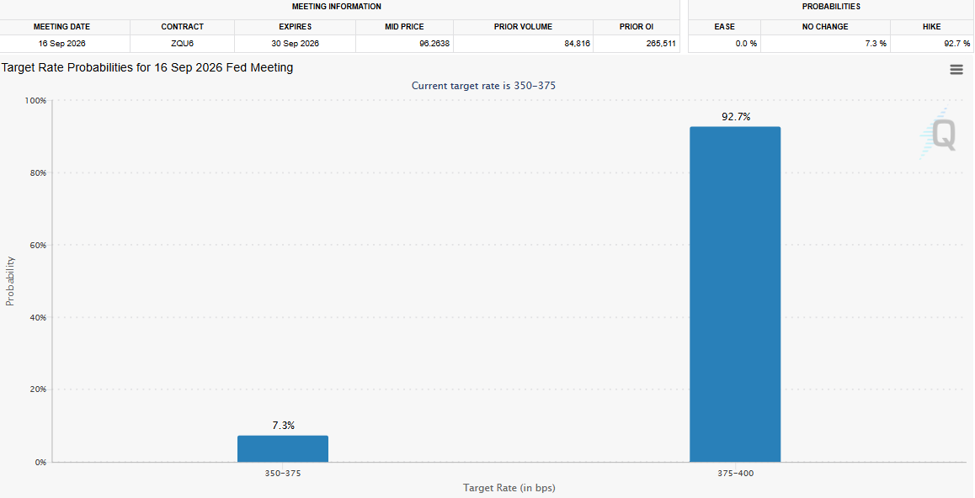
As I write on Tuesday morning, the 10-year Treasury yield trades just a hair above 5%, a 19-year high. It’s the bond market sending a very clear message to the Fed – you’d better raise rates tomorrow.
The CME Group’s FedWatch Tool currently puts the odds of a quarter-point rate hike at tomorrow’s FOMC meeting at 92.7%.
Even Louis, who for much of this year has argued that the Fed won’t raise rates, is calling for a hike now. Back to his podcast:
The Fed really does have to raise rates on Wednesday because if they don’t, they’ll weaken the dollar…
Market rates went up. The Fed doesn’t fight market rates. So, the Fed will have to raise rates on Wednesday.
Given that a hike seems to be a lock, will it be the straw that breaks the bull’s back?
Before you answer, factor in that higher rates aren’t the only potential headwind…
We’re in the middle of September, historically the single worst month of the year for stocks, so Wall Street is on edge. Plus, we’re in a midterm election year, which happens to be the weakest year of the entire four-year Presidential Cycle.
Three bearish forces, converging at once. So, is it time to batten down the hatches and go full bear?
Let’s see what the data tell us.
What history says happens after the first hike
Lucas Downey, editor of the TradeSmith Investment Report over at our corporate partner, TradeSmith, just put together a chart that tracks how stocks have performed after the first rate hike of each Fed cycle going back to 1987.
As you’ll see, in the first month after a first hike, the S&P 500 has fallen 2.9% on average, and the Nasdaq 100 has dropped 2.3%. And three months out, both are still underwater. That’s the near-term turbulence everyone fears.
But keep your eye moving to the right…
By the six-month mark, the picture flips. The S&P is up 4.2% on average, and the Nasdaq has climbed 12.4%. At 12 months, they’re up 5.7% and 15.2%.
And two years out, the gains are substantial: 21.1% for the S&P and a whopping 37.1% for the Nasdaq.
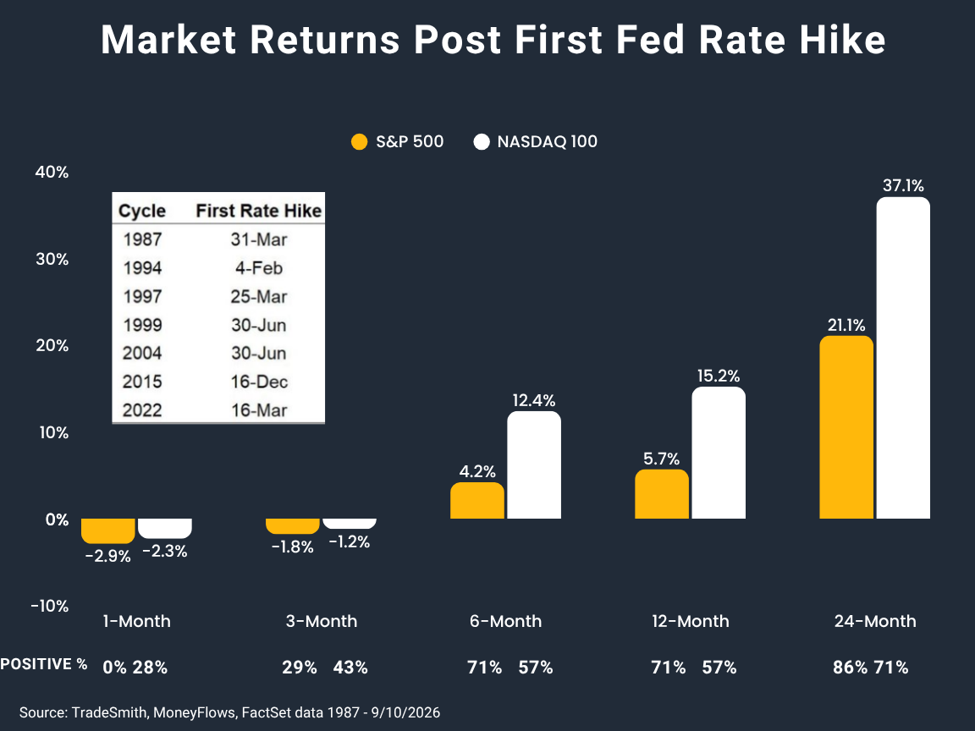
Source: Lucas Downey / TradeSmith / Money Flows / FactSet
The broader research tells the same story. Market strategist Ryan Detrick notes that following a quarter-point first hike, the S&P 500 has been higher one year later 100% of the time, with an average gain of 12.5%. The initial sting is real. But so is the recovery.
The one ugly outcome – 2022 – came during an inflation-driven scramble in which the Fed was slamming on the brakes with jumbo half-point hikes to catch up after falling behind the curve. No one expects that tomorrow, and history is clear that the size of the first hike matters. A modest one has never left stocks lower a year later.
The calendar tells the same story – twice
When we layer the seasonal and presidential-cycle data, the medium-term story only gets stronger.
As far as “September” goes, yes, it’s the worst month of the year for stocks. Since 1950, the S&P 500 has averaged a decline of roughly 0.7% in September, the only month of the year with a negative average return. And it’s finished higher just 44% of the time, the worst odds on the calendar.
So, a drawdown this month shouldn’t catch anyone by surprise. But it’s critical to remember what comes after September.
From October through December, the S&P 500 has averaged a gain of 4.2% and finished higher 80% of the time since 1950. So, the very weakness that scares investors out in September has, time and again, set the stage for the year-end rally that follows.
Finally, don’t forget where we are in the four-year Presidential Cycle.
Midterm years like this one tend to follow a well-worn script: choppy weakness through the summer and early fall, a bottom that usually arrives in the September-October window, and then a powerful rally.
How powerful?
Since 1950, the S&P 500 has been higher 12 months after every single midterm election. That’s 19 for 19. And the pre-election year following a midterm is historically the strongest of the entire cycle, averaging more than 17%.
So, we have two independent forces – one seasonal, one political – pointing to the same place as Lucas’s hike research: short-term bumpy, medium/long-term bullish.
Circling back to our question: Is a rate hike tomorrow the straw that breaks the bull’s back? Unlikely. Expect a stumble – but history says there’s plenty of life remaining.
Last call for Luke’s workshop
One last thing before we wrap up today.
If these forecasts have you thinking about how to position for the next two to three years of the AI trade, our technology expert Luke Lango, editor of Early Stage Investor, laid out his roadmap in a first-ever InvestorPlace workshop last week – mapping which of Elon Musk’s suppliers stand to benefit most as he builds out his “Vertical AI” empire.
Here’s Luke:
While the market debates whether AI demand can hold up, Musk has spent 20 years assembling the pieces of a very different bet – one that we believe converges on September 24.
If he’s right, the fallout won’t stay contained to Tesla or SpaceX. It could ripple through the same infrastructure names we’re watching for AI demand signals, and open up an entirely new market that could dwarf today’s AI trade.
Luke laid out the full case – company names, tickers, and the four bottlenecks Musk still needs to solve last week. We’re taking the free replay down tonight at midnight, so this is officially “last call.” You can watch it right here.
We’ll keep you updated on these stories here in the Digest.
Have a good evening,
Jeff Remsburg


