
Listen to the audio version of this article (generated by AI).
Why Wall Street misread Friday’s jobs report… the data weren’t dovish, they were messy… the Fed is due for a pause, not a pivot… the metal that performs well regardless of rates… how Jonathan Rose views it
Friday’s jobs report was, on its face, lousy…and Wall Street loved it.
The economy added just 29,000 jobs in September, well below the 84,000 that economists expected. Meanwhile, the unemployment rate ticked up to 4.2%. And the government quietly revised away 60,000 jobs from its July and August counts.
Bad news all around. So, why did stocks rally?
Because, as the thinking goes, a weak jobs market makes the Federal Reserve far less likely to raise interest rates again at the end of the month. So, by Friday afternoon, the financial media had declared the October hike all but dead, and stocks pushed higher.
But before you join the party, it’s worth digging deeper into what, exactly, Friday’s crowd was celebrating – and whether the data really says what the headlines claimed.
First, the number everyone saw – and the one they didn’t
Every monthly jobs report is really two surveys stitched together, and this month they told opposite stories.
The first is the “establishment survey” – a poll of employers about their payrolls. It produces the headline “nonfarm payrolls” figure, and it’s the one that came in last Friday at just +29,000 – making August’s blockbuster +162,000 look like a statistical head-fake rather than real strength.
The second is the “household survey” – a poll of actual households about who’s working. It’s what generates the unemployment rate. And it told a far sunnier story: the number of employed Americans rose by 406,000, and 485,000 people reentered the labor force to look for work.
Here’s what you need to see…
The unemployment rate didn’t rise to 4.2% because people lost jobs. It rose because hundreds of thousands who’d given up looking came back to search again – more than the job market could absorb in a month.
That’s usually an encouraging sign. More people searching for jobs reflects less despair than the attitude of “I can’t find one – what’s the point of even trying?” But if jobseekers keep streaming back while hiring stays stuck near 29,000 a month, that flips fast: a growing labor force with no jobs to meet it is exactly how unemployment starts climbing for the wrong reason.
So, together, these reports paint a mixed picture. The economy is hardly falling off a cliff – but it’s not the all-clear the market treated it as, either.
In light of all the revisions, perhaps the cleanest conclusion is that the data have simply gotten too noisy to read one month at a time. And that’s a big reason to doubt Wall Street’s rally from Friday.
A pause, not a pivot
A soft jobs report only helps you if the Fed’s other problem – inflation – is behaving well enough to let it ease. And last week, we got a reading on that, too.
As we covered in the Digest, Wednesday’s PCE report came in softer than feared. Headline inflation rose 3.4% over the past year, below the 3.7% economists expected. Meanwhile, core inflation, which strips out volatile food and energy, held at 3.0% – right where it’s sat for three straight months.
Permabulls will say, “Great news! Inflation isn’t rising!” But that’s not how the Fed is reading it. Here’s Chairman Kevin Warsh from his Jackson Hole speech in August:
While this summer’s PCE and CPI readings were better than expected, they do not tell me that underlying trends have meaningfully improved.
Here is my standard: We must be confident that underlying inflation is moving to our objective, clearly and at sufficient speed. Otherwise, we have work to do.
Warsh isn’t interpreting three months at 3% as “inflation isn’t getting worse.” He’s seeing “inflation isn’t getting better” – and it’s still well above the Fed’s 2% target.
So, the doves are probably right that October brings no hike. By Warsh’s own standard, the Fed has work left to do. Which, at best, means October could bring a pause in the rate-hiking cycle, not a pivot – which calls into question Friday’s relief rally.
Turning to the portfolio implications, this raises a question…
How do we invest when the Fed isn’t coming to the rescue?
If cheaper money isn’t coming to bail out your portfolio, you want to own things that don’t need it – assets with a structural tailwind strong enough to work whether the Fed is friendly or frozen.
One corner of the market fits that bill better than almost anything else, and we’ve highlighted it here in recent weeks – copper.
“Dr. Copper” is the wiring of the modern economy, and demand is exploding from one place that isn’t slowing down: AI.
A single AI data center uses roughly 10 times as much copper as a traditional one. Layer on electric grids, EVs and renewables, and S&P Global projects copper demand could reach 42 million metric tons by 2040 – with a 10-million-ton shortfall that year. Supply can’t answer on command, either: a new mine takes seven to 10 years to build.
Meanwhile, the scramble is already on. Deutsche Bank notes the U.S. is stockpiling ahead of possible tariffs, and China is buying to fill its strategic reserves – leaving the copper that’s free to trade at its lowest level since 1984. That squeeze is why the bank now forecasts $10-a-pound copper by the second quarter of 2027, more than 50% above today’s price of roughly $6.65.
And don’t miss how copper has been behaving recently while the rest of the commodity world struggles. Gold, silver, and uranium miners have sagged – yet copper keeps grinding higher, sitting just below the record it set in September. That relative strength is the market itself voting for the bull case.
How our trading expert Jonathan Rose is playing it
Knowing that copper is the trade is one thing. Knowing the best way to play it is another – and that’s where our trading expert Jonathan Rose, editor of Masters in Trading LIVE, comes in. Jonathan calls copper his “backdoor AI trade.” Here’s how he frames it:
Everybody’s crowding into the same handful of AI chip names. Meanwhile, the actual bottleneck in the entire AI buildout is a metal that’s been around since the Bronze Age — copper.
But Jonathan doesn’t jump into a trade just because there’s a compelling story. He needs a trigger. And with copper, he has one – a tariff.
As he recently explained to his readers, Washington slapped a 50% tax on semi-finished copper back in 2025 but left refined copper untouched – for now. A phased tax on refined copper, 15% in 2027 rising to 30% in 2028, is on the table, with the decision now sitting on the president’s desk after a government review wrapped this summer.
Here’s why that would be a gift to two companies in particular. Refining copper on American soil is a nearly extinct business: of the 16 primary smelters the U.S. had running in 1976, just two operate today. Freeport-McMoRan (FCX) runs one, in Arizona; Rio Tinto (RIO) runs the other, in Utah.
So, tax the imported metal, and you hand those two enormous pricing powers.
Here’s Jonathan’s bottom line:
All any trader is ever doing is positioning in front of the biggest players in the room. Copper is flashing that exact signal right now.
Jonathan walks through trades like this – defined risk, specific entries – live on his free Masters in Trading LIVE show every market day at 11 a.m. ET. on YouTube. He profiles trading ideas, discusses entries and exits, and hands out plenty of tickers in real time. You can follow along, ask questions, and get to know his teaching – all 100% free. Just click here to sign up and receive reminder emails.
And as I noted last week in the Digest, Jonathan will soon be hosting a free live event, the $10K to $100K Challenge, where he’ll show attendees the exact signals he uses to find trades – and how he sizes his risk. More details on that are coming later this week.
Now, returning to our inflation question, let’s address the counter – “But won’t inflation just fall?”
It’s worth looking at this question before we wrap up.
Bulls can argue that a Middle East ceasefire will send oil tumbling, and headline inflation will follow. That will hand the Fed cover to stand pat – freeing the market to stop fretting over inflation and get back to chasing earnings.
I’d love to see that ceasefire, but I’m skeptical. We’ve already witnessed several temporary truces unravel since the war started. Clearly, a lasting resolution is a difficult bet to make, which means any relief in oil prices could be brief.
But let’s grant it. Even then, cheaper oil only pulls down headline inflation. The Fed’s problem, and the heart of this issue, is core inflation. It’s been glued to 3% for three straight months.
And recall Warsh’s own rule: he doesn’t move on one report, he waits for a trend, which means months of convincingly cooler data would be required before the Fed so much as hints at easing.
Now, the stronger version of the bull case is that we don’t need a Fed cut at all – softer oil prices will drag Treasury yields down and conditions loosen on their own.
Maybe. But I’d be careful betting on a big drop in the 10-year here: with deficits swelling and bond issuance relentless, the bond market’s biggest buyers have stepped back – which is why the 10-year sits near multi-decade highs in the first place.
Short of an outright recession or real disinflation, it’s easier to picture yields stalling at a broad, elevated plateau rather than tumbling.
But – back to our trade – even if they do drift lower, copper doesn’t need a rate cut to work. And that’s more than the rate-sensitive growth trades can say.
Coming full circle
Wall Street spent Friday cheering a weak jobs report because it probably knocked an October rate hike off the table. But look one meeting further out…
As I write on Monday, the CME Group’s FedWatch Tool shows traders still put roughly 85% odds on at least one quarter-point hike in December.
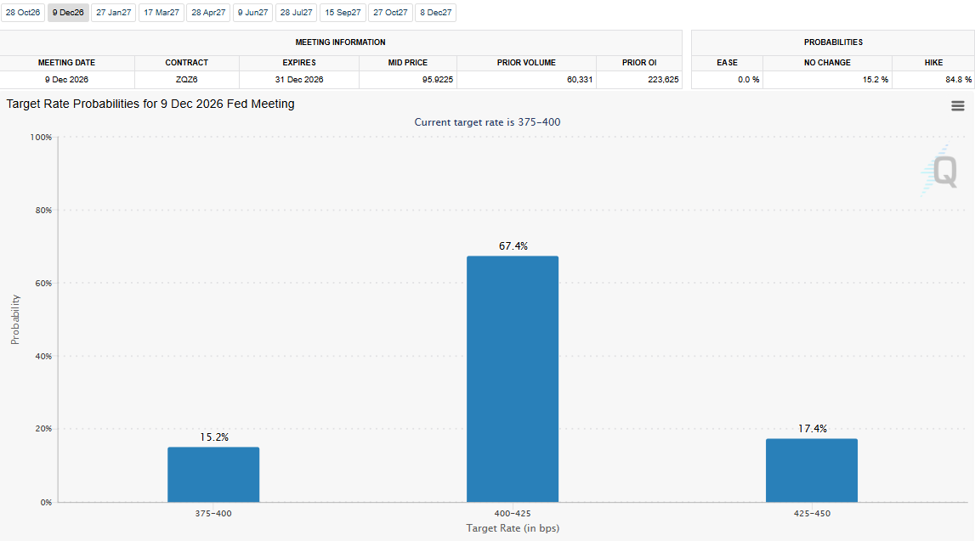
Plus, even after Friday’s data, fed funds futures still have the policy rate climbing toward 4.7% a year from now – roughly three more quarter-point hikes, with no cuts anywhere on the board.
So, Friday’s soft jobs number wasn’t an all-clear – it was a temporary postponement.
And that means we need to answer one question: “What do I own when money stays this expensive, probably gets more expensive, and the Fed has no intention of riding to the rescue?”
As we’ve covered today, one of our favorite answers is copper – an asset with a tailwind strong enough that it doesn’t need the Fed at all.
We’ll keep tracking it here in the Digest.
Have a good evening,
Jeff Remsburg


