
Luke’s “sellable bounce” and reentry checklist… the “vulnpocalypse” debate… cybersecurity’s bull market… Eric Fry’s “prodigal son” and the AI shift he’s watching
Yesterday, the AI trade roared back to life on news that the Nvidia Corp. (NVDA) Board of Directors rehired Jensen Huang as CEO. As we covered, the market reaction was extraordinary…
NVDA finished the day up 31%… the PHLX Semiconductor Sector jumped 13.5%… and numerous AI infrastructure stocks ended the day up double digits.
Our hypergrowth expert Luke Lango, editor of Innovation Investor, has been one of the most ardent AI bulls over the last few years – which is why his take on yesterday might surprise you:
Jensen Huang’s return as Nvidia’s CEO… doesn’t change our playbook, because Jensen’s ouster was one chapter in this AI sell-off, not the whole story…
Once the celebration fades, the market will still have to deal with the bigger, more durable, and still very real risks: financing, regulation, and supply.
That’s why we see [yesterday’s] rally as a sellable bounce.
What Huang’s return doesn’t solve
While Wall Street rejoiced yesterday, Luke had a different take – in short, the problems underneath the selloff remain.
Huang’s return didn’t reopen the debt markets in a big way… didn’t convince citizens and politicians across the nation to ease their opposition to data centers… and didn’t magically produce more power plants or water supplies for all those new data centers.
And as for the “Bank of Nvidia,” Luke notes that Nvidia was already scaling back those deals while Huang was still CEO. Luke thinks Huang is more likely to stay conservative after a public scandal, not less.
Put it all together, and instead of buying today because somehow yesterday changed things, Luke just recommended selling meaningful chunks of core AI infrastructure stocks.
Now, to head off a misunderstanding, here’s Luke to explain his motivation, from Innovation Investor:
We are not turning bearish on AI. Not even close.
We remain long-term true believers in AI’s power to radically reshape the global economy, and in AI stocks’ potential to be huge multiyear winners…
What we’re doing is taking profits (big ones, in most cases) on nine of our most cyclical AI infrastructure stocks, and using today’s massive rally to do it on our terms.
Prepare for pain… then lots of gain
Over the next few years, Luke believes AI capital spending will come in much lower than Wall Street expects due to three headwinds: tighter financing, tougher regulation, and physical supply shortages.
This is why he’s trimming today in anticipation of the true bottom that remains ahead.
But wait – wouldn’t yesterday’s meteoric rally change that trajectory?
Historical market data suggest no.
Here’s Luke from yesterday:
With the Nasdaq on pace to close up more than 6% [yesterday], we went back and studied every 6%-plus up day in the index’s history.
There have been 28 of them, clustered in eight different episodes. In not one of those eight episodes did the first 6%-plus day mark the bottom.
All eight times, stocks went lower before they went higher.
Now, that’s the cautious half of his analysis. But there’s also a bullish half, and it’s the reason Luke’s overall take feels more patient than panicked:
The good news: The other side of a bust inside a boom has produced some of the best buying opportunities in market history.
The SOX soared more than 150% from its summer 1996 low to its late-1997 high. Then it soared more than 570% from its late-1998 low to its early-2000 peak.
As for when the real bottom might arrive, Luke’s work points toward next year.
His checklist for getting more constructive hasn’t changed either, though one box got checked yesterday: a permanent Nvidia CEO. Here’s the rest of the list:
Fundamentally, the biggest signal is the hyperscalers’ 2027 capex guidance in late January and early February. Spending guides above about $1.1 trillion for the big four would be the strongest all-clear.
Beyond that, we’re watching for credit to loosen (narrower spreads, and private lenders like Carlyle sounding more eager), for Nvidia’s fiscal 2029 commitments to start growing, and for a clean 10-Q.
We’ll keep you up to speed with Luke’s latest analysis.
AI and the “vulnpocalypse”
Now, Luke isn’t completely moving to the sidelines:
We’re also continuing to play offense outside the AI infrastructure trade, in areas like cybersecurity, healthcare, and software.
Let’s zero in on cybersecurity, a corner of tech whose job is to keep everything else running safely.
Recent headlines have made its value hard to ignore. Over a six-day stretch earlier this month, a handful of systems we all depend on began failing one after another. Here’s Fortune:
In six days, Microsoft 365 went down, the FAA grounded every flight in the country, customers at Chase and Wells Fargo couldn’t get to their money, and the National Security Agency’s classified internal network went dark.
Nicole Perlroth, one of the best-known voices in cybersecurity, wrote on X: “We are entering a period of unprecedented technological instability.” She even coined a new term to describe what’s going on – a play on how vulnerable our technological systems are today…
The “vulnpocalypse.”
So, what exactly is driving this wave of vulnerability and instability? Many are pointing toward AI.
Back to Fortune:
Perlroth’s central claim is that AI is helping people find software flaws far faster than vendors can fix them. Part of that is true.
On Nov. 13, the 2026 count of published vulnerabilities, known as CVEs, passed 100,000, according to VulnCheck. That’s more than double all of 2025.
But let’s take it one step further. Might the issue not be simply AI, but rather AI in the wrong hands?
On that note, let’s go to Senior Analyst Brian Hunt, editor of Money & Megatrends, who recently covered the spate of technological system failures around the country:
Were any of these incidents the product of AI-powered cyberattacks?
The people in charge of most businesses and government agencies are saying “no.”
Hmm. Let’s remember that no business or government agency wants to spook the public and then suffer a major loss of business, face a PR nightmare, or be known as the inept organization that can’t keep customers or taxpayers safe.
Brian adds that whether or not AI-powered attacks caused these incidents, there’s no denying AI can be a tremendous “force multiplier” for crooks and terrorists seeking to steal money, cause harm, or sow chaos. In his words, “your average cybercriminal group recently became many thousands of times more capable of attacking you, me, businesses, and governments.”
That’s why, he says, cybersecurity is in a bull market:
It’s no wonder cybersecurity stocks are enjoying a bull market. And it’s no wonder that, among the more than 150 industry groups we track to spot trends and opportunities, few have delivered stronger performance over the past eight months than cybersecurity.
So, which cybersecurity stocks are on Brian’s radar today?
He points to CrowdStrike Holdings Inc. (CRWD) and Palo Alto Networks Inc. (PANW), which he says have returned 157% and 131%, respectively, since he first flagged the sector in Money & Megatrends back in March.
If you’d rather not try to pick individual winners but ride the entire sector higher, he points toward the Global X Cybersecurity ETF (BUG), up 94% over the same stretch.
Here’s Brian’s bottom line:
AI is the most exciting and potentially transformational technology of our time. Recent digital system failures and the high-profile concerns raised by AI insiders over the past few months suggest it’s probably also the most dangerous.
Add it all up, and you get the current bull market in cybersecurity.
For more analysis and free stock recommendations from Brian, his Money & Megatrends issues deliver actionable insights loaded with stock ideas every day the market is open – all at no cost. You can sign up right here.
And if you want to go deeper and find the cybersecurity sector leaders, Jonathan Rose has you covered
Jonathan, the veteran trader behind Masters in Trading Live, just published a one-page “Cyber Watchlist” that I’ll show you below.
It sorts the names by the job each performs: identity, endpoints, firewalls and network traffic, vulnerability scanning, and recovery after a breach.
Two figures jump out to me…
Gartner forecasts $248 billion in global security spending this year, rising to $372 billion by 2030. And the fastest attacker “breakout” time in CrowdStrike’s 2025 threat report was just 27 seconds.
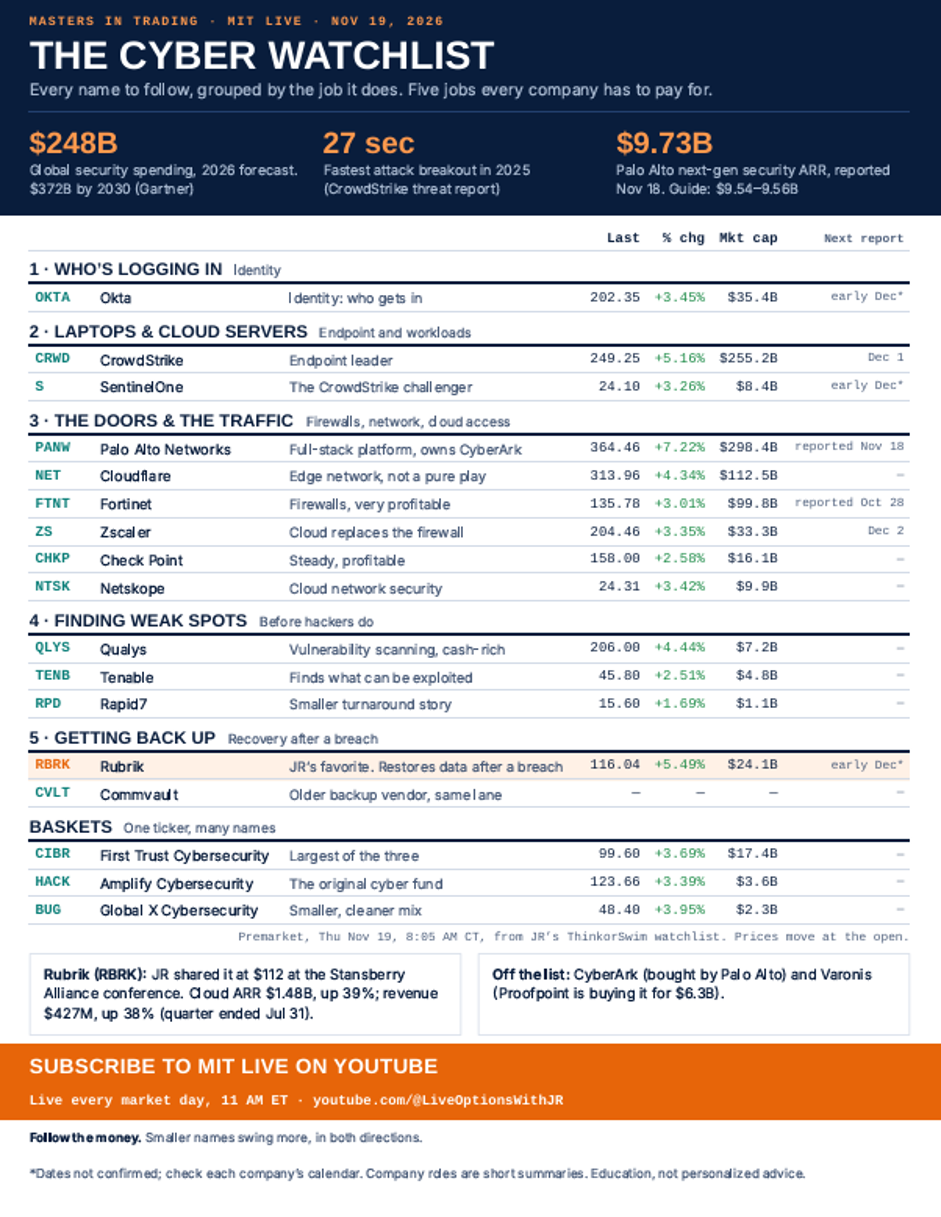
Now, there’s a lot on this sheet – so, rather than just drop it in your lap and move on, I’ll do you one better: let Jonathan walk you through it.
In Masters in Trading Live last week, Jonathan dove deep into the cybersecurity sector, how to trade it, and why Rubrik Inc. (RBRK) is his preferred play here.
It’s 100% free – just click here to catch the episode. And to watch Jonathan’s daily market analysis at 11 a.m. ET, click here to join him for Masters in Trading Live.
Builders Vs. Appliers
Notice where all that security spending is headed…
It’s not flowing into AI’s infrastructure itself. It’s going toward protecting its output.
That’s a window into a bigger shift playing out across AI today. The first chapter of the AI boom was about building the technology itself. The next may be about who puts it to work.
That’s the transition our global macro expert Eric Fry, editor of The Speculator, has been exploring, and it’s the heart of his Life After Nvidia presentation that premiered yesterday.
But has Eric’s analysis changed given Jensen Huang’s return?
No. His update yesterday opened with a parable: the prodigal son’s return. Nvidia just got its own version of that story, and Wall Street “wasted no time celebrating.”
But here’s what Eric saw beyond Nvidia’s rally:
CoreWeave Inc. (CRWV) also surged nearly 30%, which is especially telling.
It’s a major data center operator and Nvidia customer that’s been hit hard by concerns about the cost of building AI infrastructure and the debt needed to finance it.
So, its rebound suggests investors are rushing back into some of the riskiest corners of the AI trade.
Like Luke, Eric believes the Huang celebration can’t resolve the underlying economic problems facing the AI industry. And those headwinds are accelerating the shift from building AI to using it, a turning point Eric calls “The Crossing.”
Critically, he says that The Crossing has little to do with who runs Nvidia:
Jensen could run Nvidia for another 20 years. That wouldn’t change the economics of The Crossing.
Nvidia could remain one of the greatest companies in the world while the biggest investment opportunities emerge somewhere else.
Where might those opportunities emerge?
Eric points to what he calls “AI outsiders”: farmers, miners, manufacturers, hospitals, retailers, and insurers that use the technology rather than build it.
You’ll find more in Eric’s Life After Nvidia presentation from yesterday. If you missed the premiere, catch the replay here.
Wrapping up
We opened today with Monday’s headline: Jensen Huang is back at Nvidia, revitalizing the AI trade.
So, is it time to buy?
For AI infrastructure, Luke says not yet. He sees a bounce, not a bottom.
For cybersecurity, Brian and Jonathan see a corner of the market where AI’s risks are already creating demand – though, even there, not all stocks are equally attractive.
And Eric argues the biggest opportunities may lie with companies using AI rather than building it, no matter who sits in Nvidia’s corner office.
Different angles, but all three remind us that “AI” isn’t one trade. So be intentional about how you’re approaching it.
Have a good evening,
Jeff Remsburg


