

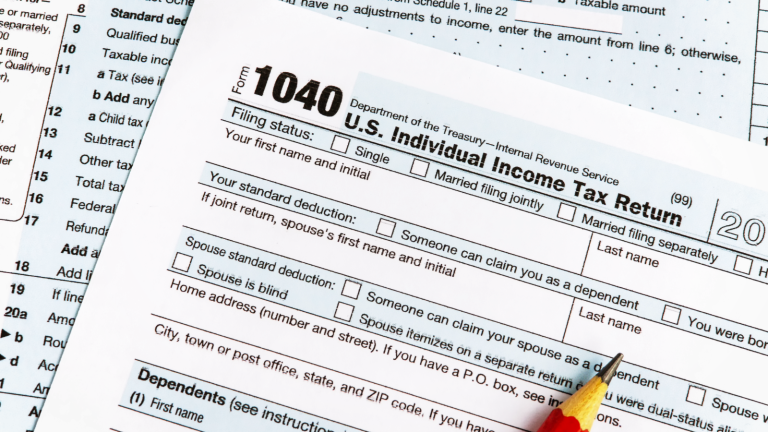
If you’ve been tuning into White House press briefings or scrolling Truth Social lately, you’ve heard the siren song. It’s a seductive melody, perhaps the most intoxicating promise this administration has floated yet: the abolition of federal income tax.
Recently, President Trump has been doubling down on his grandest economic proposal thus far – to abolish the hated IRS income tax regime and replace every dime of that lost revenue with tariffs on foreign goods.

In lieu of an income impost, we would tax China, Mexico, and Europe to pay for our government so the American worker could take home 100% of their paycheck.
It sounds spectacular, like the dawn of a new golden age. We could hold onto our hard-earned cash, easing widespread financial strain and boosting the economy in one fell swoop.
But unfortunately, it is my duty to throw a bucket of ice water on this fever dream…
Because when you strip away the rally rhetoric and look at the cold, hard ledger of the United States Treasury, this proposal isn’t just improbable. Mathematically speaking, it’s out of the question.
Let’s take a quick reality check, following the math all the way to the economic cliff it creates – and the political buzz saw waiting on Capitol Hill…
Why Federal Income Tax Is So Critical to the Budget
First, we need to grasp the scale of the beast we are trying to feed.
The U.S. federal government is a leviathan that consumes trillions of dollars annually, primarily via us, American citizens.
In Fiscal Year 2024, for example, the federal government collected roughly $2.4 trillion in individual income taxes. That is the amount we’d have to cover if we want to nix the 1040 form.
Now, let’s look at the proposed replacement: Tariffs.
Before 2025’s aggressive hikes, the U.S. imported roughly $3.1- to $3.8 trillion worth of goods annually. Under normal, pre-2025 trade circumstances, tariffs generated a quaint revenue stream of about $80 billion a year.
See the problem? The distance between $80 billion and $2.4 trillion is not a gap; it is an abyss.
But wait, the true believers argue, we just need to raise the tariff rates! If we tax imports enough, surely we can hit that $2.4-trillion mark.
That brings us to the next important part of this delusion – the assumption that you can tax at punitive rates without underlying activity vanishing into thin air.
Running the Numbers: Can Tariffs Replace Income Tax Revenue?
If you want to raise $2.4 trillion from a roughly $3.5-trillion base of imports, the back-of-the-envelope math suggests you need an average, across-the-board tariff of roughly 70% on every single thing that enters the country.
That would mean…
A $30,000 imported car now costs over $51,000 – before you even get to the dealer markup…
A new $1,000 iPhone is now $1,700…
The cost of avocados, coffee, clothing, and electronics skyrockets overnight.
But the basic economic principle that turns this proposal into a snake eating its own tail? Elasticity.
The White House’s math assumes static behavior; that if you slap a 70% tax on a Toyota (TM), Americans will keep buying them at the exact same rate.
In reality, consumers react to price shocks. If the price of imported goods nearly doubles, people stop buying. Businesses stop importing raw materials because they can no longer sell the finished product at a profit. Global supply chains shatter.
As tariff rates climb into the stratosphere, import volumes crater – meaning the ‘tax base’ we’d be trying to exploit constricts immensely.
Economists have modeled this, arriving at the consensus that there is a “peak revenue” point for tariffs – a Laffer Curve of trade – somewhere around the 40- to 50% rate. At that point, you might maximize tariff revenue at perhaps $700- to $800 billion annually.
Why does revenue fall after that? Because at rates higher than 50%, you have effectively embargoed your own economy. Trade ceases. And you cannot collect a tariff on a good that no one imports.
Even in the absolute best-case scenario, where we push trade protectionism to its revenue-generating limit before it collapses the economy, we would raise less than one-third of what is needed to replace the federal income tax.
In other words, there is no mathematical path to $2.4 trillion through tariffs in the modern world.
Even at Record Tariff Revenues, the Maximum Income Tax Cut Would Be Negligible
We don’t have to rely entirely on hypothetical models. We have hard data from the fiscal year that just ended on September 30, 2025.
For nearly a year now, we have been living under the most aggressive tariff regime in a century. The universal 10% baseline, the punitive 60%-plus on China, the targeted steel and auto tariffs – they are all active.
And indeed, tariff revenue has soared.
According to the final Monthly Treasury Statements for FY 2025, customs duties collected jumped by a staggering 150%, hitting a record high of approximately $195 billion.
That sounds like a lot of money. In Washington, however, it’s more like a rounding error.
Let’s play pretend for a moment, imagining a world where the deficit doesn’t exist and we take every single penny of that record-breaking $195 billion in tariff loot and use it exclusively to cut individual income taxes.
What do we get? A roughly 7.5- to 8% reduction in overall income tax receipts.
If your effective tax rate was 20% last year, this ‘historic’ tariff windfall could lower it to roughly 18.5%.
We’d have upended global trade partnerships, spiked inflation on consumer goods, and rattled markets, all to generate enough cash to shave less than two percentage points off your effective tax rate.
Even if we annualized the higher monthly run-rates we saw in late 2025, pushing tariff revenue closer to $350 billion a year, the absolute maximum income tax cut you could fund is about 14- to 15%.
We would still need to keep 85% of the IRS income tax machinery in place just to tread water… making the rhetoric behind eliminating income tax off by a factor of about seven.
The Hidden Cost: What a Tariff-For-Tax Swap Would Do to Main Street
We must also briefly touch on the social fallout of this “plan.” Replacing an income tax with a tariff regime is not a tax cut; it is a massive, regressive tax shift.
The current U.S. income tax code is progressive. The top 10% of earners pay roughly 76% of all income taxes, while the bottom 50% of earners make up just about 3%.
But tariffs are consumption taxes, paid at the register by the buyer. When a company pays a tariff, they pass that cost to you.
A tariff-for-income-tax swap means shifting the burden of funding the U.S. military, Social Security, and Medicare away from high-earners and corporations and onto the backs of working- and middle-class consumers at the checkout line. A family spending 90% of their paycheck just to survive will feel the sting of tariff-induced inflation far more acutely than a wealthy individual investing their surplus income.
It is a wealth transfer of historic proportions disguised as populist relief.
The Capitol Hill Kill Box
It’s true that the economic math here is impossible; but the political math may be even worse.
Even if President Trump genuinely wanted to push this through, we think the proposal would be ‘Dead on Arrival’ (DOA) to Congress.
You might ask, “But don’t the Republicans control the House and Senate?”
Yes, they do. But the GOP is not a monolith, especially when it comes to the national debt.
We are currently staring down a national debt north of $36 trillion. The budget deficit for the fiscal year just ended was a horrifying $1.8 trillion. We are borrowing money just to pay the interest on the money we already borrowed.
This brings us to the Republican “Fiscal Hawk” revolt.
There is a significant bloc of Republican senators – including leadership figures like Majority Leader John Thune and stalwarts like Rand Paul – who have looked at the books and turned pale. Their position is clear: a dollar can only be spent once.
If the Trump administration succeeds in wringing an extra $200- or $300 billion out of consumers via tariffs, these senators argue that money must go toward reducing that catastrophic $1.8 trillion deficit. It cannot be used to fund new tax cuts.
With a slim 53-seat majority in the Senate, these deficit hawks hold the keys. They will not vote for a bill that blows an even bigger hole in the budget by eliminating income tax revenue, even if tariffs are ostensibly ‘paying’ for it. They know the math doesn’t balance.
Furthermore, let’s not forget the legislative fatigue. Congress just expended massive amounts of political capital passing the “One Big Beautiful Bill Act” (OBBBA) back in July, which extended the 2017 tax cuts. That fight is over. The appetite on the Hill to reopen the tax code four months later for a radical, mathematically impossible overhaul appears non-existent.
The administration knows this. That is why the rhetoric has been shifting away from “abolishing the income tax” toward “$2,000 tariff dividend checks.”
When an administration pivots from structural reform to mailing out ‘stimulus checks,’ it is an attempt to buy popularity because the actual policy work is impossible.
Even those dividend checks are stalling in the Senate, for the exact same reason: we don’t have the money.
Conclusion: The Tariff Proposal Is Fiscal Fantasy, Not Practical Reform
As investors and taxpayers, we must separate campaign rally rhetoric from hard-nosed fiscal prose.
The idea of financing the United States government solely through tariffs is a relic of the 19th century, a time when the government’s largest jobs were running a small Navy and delivering the mail.
It is wholly incompatible with a 21st-century superpower that manages a massive welfare state, a global military footprint, and complex infrastructure.
Neither the economics nor the politics work.
Expect the rhetoric to continue. It’s great politics, after all. Who doesn’t want to hear that China will pay their taxes for them?
But in reality, do not expect a single dime of income tax relief to stem from this proposal. The deficit is a black hole that will swallow every dollar of tariff revenue the administration can generate.
The most likely outcome for the remainder of 2025 and into 2026 is the worst of both worlds: The income tax will remain exactly where it is, and the prices of the goods you buy will continue to rise as tariffs bite harder.
Keep your eye on the real numbers, stay hedged against inflation, and don’t spend that hypothetical tax refund just yet.
Of course, none of this is to say that everything we hear from Washington is little more than posturing. We’ve seen the federal government put its money where its mouth is for months now – literally – by taking equity stakes in domestic suppliers critical to America’s AI buildout.
The U.S. government is about to launch another historic stock market buying spree…
But this time, it won’t be natural resource stocks suddenly exploding 200%-plus higher.
We’re taking our cues from the little-known national security plan that reveals what the White House is planning next.

