


Listen to the audio version of this article (generated by AI).
We all know the feeling when September comes around.
It’s back-to-school time.
If you ever read the Peanuts comic strip, you know the character Charlie Brown could be a bit of a worrier.
At one point, he captured the anxiety of heading back to class when he admitted:
“I worry about school a lot. I worry about my worrying so much about school. My anxieties have anxieties!”
A lot of investors probably know the feeling.
That’s because September isn’t just back-to-school month. On Wall Street, it has historically been the weakest month of the year for stocks.
And because 2026 is a midterm-election year, history suggests we could be in for an especially wild ride.
Consider this: The four best and four worst Septembers since World War II all occurred during midterm-election years.
So, there are certainly reasons for investors to feel a little anxious right now. But I don’t think we should let our anxieties develop anxieties of their own.
Because beneath all the seasonal noise, the market is entering September from a remarkably strong position, folks.
In today’s Market 360, I’ll explain why September has earned its bad reputation on Wall Street and what could make this month especially volatile. I’ll also tell you why I believe any weakness could create some compelling opportunities – especially in some fundamentally superior stocks poised to write the next chapter of the AI boom.
Why September Makes Wall Street Nervous
September’s reputation is well-earned.
Since the 1890s, the Dow has posted an average loss of 1.1% during the month. And it has finished higher just 43% of the time.
Our friends at Bespoke have found a similar pattern in the S&P 500. Since 1945, the index has declined an average of 0.7% in September.
Midterm-election years like this one have historically been even tougher, with the S&P 500 dropping an average of 1.3% in September.
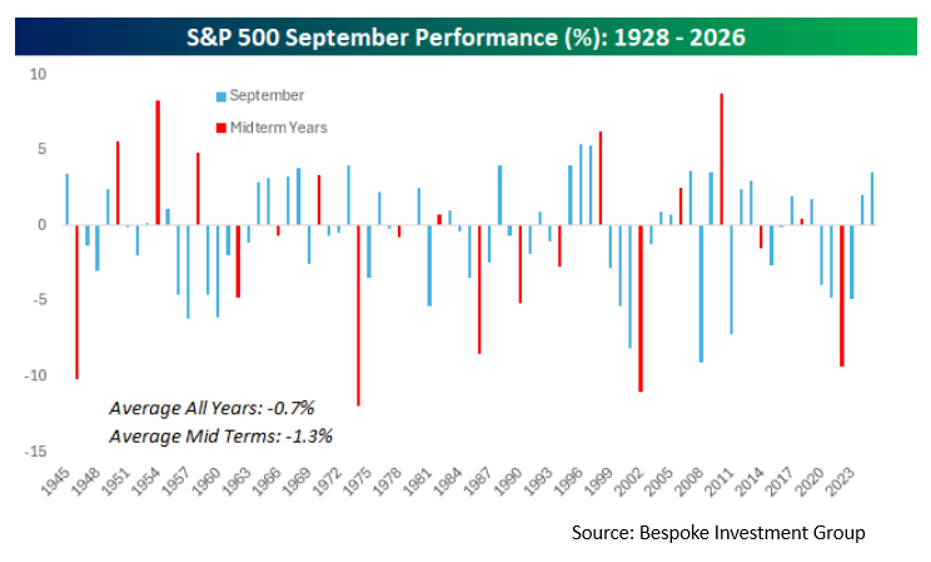
But midterm Septembers have also been unusually volatile in both directions. As I mentioned earlier, the four best and four worst Septembers since World War II all occurred during midterm-election years.
So, history doesn’t tell us that stocks are destined to fall this month. It does suggest we should be prepared for some bigger-than-usual swings.
There are also a few reasons September tends to be so unsettled.
One of the biggest is taxes, especially during the first half of the month. Many investors raise cash ahead of estimated tax payments due September 15.
Institutional investors also tend to rebalance their portfolios at the end of the summer and ahead of quarter-end. And mutual funds may harvest tax losses before the end of their fiscal years.
And this year, Wall Street has another major source of uncertainty to contend with: the Federal Reserve.
The Fed Is the Biggest Wild Card
The Federal Reserve will hold its next policy meeting on September 15-16, and Wall Street is increasingly nervous that another rate hike could be on the table.
The latest Personal Consumption Expenditures (PCE) index didn’t exactly ease those concerns.
Headline PCE rose 0.2% in July and was up 3.7% over the past 12 months. Core PCE, which excludes food and energy and is closely watched by the Fed, also increased 0.2% and was running at a 3.3% annual pace.
Both remain well above the Fed’s 2% inflation target.
Fed Chair Kevin Warsh made it clear at Jackson Hole last week that he takes that target seriously.
He acknowledged that inflation isn’t meaningfully slowing and vowed to bring it back down “at sufficient speed” to the Fed’s 2% goal, which he called “firm and fixed.”
Not surprisingly, those comments have fueled speculation that the Fed could raise rates this month.
But I’m still not convinced.
Warsh also stressed that future policy decisions will depend on new information, including developments in supply chains, investment flows and geopolitical tensions. And much of the recent inflation pressure has come from energy, which the Fed can’t control by raising interest rates.
We’ll also get the August jobs report later this week. Economists are expecting the economy to add 53,000 jobs after payrolls declined by 23,000 in July. Another weak report could give policymakers another reason to hold steady.
So, yes, the Fed could add to the market’s September jitters. But despite the seasonal and interest-rate uncertainty, several major factors are working in our favor.
Why I’m Still Optimistic
For starters, the market is entering September from a position of strength.
All of the major indices finished August higher, which is not always the setup we get heading into the market’s weakest month of the year. More importantly, the fundamental backdrop remains exceptionally strong.
Our friends at FactSet report that the S&P 500 achieved 52% average earnings growth in the second quarter, while revenue increased 15.5%.
Even more impressive, 86% of S&P 500 companies exceeded analysts’ earnings estimates.
And Wall Street expects that momentum to continue.
Analysts currently anticipate 28.2% average earnings growth in the third quarter and 25.8% growth in the fourth quarter.
Those are phenomenal numbers, folks.
So, even if September brings some seasonal weakness, we’re not dealing with a market where corporate profits are rolling over. Quite the opposite.
And nowhere is that more obvious than in artificial intelligence.
Last week, NVIDIA Corporation (NVDA) reported 106% year-over-year revenue growth, while data center revenue jumped 117% and earnings surged 118%. The company also provided a strong outlook.
But one of the most interesting comments came from CEO Jensen Huang, who noted that NVIDIA’s revenue could be even stronger if not for the ongoing memory-chip shortage.
Think about what that tells us.
Demand for AI infrastructure is so strong that one of the world’s largest chip companies is being held back by supply constraints.
That doesn’t look like an AI boom running out of gas. It looks like one that is still expanding.
So while I do think this month will likely be stronger than usual, I view any dip as an opportunity to buy fundamentally superior AI stocks at better prices.
The Next AI Winners May Look Different
And I’m not just talking about the same mega-cap AI stocks that have led the market so far.
As AI models become more powerful, they require more memory, advanced chips, faster networking, data-center capacity and enormous amounts of electricity.
That’s creating opportunities across the AI supply chain. And one of the biggest developments I’m watching right now is coming from Elon Musk.
Musk is rapidly expanding his AI infrastructure, and my research team and I have identified an A-rated company at the center of a critical technology powering that buildout.
And no, I’m not talking about Tesla, Inc. (TSLA) or Space Exploration Technologies Corp. (SPCX).
I recently put together a special presentation explaining what Musk is building, why I believe it could accelerate the next stage of the AI boom and the name and ticker symbol of the company positioned to benefit.
So, if September gives us the volatility history says we should expect, don’t fear it. Use it to your advantage.
Click here to watch my special presentation now.
Sincerely,

Louis Navellier
The Editor hereby discloses that as of the date of this email, the Editor, directly or indirectly, owns the following securities that are the subject of the commentary, analysis, opinions, advice, or recommendations in, or which are otherwise mentioned in, the essay set forth below:
NVIDIA Corporation (NVDA)


