


Listen to the audio version of this article (generated by AI).
Editor’s Note: Professional gambler Archie Karas turned $50 into $40 million, then lost every dollar. His downfall is a textbook case of overconfidence, a trap that costs investors every day.
Today, my colleague Louis Navellier explains how it shows up in the stock market and how his Stock Grader signaled the exit from Lululemon Athletica Inc. (LULU), a stock that’s now 64% below where he sold.
To know exactly what to sell in 2027, watch the replay of Louis’ special broadcast, where he shares what he sees coming for the market, one stock to buy now, and one to avoid.
Now, here’s Louis…
Archie Karas was a Greek immigrant waiting tables at a Los Angeles restaurant. But in his spare time, he liked to hustle games of pool at the place next door.
In December 1992, with just $50 in his pocket, he began playing poker at the Mirage in Las Vegas. That’s when his record two-and-a-half-year run began.
Over the next several months, Karas took on five World Series of Poker Main Event champions – and came out ahead of most of them.
Eventually, the top players stopped playing him, so Karas decided to try his hand at craps and baccarat – games of chance, not skill.
In the beginning, Karas was unstoppable, and by early 1995 he had $40 million.
And then Karas’ luck turned sour.
By 1996, Karas had lost his entire $40 million fortune.
Karas’ downfall is a textbook example of one of the most dangerous psychological traps in investing: overconfidence.
This same overconfidence can occur when investing, too. So today, I’ll explain how overconfidence applies to the stock market and the tool that can help investors avoid the overconfidence trap… and still make big gains by telling you when to sell.
Knowing when to sell will be incredibly important over the next few months. That’s why I urge you to watch the replay of my special broadcast from last week, where I detail the disciplined approach investors need to take to profit in today’s market. (Click here to watch it now.)
First, let’s get into where investors get it wrong…
How Do You Combat Overconfidence?
In the stock market, overconfidence usually shows up in three ways:
- Overestimating skill: Investors think they’re better at picking stocks than they really are.
- Taking credit for gains: Wins get attributed to skill and losses to bad luck, so a hot streak inflates confidence.
- Feeling too sure of a forecast: An investor is more certain about where a stock is headed even if evidence suggests otherwise.
This ultimately results in trading too often, owning too few stocks, making oversized bets, and holding on too long.
I believe the best way to combat overconfidence is to stay focused on the numbers. In other words, depend on evidence for my decisions.
A good example of this is Lululemon Athletica Inc. (LULU).
For more than 20 years, Lululemon had led the athleisure fashion movement. It differentiated itself by making some of the highest-quality, most comfortable workout clothing on the market.
Consumers loved Lululemon clothes, which translated into strong earnings and sales growth. That growth caught my attention, and after it earned an A-rating in Stock Grader, I recommended it in my Growth Investor service in June 2018. I liked the stock so much that I also made it my pick for the “Best Stock of 2019” InvestorPlace contest. (The stock gained 91% in 2019, and I came in first that year.)
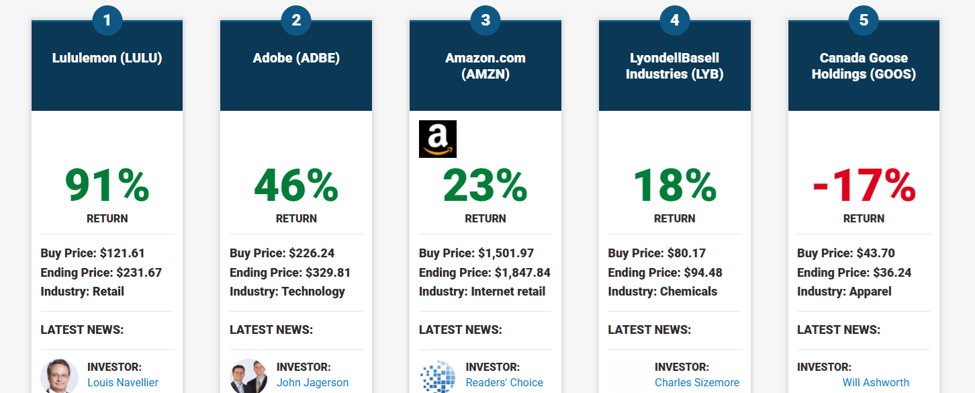
But then Lululemon began to lose momentum – and when the stock fell to a D-rating in my Stock Grader, I took that as my cue to exit and recommended my subscribers sell Lululemon for a 156% gain in February 2021.
While Lululemon did well during the Covid-19 era, its growth has declined tremendously in recent years. In 2024, U.S. comparable store sales began to fall, forcing management to cut its full-year guidance. In 2025, management continued to revise its guidance lower. After cutting its full-year earnings estimates in June 2025, the stock fell 20% in after-hours trading. The stock ended 2025 down about 45%.
2026 hasn’t been much kinder. LULU shares remain under pressure and, as of this writing, are down about 47% year-to-date.
This weakness is also reflected in my Stock Grader. As you can see in the chart below, it’s held a D- or F-rating for all of this year.
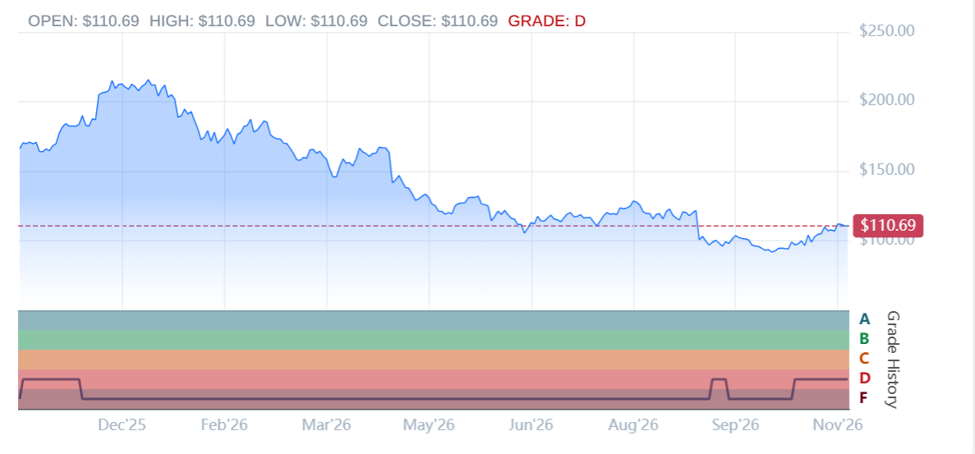
I should also add that the stock trades about 64% lower from where I sold it.
The bottom line is my Stock Grader system gives me confidence to buy a stock. And when Stock Grader loses confidence in a stock, I know it’s time to sell.
With 2027 right around the corner, knowing when to buy – and, more importantly, when to sell it – will be critical.
I believe a big market-moving event is coming that will give way to a new group of winners. Investors who are overconfident and stick with the stocks working for them now could miss out on the potential gains in next year’s outperformers.
I don’t want that to happen to you, so I put together a special presentation to share my approach.
During the event, I share…
- What I see coming for the stock market in 2027
- The warning signs investors need to watch
- And how I’m approaching the search for tomorrow’s market leaders.
I also reveal one stock I believe investors should consider buying right now — and another I believe they should avoid.
Most importantly, I reveal a brand-new way I’m putting Stock Grader to work to identify what I believe could be the market’s next big winners.
I hope to see you there. If not, you could be at risk of gambling your fortune away like Karas did with his own.
Learn how to thrive – not just survive – in today’s market here.
Sincerely,
Louis Navellier


