Block eliminates almost half of its workforce… Luke Lango’s forecast for how high unemployment will go… two ways the AI trade gets a haircut… the corner of AI that will survive… Luke’s new trading tool that spots impending breakouts
Most investors didn’t see it.
And even if they noticed, the story quickly disappeared from the headlines as the conflict with Iran took over the news cycle last weekend.
But last Thursday, Block (XYZ) did something unprecedented – it announced the largest corporate layoff (by percentage) in the recorded history of the S&P 500.
40% of workers eliminated.
Why?
Block CEO Jack Dorsey was clear:
Today we’re making one of the hardest decisions in the history of our company: we’re reducing our organization by nearly half…
We’re not making this decision because we’re in trouble. Our business is strong…
Something has changed…
That “something” is AI.
Dorsey explained that the intelligence tools they’re building – combined with smaller, flatter teams – fundamentally change what it means to run a company.
Luke Lango, our technology expert and editor of Innovation Investor, put it bluntly:
This is the first domino. Because Dorsey is right.
AI has changed the rules of running a business. You just don’t need as many people anymore…
Dorsey just broke the dam.
For more than a year in the Digest, we’ve urged readers to recognize the profound shift in the corporate landscape that’s heading toward us.
While many analysts argue that AI will follow the pattern of past technological revolutions – where the jobs displaced were ultimately replaced by new roles the innovation created – we’ve disagreed.
That’s because we’ve never faced a technology capable of performing nearly every human task better, faster, and at a lower cost. And that means substantial labor market disruption is on the way.
Here’s Luke with the potential scope:
Our modeling suggests we will be looking at 8%-13% structural unemployment.
This, of course, has massive economic, societal, and market implications.
But the “north star” idea here is that the labor class will increasingly lose wealth while the capital class will increasingly gain wealth (so be in the capital class – own stocks).
I’ll be doing all I can to share our analysts’ ideas on the best stocks to own as AI radically reshapes our world. But let’s look a bit further out on the horizon to a looming risk – even if you own AI stocks.
The coming “gray” swan
You’ve heard of a black swan – a rare, unpredictable event.
What’s ahead in AI isn’t quite that. It’s more of a “gray swan” – an event that’s highly probable, though the exact details of how we get there, and when, are unclear.
In this case, the event is legislation that slams the brakes on AI’s buildout, leading to a massive market shakeout. What’s unclear is what will precipitate it.
I see two highly likely potential paths:
1. Political Backlash from Job Losses
If layoffs accelerate as Luke predicts, public pressure will mount on politicians to step in to do something to protect jobs. Wanting to keep their own jobs, elected officials – even those who support AI – will be forced to swing into action.
The core issue here is public sentiment. So, where are we on that today?
Let’s go to The Wall Street Journal from Saturday:
Backlash to AI has been simmering for months.
In a YouGov survey released in December, 77% of respondents said they worried AI could pose a threat to humanity.
A separate survey from the Pew Research Center showed many people were more concerned than excited about AI.
Fearing higher utility costs or job losses, communities around the country have sought to block or delay new data-center projects, part of growing resistance to such projects.
Unchecked, this public outcry will only increase.
This issue is already on the radar for some politicians. Last November, Senators Josh Hawley, R-Mo., and Mark Warner, D-Va., introduced the AI-Related Job Impacts Clarity Act. It would force companies to report AI-related job cuts to the U.S. Department of Labor (DOL).
Here’s Hawley:
Artificial intelligence is already replacing American workers, and experts project AI could drive unemployment up to 10% to 20% in the next five years.
The American people need to have an accurate understanding of how AI is affecting our workforce, so we can ensure that AI works for the people, not the other way around.
But spiking joblessness is just one concern that could spur new legislation. As disruptive as 20% unemployment would be, the second path could even more chaotic…
2. A Crisis Event
The second path involves a true shock – a visible failure or misuse that makes AI risks undeniable overnight. Think a “Three Mile Island” meltdown scenario for AI.
Last December, President Trump issued an Executive Order emphasizing minimal barriers to U.S. AI leadership:
United States AI companies must be free to innovate without cumbersome regulation…
It is the policy of the United States to sustain and enhance global AI dominance through a minimally burdensome national policy framework.”
This “all gas, no brakes” posture accelerates innovation, but it also increases risk.
Technology ethicist Tristan Harris, the central figure of the 2020 Emmy-winning Netflix documentary The Social Dilemma, described the dynamic in stark terms:
“Let It Rip” means to open-source, deregulate, and accelerate AI’s benefits into every corner of society.
But it also unleashes chaos.
Floods of deepfakes and AI-generated content overwhelm our information environment. Frauds and scams skyrocket.
AI increases hacking capabilities that makes critical infrastructure more vulnerable. AI enables bad actors to do dangerous new things with biology.
Meanwhile, former-Googler Geoffrey Hinton, often cited as the “Godfather of AI,” put it far more directly:
Politicians don’t preemptively regulate.
So, actually, it might be quite good if we had a big A.I. disaster that didn’t quite wipe us out – then, they would regulate things.
Bottom line: Whether our gray swan is economic pain or a singular crisis moment, the outcome would likely be the same…
Sudden, sweeping governmental regulation.
So, what happens to your AI stocks?
Well, AI won’t stop – it will simply become concentrated after a painful shakeout.
Yes, Wall Street will sell first and ask questions later. So, nearly every AI-tied stock would likely get hit in the initial drawdown. It will be hard to protect against this entirely.
The biggest losses will go to software platforms, high-multiple application plays, and “AI-adjacent” consumer names. Those are especially vulnerable as investors reassess growth assumptions overnight.
But here’s the part of the AI trade that won’t disappear:
- Data centers
- Advanced semiconductors
- Power generation
- Critical minerals and rare earths
This “physical backbone” of AI will remain mission critical.
In fact, if regulation tightens, AI development would likely become more centralized, shifting toward government oversight and strategic partners.
Luke reminds readers that we’ve already seen Washington take equity stakes in key companies tied to AI and national security, and the market reaction has been explosive:
- MP Materials soared 50% in a single day after the Pentagon bought a stake.
- Lithium Americas doubled overnight, jumping 100% when the Department of Energy bought in.
- Trilogy Metals didn’t just double; it tripled overnight after the government wrote the check.
So, this is where Luke is urging investors to focus their AI investment dollars today. After all, though legislation would slam the brakes on much private-sector AI spending, it won’t stop the White House.
For Luke’s specific portfolio action steps, he just released a video briefing that compiles all his research on 119 companies – including their names, ticker symbols, buy-up-to prices, and the top 5 to buy right now. It’s in his report, The President’s Market.
As he puts it:
If you’re not watching what Washington is buying, you’re already behind.
But there’s another reality to this potential for legislative disruption
When this gray swan hits, we won’t see an orderly transition in the markets. We’ll see a convulsion.
Leadership will flip. Momentum will surge and fade as the market adjusts. And former Wall Street darlings could break down fast while entirely new names enter powerful breakout phases.
That kind of environment doesn’t reward complacent buy-and-hold investing. It requires agility.
That’s why Luke just launched something in addition to his physical layer/government AI research – it’s a breakout-focused trading framework built specifically for today’s structurally volatile market.
Basically, instead of trying to forecast winners many quarters away, this strategy is all about now.
It targets stocks entering what technical traders call “Stage 2” – the phase where major price runs historically begin.
You see, at any given point in time, a stock is in one of four unique stages: 1) going sideways at a bottom, 2) going up, 3) going sideways at a top, or 4) going down.
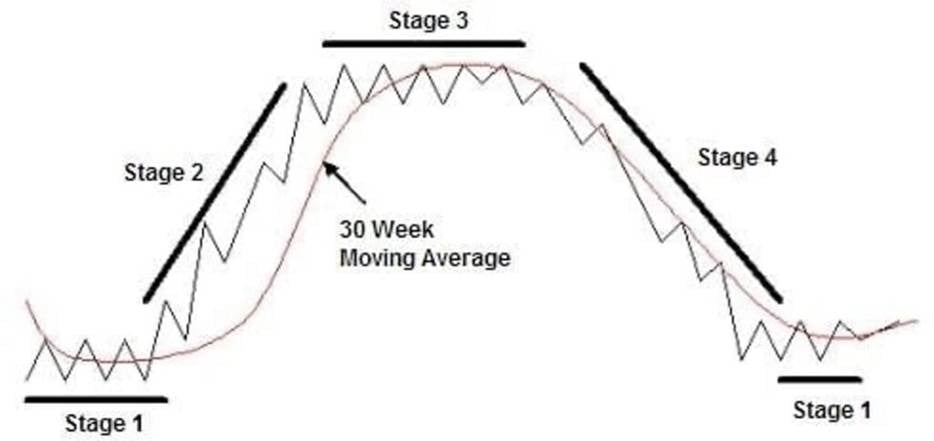
The key to scoring consistently big returns in the market – and navigating leadership shifts in the market – is to find stocks already in, or are on the cusp of entering, Stage 2…and then getting out with your profits before Stage 4.
To help investors and traders with this, Luke and his team just opened access to:
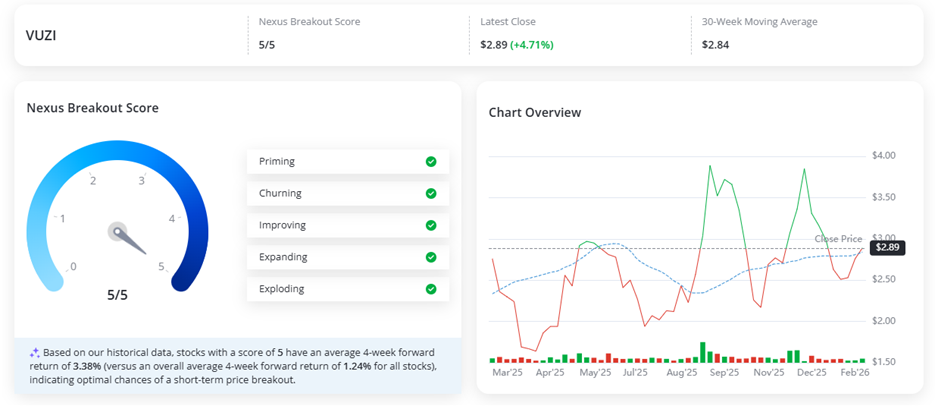
- A brand-new breakout stock screener scoring 3,000+ stocks on a 1-5 scale
- A weekly breakout watchlist highlighting top momentum candidates (the top 10 scoring stocks on the screener)
Here’s an example, using augmented reality smart glasses company Vuzix (VUZI). It gets a “5” today, meaning it is highly primed for a breakout.
I’ll bring you additional details in tomorrow’s Digest, but if you’d like to dig deeper right now, Luke just released a new video that lays out why volatility won’t be going away anytime soon – and how a Stage-2 framework can turn that volatility into a tailwind.
Wrapping up
AI’s advance isn’t in question. What’s uncertain is the path it takes – and how quickly a gray swan event may force that path to change.
If the AI transformation unfolds gradually, capital will continue flowing steadily into the infrastructure that powers it – chips, data centers, energy, and critical materials.
If it deviates from that path suddenly – through surging unemployment or a crisis event – markets will lurch, leadership will rotate, and volatility will spike before a new equilibrium forms after legislation.
Either way, our safest takeaway remains the same…
Own/trade what’s essential… stay alert to shifts in momentum… and be prepared to adapt as conditions change.
The investors who combine longer-term structural positioning with shorter-term tactical flexibility will be the ones who navigate this transition best.
Have a good evening,
Jeff Remsburg


