Listen to the audio version of this article (generated by AI).
The gold-to-silver ratio resets to equilibrium… Luke’s case for a silver melt-up… Eric’s case for gold… the fiscal disorder fueling the longer-term bet… so, which do you buy?
In the horse race between gold and silver, which metal is poised to take the lead – and which should you be betting on right now?
For more than two years, we’ve urged Digest readers to own both gold and silver.
But as relative value has shifted, we’ve also been clear about which metal should lead at different points in the cycle.
To navigate these shifts, we’ve frequently referenced the gold-to-silver ratio – a long-standing measure of relative value between the two metals that has historically been mean-reverting, though its baseline has shifted over time.
- In the 20th century, it averaged roughly 47:1
- From 2000 through 2020, it averaged closer to 60:1
In the first half of 2025, fear and a preference for gold sent the ratio above 105 – just shy of its COVID-panic peak. At that point, silver was deeply undervalued relative to gold.
When the ratio began to roll over, we flagged silver’s asymmetric upside. In our July 25 Digest, we wrote:
We don’t anticipate a meaningful decline in gold’s price beyond normal profit-taking and healthy “two steps forward, one step back” market action.
Therefore, if the gold/silver ratio is to continue normalizing to the more recent average of around 60, it’ll be up to silver to do the heavy lifting – meaning silver’s price gains must outpace those of gold.
That’s exactly what we expect.
Sure enough, between that July 25 Digest and January 15, gold climbed a respectable 37%, but silver exploded 137%.
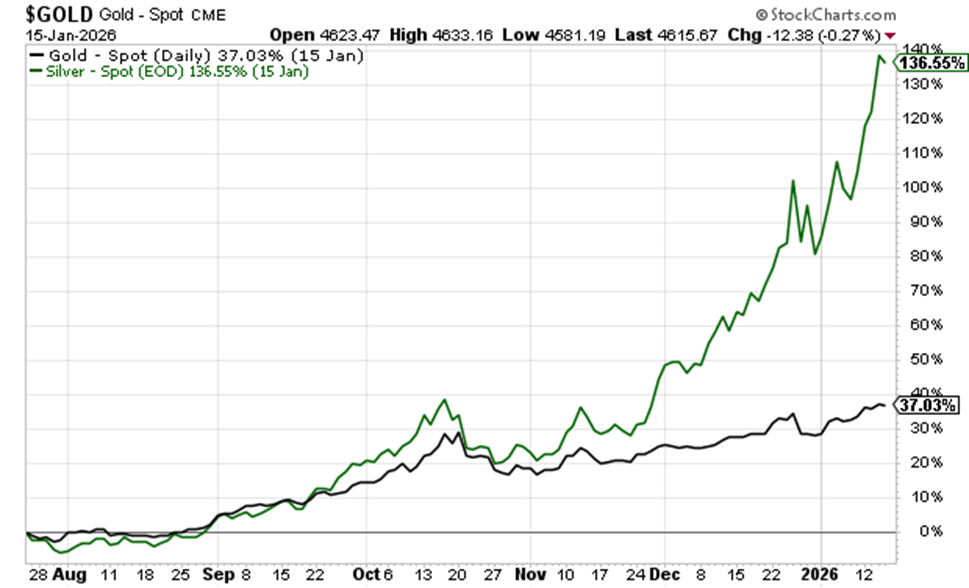
I mention January 15 because that’s when we updated our analysis and our forecast
In our January 15 Digest, we argued that after silver’s blistering rally, it was time to bet on gold for outperformance:
Silver’s explosive move has dramatically reset the gold-to-silver ratio. It sits at about 51 – its lowest level since 2012.
Practically speaking, it means silver has gone from undervalued to relatively expensive versus gold in a very short period.
From here, history argues that gold is more likely to outperform silver as the ratio works its way back toward equilibrium, which we’d peg in the mid-to-upper 50s, with 58 to 60 as a reasonable medium-term target.
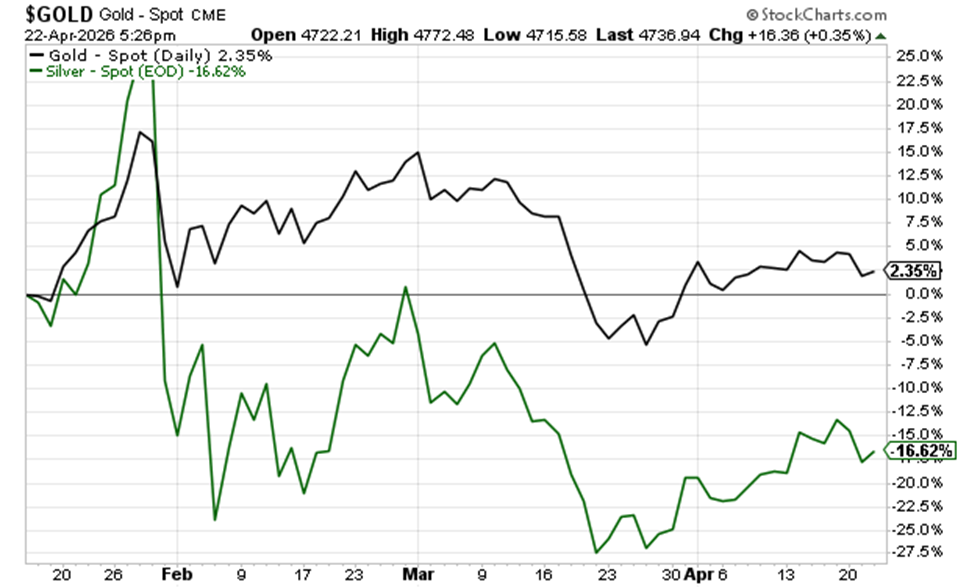
As you can see below, that’s exactly what’s happened.
While gold has managed to eke out a 2% climb, silver has fallen 17% as the gold-to-silver ratio climbed back to where it sits as I write – nearly 61.
So, where should you put your money now?
With the gold-to-silver ratio back to equilibrium, there’s no lopsided imbalance that tips the odds squarely in one camp.
That said, our technology expert Luke Lango of Innovation Investor is looking for silver to make a sharp move higher for one primary reason…
Its critical role in the AI rollout.
Silver is one of the most overlooked heroes in the AI story.
It’s not just a precious metal; it’s the best natural conductor of electricity we have. That makes it indispensable for wiring, switches, and contacts inside data centers where AI models are trained, as well as for the chips that run those models.
The more AI scales, the greater the demand for components that can move massive amounts of energy and data at lightning speed – and silver’s conductivity makes it irreplaceable in those applications.
So, are you bullish on AI? Then you’re also bullish on silver.
Now, in Luke’s Innovation Investor Daily Notes from earlier this week, he explained how the VanEck Semiconductor ETF (SMH) has been a very good proxy for general global economic strength and AI-driven demand over the last 2.5 years.
Here he is explaining the relationship:
When SMH is rising, global economic strength and demand is improving, so silver (the offensive precious metal with tons of AI applications) outperforms gold (the defensive precious metal with limited AI applications).
When SMH is falling, global economic strength and demand is weakening, so silver underperforms.
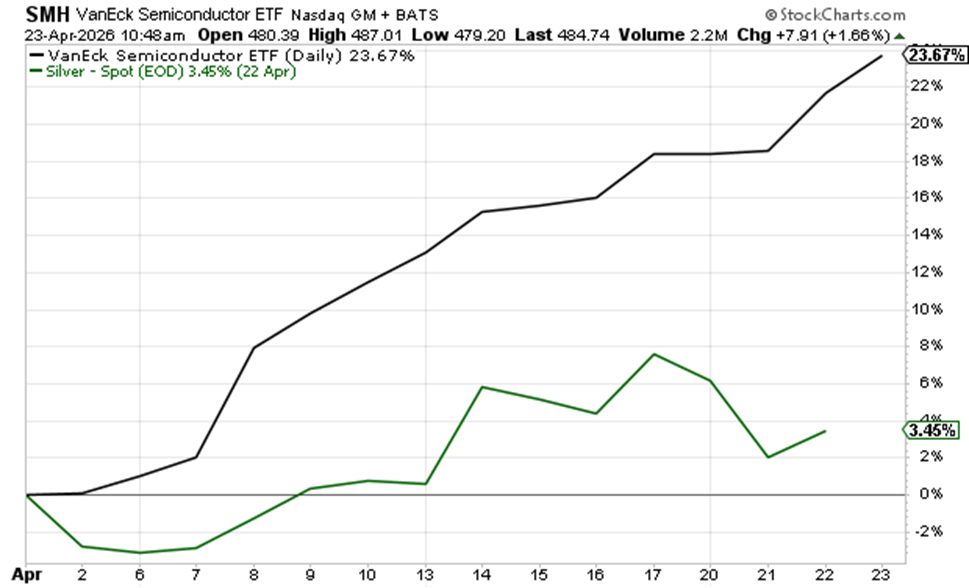
Luke notes that while semiconductors have had a massive breakout rally over the last few weeks, silver has underperformed.
Here’s how that looks: SMH is up 24% so far in April, while silver has climbed just 3.5%.
Back to Luke:
This implies that silver is due for a massive short-term melt-up over the next few weeks.
Meanwhile, semis will likely keep surging higher amidst all this positive AI infrastructure buildout and funding news, so silver should keep pushing higher over the next few quarters.
The set-up for silver looks quite attractive over the short and long term.
To get Luke’s latest analysis, as well as his specific silver and AI picks, click here to learn about joining him in Innovation Investor.
But you don’t want to overlook gold either
While Luke is bullish on silver, our macro investing expert, Eric Fry of Fry’s Investment Report, believes gold has plenty of upside ahead.
Nearly a year ago, Eric made a formal bullish argument for gold and gold stocks. To frame it, he borrowed a line from the esteemed financial writer James Grant:
Gold is a bet on monetary disorder – indeed, on other kinds of disorder too, including fiscal, geopolitical and presidential.
Eric’s bet has since more than doubled the S&P 500’s returns over the same period. Not bad for a “bet on disorder.”
But with gold still sharply lower than its January all-time high, Eric is asking the natural follow-up question…
Is it time to take profits and walk away, or add to the gold bet?
Here’s Eric:
I recommend the latter, simply because the four disorders Grant identifies have not dissipated.
If anything, they have grown more disorderly over the past year.
The one disorder Eric thinks is most underappreciated – and most consequential – is fiscal disorder.
Fiscal disorder is an elegant term for soaring government deficits and debts. When a nation’s finances spiral out of control and its creditors back away, that nation loses a significant portion of its freedom, its self-determination and its power.
A debt crisis quickly becomes a currency crisis, and a currency crisis can destroy an entire economic foundation.
The U.S. is not yet on the threshold of a currency crisis, but it is inching toward the kind of fiscal disorder that could put sustained downward pressure on the dollar’s value.
The stories about our government’s fiscal disorder are never-ending
As we’ve profiled in the Digest last month, the U.S. national debt stood at $39 trillion – growing by roughly a trillion dollars every three months.
That number alone is striking. But the more important story is what’s happening around it.
Last week, the IMF issued a warning that should have commanded far more attention than it did:
The increase in the U.S. Treasury security supply is compressing the safety premium that U.S. Treasuries have traditionally commanded—an erosion that pushes up borrowing costs globally.
In plain English: the world’s most trusted financial instrument is losing its status as the world’s most trusted financial instrument.
It gets worse…
The IMF also found that the international “convenience yield” of Treasuries – the premium investors pay for liquidity and the perceived “safety” of U.S. Treasuries – has now turned negative.
From the report:
Treasuries now offer a higher yield than the synthetic-dollar equivalents for hedged G10 sovereign bonds.
In other words, investors aren’t paying up for safety anymore. They’re demanding compensation for the risk.
And it doesn’t stop there…
Also last week, Henry Paulson, Treasury secretary during the George W. Bush administration, issued a stark warning.
According to Fortune, Paulson believes the country’s debt problem is beginning to erode the long-standing reliability of Treasury securities – and could eventually cause demand to collapse.
Here’s Paulson:
We need an emergency break-the-glass plan, which is targeted and short-term, on the shelf, so it’s ready to go when we hit the wall.
The former treasury secretary isn’t saying this crisis is at our doorstep, but he does warn that when it arrives, “It will be vicious.”
Back to Eric as we refocus on gold’s role in all this:
America’s rising indebtedness – and the waning appetite of foreign creditors to finance it – provides plenty of raw material for the “bet on gold” to keep paying off.
That is why we continue to hold several positions in our Fry’s Investment Report portfolio that provide exposure to the gold market.
The U.S. government’s financial predicament is not a crisis today. But it is a slow-motion reckoning that is becoming harder to ignore and more expensive to defer.
For investors looking to act on Eric’s analysis, he’s put together a list of three gold stocks he currently recommends – including one he considers the lowest-risk entry point for investors who want to increase their precious metals exposure at current levels. You can find his full breakdown here.
Coming full circle, what’s our portfolio action step – gold or silver?
The case for owning both is strong.
Gold is a bet on disorder.
Silver is a bet on AI.
Silver might move up faster in the short term as it plays catch-up to SMH as Luke flagged… but gold’s longer-term payoff remains enormous due to our government’s fiscal excesses.
So, which wins?
Both.
Invest accordingly.
Before we sign off…
Our friends over at TradeSmith are getting phenomenal feedback about CEO Keith Kaplan’s AI Signals Trading Event presentation yesterday morning – and for good reason.
He explained how his team is using AI to detect what they call “signals”—specific data combinations that have historically led to profitable trades, regardless of the underlying story.
Using TradeSmith’s platform, you can detect the morning’s best trades, 90 minutes before they occur – with 90% historical accuracy. And if you prefer more guidance, Keith has created a model portfolio that returned 124% in his backtest last year.
Click here for the free replay of the full presentation – including the AI’s #1 pick today.
Have a good evening,
Jeff Remsburg


