
Listen to the audio version of this article (generated by AI).
Silver coils for a breakout… the Ferrari/Honda math behind the drone boom… why Yardeni says FEMO beats FOMO…
Is silver about to break out?
For more than a year, we’ve been tracking the horse race between gold and silver, flagging which metal appeared better suited for outperformance due to the gold-to-silver ratio.
The quick recap: In early 2025, with the gold-to-silver ratio above 105, silver was deeply undervalued. We flagged its asymmetric upside, and between July 25 and January 15, silver exploded 137% while gold climbed a respectable 37%.
Then, with silver’s explosive run having reset the ratio to around 51 – its lowest since 2012 – we flipped the script and said gold was the better bet. Sure enough, gold outperformed as the ratio climbed back toward equilibrium.
When we last checked in on April 23, the ratio sat near 61 – squarely in the middle of its historical range. That resulted in the following takeaway:
With the gold-to-silver ratio back to equilibrium, there’s no lopsided imbalance that tips the odds squarely in one camp.
Sure enough, since then, there’s been no breakout performance either way. Both gold and silver have drifted slightly lower, so the gold-to-silver ratio is roughly 60.
But if Senior Analyst Brian Hunt is right, there’s a different potential catalyst racing toward us that could send silver higher…
The fundamental case for silver
Brian, editor of the free daily e-letter Money & Megatrends, has been long and bullish silver for years – both for its dollar-debasement hedge properties and what he calls its “high-tech tailwind.”
From Brian:
Silver has the highest electrical and thermal conductivity of any metal. This makes it a critical component in AI infrastructure, solar energy systems, and other electrical systems.
That structural demand story hasn’t changed. If anything, it’s deepening.
Brian notes that as AI moves toward “the edge” – running on local devices like phones, cars, robots and satellites – the performance demands on electrical components tighten:
These systems don’t just demand more electrical performance — they demand better electrical performance within increasingly tight thermal and power constraints.
Every watt matters. Every degree of heat matters.
Silver is present across every critical piece of that infrastructure.
Meanwhile, the supply picture remains structurally constrained…
According to the 2025 World Silver Survey, cumulative market deficits since 2021 have reached roughly 680 million ounces. And roughly 80% of silver is mined as a byproduct of base metals – meaning higher prices alone can’t simply call more supply into existence.
As Brian puts it:
The market cannot drill its way out of a silver shortage.
“But why now?”
As we walked through earlier, the gold-to-silver ratio remains in relative equilibrium today.
So, what’s the catalyst that could send silver higher?
Here’s Brian:
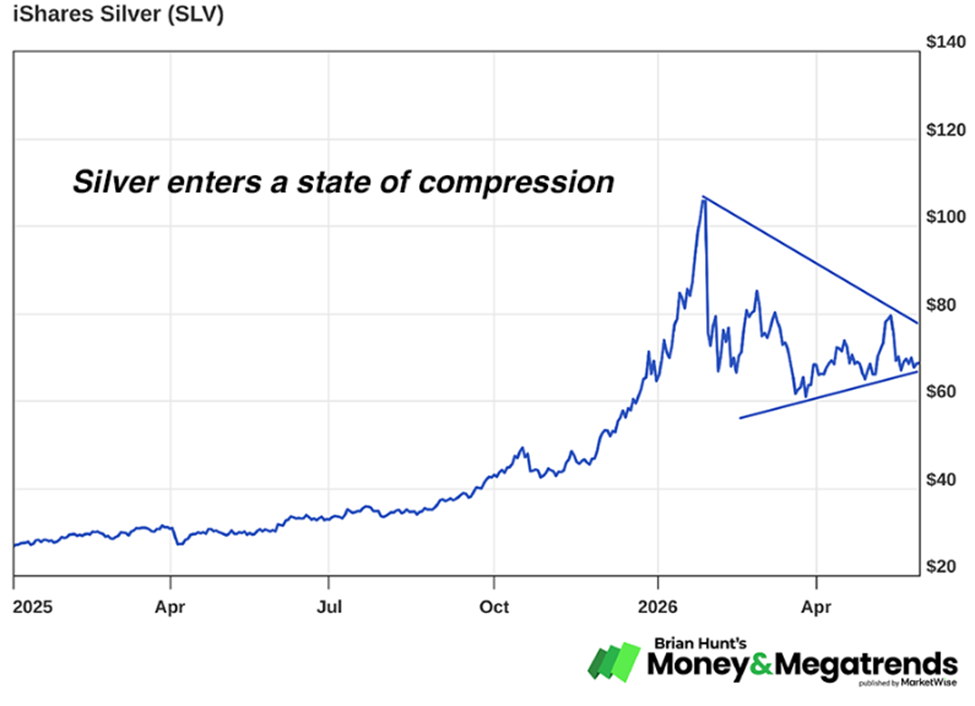
The chart below shows how, over the past few months, silver has traded in what I call a “compression pattern.”
Its recent range of highs and lows is tighter than that which preceded it.
Such compression patterns often lead to strong moves in the direction of the primary trend.
For broad exposure, the iShares Silver Trust (SLV) is your simplest play – it’s the largest physically backed silver ETF with over $40 billion in assets.
If you want a more concentrated bet, Brian highlights Pan American Silver (PAAS) – the world’s largest silver-focused producer, with 10 mines across the Americas and $1.3 billion in cash on the balance sheet.
I’ll throw in a fun wrinkle before we move on…
Guess what’s also in its own compression pattern?
You guessed it – gold.
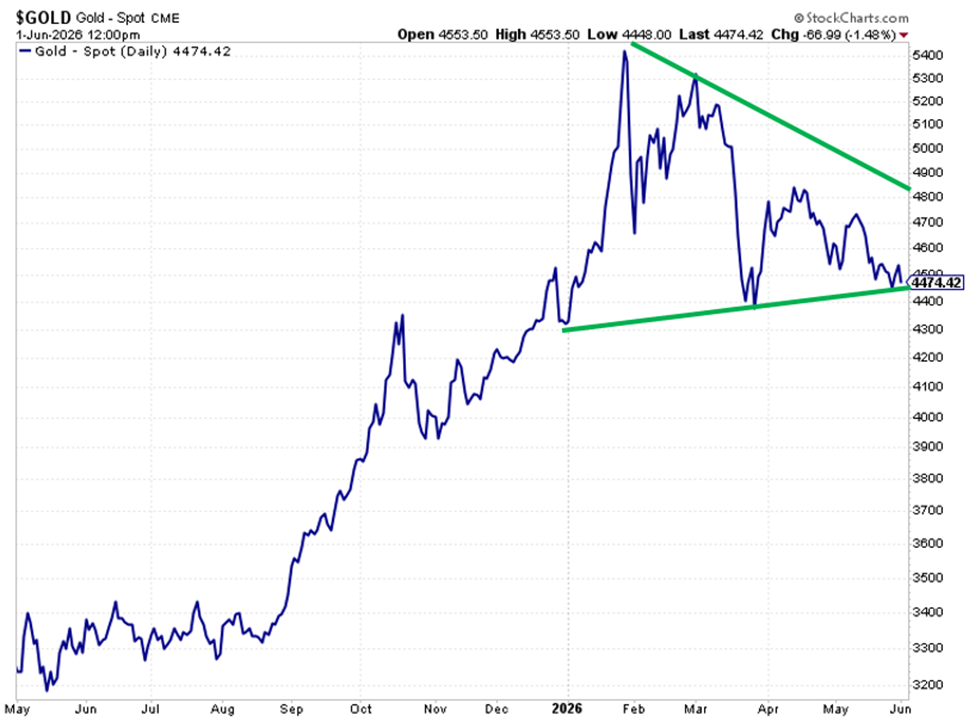
Are we on the verge of a jump in both silver and gold, which would effectively mean the gold-to-silver ratio remains in rough equilibrium?
It’s certainly possible. And if both metals move together, the gold-to-silver ratio stays roughly where it is, which would make the size of the move more important than which metal you own.
Whatever you decide, if you want to fine-tune your entry of either gold or silver even further, I’d point you to last week’s Convergence Trigger event with master traders Jonathan Rose and Marc Chaikin.
The biggest moves in gold and silver typically start with institutions – not retail investors. By the time the average trader sees what’s happening, the easy money has already been made.
Jonathan and Marc have made respective fortunes in the market by solving exactly that problem – tracking where institutional money is moving before it becomes obvious.
Last week, they held their first-ever joint event – The Convergence Summit – to explain how they do it and which setups they’re watching right now.
If silver – or gold – is about to break out of its compression pattern, Jonathan’s and Marc’s “convergence trigger” indicator will spot the institutional fingerprints before the rest of the market does. So, if you’d rather not just buy both metals and wait, you can track the institutional money and use their activity as your starter pistol.
Here’s the free replay to last week’s event for all the details.
Now, silver’s high-tech tailwind runs through nearly every emerging defense and infrastructure technology – including one that’s been quietly building one of the strongest fundamental cases in the market right now.
The math that’s driving the next defense megatrend
Silver’s role in the drone buildout is one reason the metal’s industrial demand story keeps deepening. But the drone opportunity itself deserves its own look – and for one reason that’s impossible to argue with…
The bottom-line math.
To illustrate, let me pull from an issue of Investing Insider that I wrote in early May:
The Shahed drone, which Iran mass-produces and fires in swarms, costs roughly $20,000 to build.
The Patriot interceptor that the U.S. fires to shoot it down costs approximately $3–$4 million.
This is like using a Ferrari to destroy a used Honda Civic – except the Civic keeps coming, a thousand at a time.
That cost asymmetry isn’t just a talking point. It’s the central math problem driving U.S. defense procurement right now.
And with the Iran conflict still unresolved and the Strait of Hormuz situation remaining fragile, Washington isn’t treating this as a future problem – Congress and the White House have just made that explicit.
While the final $839 billion defense spending bill for fiscal 2026 earmarked $13.4 billion for autonomous systems and $3.1 billion for counter-drone technologies, active warfare has shattered those boundaries.
Because the conflict has heavily depleted U.S. missile interceptor and drone stockpiles, the Pentagon has pivoted toward a historic fiscal 2027 defense blueprint – a $1.5 trillion total request – that includes $53.6 billion for autonomy and drone platforms and another $21 billion for counter-drone systems and advanced capabilities.
That’s roughly $74 billion combined.
For context, the Pentagon’s dedicated drone office – the Defense Autonomous Warfare Group – received just $225.9 million this fiscal year. The proposed jump to $54 billion is one of the most dramatic single-year spending increases in Pentagon history.
Once capital of that magnitude hits the market, supply chains form, contracts ramp, and permanent, multi-year industrial demand tends to follow.
The broader strategic case has been building for years. And Jonathan has been all over it, helping his readers make triple-digit returns on drone stocks over the last year. Looking forward, he says the fundamentals are still constructive:
Drones are rapidly becoming core military infrastructure — a foundational pillar of the next global defense build-out.
The data backs him up – drones accounted for 27% of civilian deaths in Ukraine as of early 2025, according to the UN, surpassing every other weapon system. Meanwhile, The New York Times reported they account for at least 80% of Russian frontline losses.
But here’s the catch – despite all this, drone stocks are down on the year.
It’s a reminder that timing matters as much as thesis…which circles us back to Jonathan and Marc and their Convergence Trigger.
A drone breakout driven by defense contract flows and geopolitical escalation is precisely the kind of move that shows up in their system before it shows up on CNBC.
Bottom line: Though the timing of the next surge is unclear, the fundamental case for drone stocks is incredibly strong.
Finally, this bull market just got a name
In recent weeks, we’ve been making the case that the bears’ predictions of a market crash keep misfiring because they’re reading backward-looking valuations in a market being driven by forward earnings momentum.
In our May 28 Digest, we walked through exactly this argument using Micron (MU) as a live example – while its trailing P/E looks alarming, its forward P/E, based on beefy forward earnings projections, tells a completely different story.
Last week, veteran market strategist Ed Yardeni put a name on this dynamic.
Yardeni – president of Yardeni Research and Louis Navellier’s favorite economist – coined the term “FEMO” on Bloomberg Television.
To be clear, this isn’t “FOMO” – “fear of missing out.” This is FEMO: “fabulous earnings momentum.”
Yardeni said, “the big difference is earnings,” adding that the forward price-to-earnings ratio for the S&P 500, at 20 to 22, looks reasonable if the economy avoids recession over the next few years.
That’s precisely the distinction we’ve been drawing. The bears point at stretched trailing multiples and call it a bubble. Yardeni – and the numbers – point at where earnings are headed and call it a rational rally.
His 2026 S&P 500 target sits at 8,250 – the highest among analysts tracked by Bloomberg – with a path to 10,000 by decade’s end in what he calls the “roaring 2020s” scenario.
We hope he’s right.
Coming full circle
While the bears are reading yesterday’s numbers, FEMO is about tomorrow’s earnings.
And in a market where AI capex could be on the verge of juicing silver prices yet again, and drones are underfunded relative to a $74 billion policy mandate, “fabulous earnings momentum” is a valuable frame for what’s ahead.
The harder question isn’t whether these trends play out. It’s when the spark will hit that sends them higher – and whether you’re already positioned when it does.
That’s the challenge Jonathan and Marc set out to solve with the Convergence Trigger.
We’ll keep tracking these stories here in the Digest.
Have a good evening,
Jeff Remsburg
(Disclaimer: I own MU.)


