Listen to the audio version of this article (generated by AI).
The FOMC decision is in … what Warsh signaled … why the market’s inflation relief may be premature … the curveball every new Fed chair faces …
As I write on Wednesday in the wake of new Federal Reserve Chairman Kevin Warsh’s press conference, markets are selling off as investors process Warsh and his changes at the Federal Reserve.
The quick read on Wall Street appears straightforward: Warsh wasn’t as dovish as the market wanted.
Meanwhile, what Warsh did say – and what he deliberately didn’t – told you everything about where this chairmanship is headed.
Stepping back, as expected, the FOMC voted unanimously to hold rates at 3.5%–3.75%. But as we noted in yesterday’s Digest, the rate decision itself was never going to be the story today.
The question marks surrounded the official statement language and the easing bias, the press conference, and what Warsh did with the dot plot.
Let’s take them in order.
The statement first. Warsh didn’t just trim it – he gutted it. Today’s official release came in at 132 words. The prior statement under Jerome Powell ran 344.
Warsh acknowledged the change directly at the top of his press conference:
It’s a bit shorter, a bit simpler and it dispenses with some older language. That statement just gives you the facts, as best we can judge it.
More importantly, gone was the easing bias – the language that had signaled the next move in rates was more likely down than up, and one of the three things we told you to watch for yesterday.
But Warsh went further than simply removing it. Gone, too, was all forward guidance. Back to Warsh:
Absent, also, is so-called forward guidance, which we agreed was not well suited to the current policy conjuncture.
The era of explicit Fed guidance appears to be changing dramatically, at least for now.
As for Warsh’s tone at the podium, he was thoughtful, but didn’t overspeak, or give much hope to doves.
He said the committee is ‘unambiguously and unanimously’ committed to delivering 2% – but when reporters pushed him toward forward guidance, he wouldn’t take the bait.
He also declined to commit to holding a press conference after every future meeting, leaving that open as well.
Then there was the dot plot.
In yesterday’s Digest, we flagged this as a potential point of major change – and specifically suggested that Warsh might decline to submit his own dot as a first, deliberate step toward dismantling the framework.
That’s exactly what happened.
Warsh confirmed it himself in the press conference:
I did not submit a dot for me. It’s not helpful in the conduct of policy.
The remaining 18 participants submitted projections, and the results were striking in their own right.
The committee is split nearly down the middle – nine officials see at least one rate hike this year, eight see no change, and one wants a cut.
The median projection now puts the fed funds rate at 3.8% by year-end, up from 3.4% in March.
But with Warsh absent from the grid, and given his publicly stated hawkish lean, the real committee center of gravity may lean further toward a hike than the median projection suggests.
But there was a twist we didn’t see coming…
Warsh announced the formation of five task forces that will formally review Fed operations going forward – covering communications, the balance sheet, data sourcing, the impact of AI and productivity, and the Fed’s inflation framework.
Critically, the dot plot and press conference format are both explicitly on the table. Warsh made it clear he’s interested in updating the Federal Reserve, as well as how it operates and communicates.
One more line from the press conference worth noting…
When asked whether Fed policy is actually restrictive, Warsh said:
Broadly, I would say Fed policy appears to be somewhat restrictive.
I would have a hard time managing to say those words if I were to see what’s happening in financial markets.
That’s a subtle but important signal.
Warsh is watching financial conditions – not just the policy rate – and he doesn’t think markets are behaving like policy is tight. File that one away.
The market wanted dovish…but didn’t get it
Since Sunday’s Iran peace deal, markets have been moving in one direction – bullish.
The narrative taking hold was simple: the Strait of Hormuz is reopening, the oil shock is over, inflation is yesterday’s problem, and the Fed can now pivot toward easier policy.
Warsh didn’t validate that narrative. And today’s selloff is the market’s response.
But here’s what’s worth understanding: the market’s disappointment may say more about its own assumptions than about anything Warsh got wrong.
After all, the inflation problem that Warsh is navigating was never really about Iran – and the Iran peace deal was never really a solution to it.
Here’s what the deal actually fixes: the acute energy price shock. Oil surged to roughly $115 a barrel at the height of the conflict. With the Strait reopening, that spike will unwind. Headline inflation – the number that includes energy – will soften in coming months.
On that specific point, the market’s prior optimism was rational.
But headline inflation softening is not the same as the Fed’s problem being solved.
The Fed targets Personal Consumption Expenditures (PCE) inflation – and specifically core PCE, which strips out energy prices entirely. Core PCE has been above the Fed’s 2% target for five consecutive years – through rate hikes, through pauses, and through the entire arc of the Iran conflict. The peace deal doesn’t touch any of that.
The drivers of core inflation – a federal government running $2 trillion annual deficits, services costs that have proven remarkably stubborn, wage growth that hasn’t fully normalized – are structurally unchanged.
So, expecting the ceasefire to clear the path for rate cuts was always a headscratcher.
Unconvinced?
Here’s the simplest way to stress test it.
Before the Iran conflict began on February 28, core PCE – the Fed’s preferred inflation measure, which strips out energy entirely – was running at 3.1% and moving in the wrong direction, already well above the Fed’s 2.0% goal.
The Iran conflict itself, according to Dallas Fed modeling, added roughly 0.3 percentage points to core at its peak. So, even if the peace deal unwinds every last bit of conflict-related inflation, you’re still left with core running somewhere around 2.8% to 3% – well above the Fed’s 2% target, and on a trajectory that was already stalling before Iran entered the picture.
The market was celebrating the removal of something that was never the root of our core inflation problem to begin with.
As the inflation picture returns to its baseline, here’s what genuinely has changed
The labor market has been quietly tightening back up in recent months.
Job openings per unemployed worker have risen back above 1.0. And nonfarm payrolls in May jumped 172,000.
This is important. It means that there is less labor market fragility that gave interest-rate doves hopes of cuts.
Before the Iran peace deal, traders were pricing roughly a 66% probability of at least one hike before year-end.
Right after the Iran peace deal, that number fell sharply.
But today, in the wake of this FOMC decision and Warsh’s press conference? It’s spiked to nearly 86%.
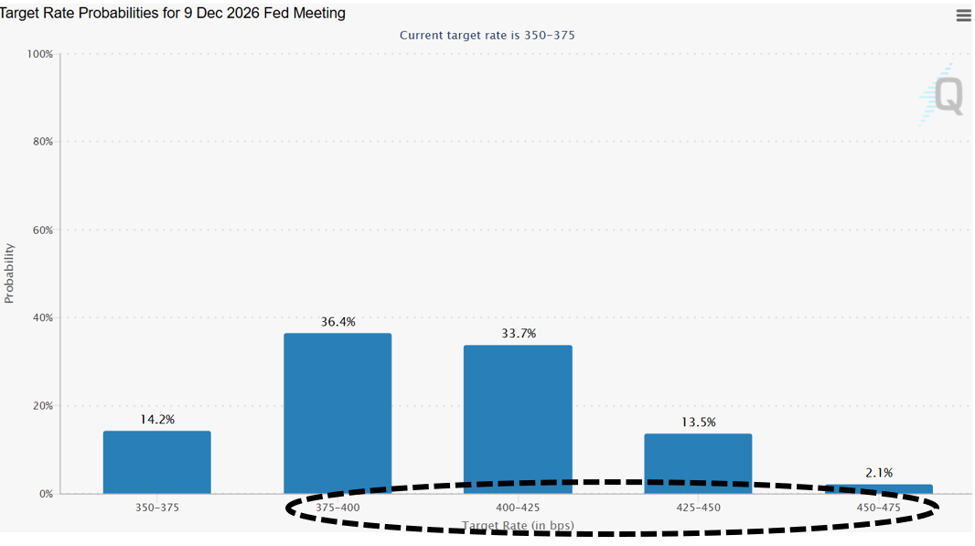
The labor market data pushing toward hikes had nothing to do with Iran – and hasn’t changed. The market seems to be waking up to this as they wrestle with Warsh’s hawkishness.
Put it all together and here’s our bottom line…
The Iran deal is genuinely good news for headline inflation, and the market was right to price that. But the broader inflation problem is only partially energy-driven. The part that isn’t energy-driven is still there, still sticky, and still the Fed’s problem.
Meanwhile, the fragile labor market that was holding the Fed’s dual mandate in rough equilibrium is no longer so fragile.
What this means for Warsh
The question he now faces isn’t whether the conflict is over – it’s whether core inflation (which was going the wrong direction before Iran) starts cooperating once the energy distortion clears, and whether the labor market keeps tightening.
Those are genuinely open questions, and the data over the next several months will answer them.
Meanwhile, the market wants what it always wants: easier policy, lower rates, a Fed on its side. That’s not different.
What is different is the new Fed chair, who, on his very first day, gave the doves almost nothing to work with – no forward guidance, no easing bias, no dot of his own, and a press conference that pointedly refused to sketch out a path to cuts.
Today’s selloff is the market processing that reality.
His decisions in the months ahead will tell us more about his chairmanship than anything he said today.
Coming full circle
Yesterday, we asked whether Warsh would signal – directly or through deliberate vagueness – that the era of explicit Fed guidance was ending. We got a direct answer.
He stripped the statement to its bones, declined to submit his own dot, confirmed it publicly on camera, and launched a formal institutional review of every major communications tool the Fed has used for the past 15 years.
That’s not a signal. That’s a regime change, confirmed.
But here’s the thing about regime changes: the first move is the easy part…
The harder test comes when the data don’t play nice – and today’s selloff suggests the market already senses that gap between what it wants and what Warsh is willing to deliver.
Welcome to the Warsh era.
Have a good evening,
Jeff Remsburg


