

Editor’s note: “The End of the Free Market Fantasy” was previously published in January 2026 with the title, “Welcome to the End of the Free-Market Era (and the Birth of the Technological Republic).” It has since been updated to include the most relevant information available.
In the early 1940s, Americans couldn’t quite explain why steel was rationed, why obscure chemical companies were suddenly flush with cash, or why Washington cared so much about desert towns in New Mexico.
And in the early 1960s, few investors understood why the government was pouring billions into rockets, computing machines, and aerospace firms most people had never heard of.
But those who recognized what was really happening (that the United States had mobilized private industry to win an existential race), were able to position themselves early and change their financial futures forever.
Stop trying to make sense of 2026 using the rulebook from 2019. That book is burned. Today, we are living through the most profound economic reorganization in American history since the signing of the Declaration of Independence 250 years ago.
We have left the era of “free market globalism” – a fifty-year fever dream where we pretended geography didn’t matter and that selling cheap consumer apps was the pinnacle of human achievement.
That party is over.
We’ve entered a new era where the U.S. government is no longer just regulating markets … it’s actively partnering with private companies to win an existential race.
You can call it state-sponsored capitalism. You can call it mercantilism 2.0. Alex Karp, one of the primary architects of this new reality, calls it the Technological Republic.
The label doesn’t really matter.
What matters is when the government decides it can’t afford to lose, it stops debating and starts building.
That’s what we’re watching right now.
The United States is doing what it has always done at pivotal moments in history: mobilizing private industry, clearing regulatory roadblocks, funding winners, and setting hard deadlines to achieve a strategic goal.
That’s how we won the race to the atomic bomb.
That’s how we beat the Soviets to the Moon.
And that’s how we’re now responding to China’s push for AI dominance.
By naming its partners and moving money, the government has made its priorities clear. At moments like this, the market rewards understanding how the system works, and positioning yourself before the execution phase begins.
The only real question for your financial future is whether you’re positioned while the window is still open…
A Merger of State and Tech
For decades, the prevailing wisdom in Washington was that the government should set fair rules and then get out of the way. The “invisible hand” would guide capital to its most efficient use.
Well, it turns out the invisible hand loves cheap labor in China and doesn’t care about national security. When you let the market decide, you end up with a hollowed-out industrial base and an adversary that controls 90% of the critical minerals needed to build the future.
The new administration, backed by the “Hard Power” axis of Peter Thiel, JD Vance, and Alex Karp, has looked at that reality and said: “To hell with the invisible hand. We’re using the iron fist.”
We are no longer in a free market, but a “Command Economy for National Survival.”
In this new system, the government doesn’t seize the means of production like some Soviet cosplayer. Instead, the government directs the means of production. It picks the winners based on one simple criterion: Does this company help America achieve undeniable, durable dominance in AI?
If the answer is “yes,” that company gets deregulation, subsidized capital, and the full diplomatic and military weight of the U.S. government clearing its path.
If the answer is “no,” enjoy your antitrust lawsuit.
You saw the tech CEOs trooping to Washington last year to “bend the knee.” More than just a photo op, that was the signing of a new social contract….
Silicon Valley agreed to stop building useless consumer hedonism and start building the Arsenal of Democracy 2.0.
In exchange, Washington agreed to stop pretending it cares about environmental reviews that take five years to approve a power line.
The result is a merger of State and Tech that would make a 19th-century railroad baron blush.
Geopolitics as Supply Chain Management
If you want to understand why the world looks so crazy right now, stop looking at it through the lens of foreign policy and start looking at it through the lens of supply chain management.
The Technological Republic has an insatiable hunger. It needs three things to build the AI godhead: Infinite Energy, Infinite Raw Materials, and Infinite Compute. It is currently starving for all three.
Exhibit A: Venezuela. Do you think the operation on Jan. 3 was because America’s heart suddenly bled for the plight of Caracas? Please.
The math is simple. We are trying to build AI clusters that require 5 Gigawatts of power – the equivalent of five nuclear reactors – per campus. We need that power tomorrow. And we cannot build nuclear plants fast enough. Solar panels are a joke at that scale.
We needed the world’s largest proven oil and gas reserves brought back online, under American management (hello, Chevron), to crash the price of energy and provide the bridge fuel for the AI buildout.
Exhibit B: Greenland. Why is the administration suddenly threatening to buy (or “liberate”) Greenland? Because China choked off the supply of Dysprosium and Terbium last October. You cannot build high-performance electric motors for humanoid robots or advanced wind turbines without them. Guess who has them? Greenland. And if the “Technological Republic” needs them? Well, that’s the end of the discussion.
This is the new reality.
The U.S. military and diplomatic corps are now effectively the procurement department for “Project Stargate”: the $500 billion government-backed AI initiative.
Adapt to the New Investment Paradigm… or Die
So, what does this mean for your money?
It means that if your portfolio is still optimized for the 2010s (full of ESG-friendly consumer brands, ad-tech companies, and decentralized crypto-fluff), you are going to get slaughtered.
We’re moving into a new investment environment – one defined by massive, government-backed industrial buildouts. Not slogans or studies but actual construction: data centers, advanced chips, power infrastructure, manufacturing capacity.
And this time, the government isn’t standing on the sidelines. In plain English, the message to industry is simple: Build the most powerful computing infrastructure in history … and do it fast.
The government has essentially told Big Tech: “You have an unlimited budget and a mandate to build the most powerful computing infrastructure in human history. Don’t let anything stop you.”
When unlimited capital chases scarce physical resources, what happens? The prices of those resources go parabolic.
The only way to invest in this environment is to own the choke points. You must own the things that the Technological Republic cannot build its AI without, and which it currently doesn’t have enough of.
We have identified the 6-Layer AI Bottleneck Stack. This is the playbook for the next decade.
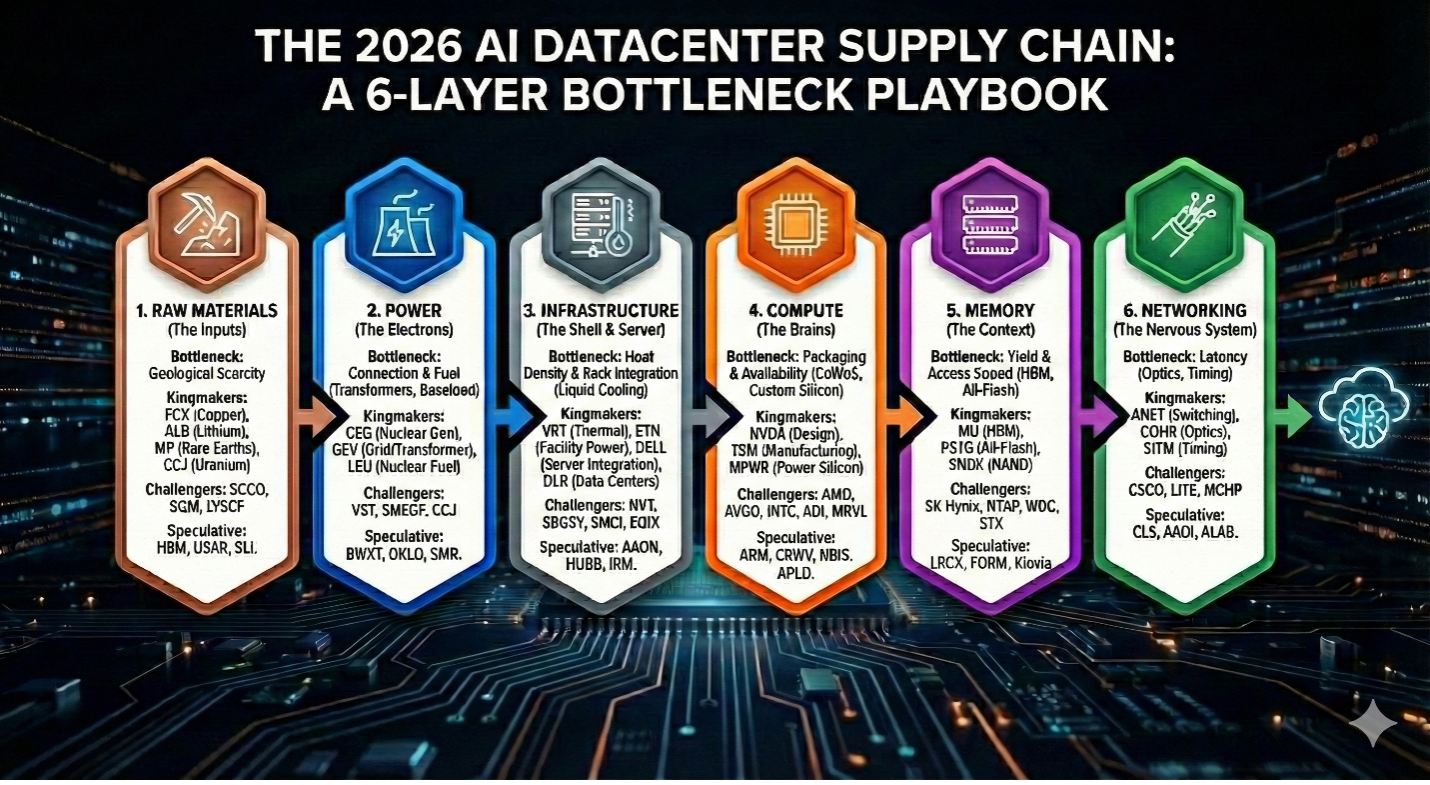
The Raw Materials Layer (The Dirt)
You can print money, but you cannot print copper. You cannot code lithium. The physical inputs required for this buildout are in terrifyingly short supply. We are facing a 10-million-ton copper deficit over the next decade. The administration knows this. That’s why they are laser-focused on domestic mining and “friend-shoring” resources.
- The Play: Own the western copper, lithium, and uranium narrative. The ground itself is now a strategic asset.
The Power Layer (The Electrons)
This is the biggest crisis of them all. AI is an energy vampire. The grid is full. The new paradigm is “pay to play”—Big Tech is being forced to build its own power generation “behind the meter,” bypassing the public grid entirely. The only solution for 24/7, carbon-free, massive-scale power is nuclear.
- The Play: Own the existing nuclear fleet and the fuel cycle. They hold the keys to the only energy source that fits the mission profile.
The Infrastructure Layer (The Shell)
We aren’t just plugging new computers into old buildings. A rack of Nvidia Blackwell chips runs so hot it would melt a standard server room. We have to retrofit the entire internet with liquid cooling plumbing. We need new switchgear, new transformers, and massive new physical shells.
- The Play: Own the companies that manage heat and physical power distribution. The “plumbers” of the AI age are about to become kings.
The Compute Layer (The Brains)
The bottleneck here has shifted. It’s no longer just about getting a raw GPU. It’s about “packaging”—the incredibly complex process of stitching the GPU and memory together on silicon. Taiwan Semiconductor (TSMC) is practically the sole provider of this magic. Furthermore, the US government is actively pushing American-designed custom silicon to reduce reliance on generic chips.
- The Play: Own the packaging monopoly and the leaders in US-designed custom silicon.
The Memory Layer (The Context)
An AI chip without memory is useless. The new HBM (High Bandwidth Memory) chips are stacked vertically like skyscrapers on a microscopic scale. The manufacturing yield is terrible, and the entire global supply is sold out until 2027.
- The Play: Own the domestic memory producers who have cornered the market on the high-end supply.
The Networking Layer (The Nervous System)
When you connect 100,000 GPUs together, copper wires are too slow. You need light. The entire inside of the datacenter is switching from electrical cables to fiber optics and lasers. We are short on the lasers.
- The Play: Own the masters of optical interconnects and low-latency switching.
The Train Is Leaving
Look, I understand why this feels unsettling.
For decades, we were taught that markets move on innovation, consumer demand, and free-market competition alone. That governments regulate… and companies create. That line is blurring fast.
The Technological Republic is here, and it was born out of necessity. If we lose the AI race to China, nothing else matters. So the entire apparatus of the United States is now geared toward one singular goal.
And history is clear on one thing: when the United States decides it cannot afford to lose, ideology takes a back seat to execution.
That’s why the response has been decisive…
The government has named its partners.
It has cleared regulatory obstacles.
It has set hard deadlines.
And it has begun directing a flood of money – trillions of dollars from both private coffers and the public purse – to the six bottlenecks listed above. The government is using a firehose to blast away regulatory hurdles and using its military to secure the supply lines.
In moments like this, the market rewards those who understand what’s happening and position themselves before execution begins.
I have compiled all my research on 119 companies – including their names, ticker symbols, buy-up-to prices, and the top 5 to buy right now – in a new report all about ‘The President’s Market.’
The buying spree has started. Don’t wait until the press release drops. By then, it’s too late.
Watch the presentation and get the list of stocks immediately.


