

Earlier this week, during our Masters in Trading Live sessions, we walked through an emerging collision that almost nobody in the trading world is paying attention to yet: quantum computing versus cryptocurrency security.
Before this revelation, the idea felt speculative – a thought experiment lodged somewhere between cutting-edge science and market irrelevance. The kind of thing most traders would scroll past without a second thought.
Then reality caught up. A 57-page white paper from Google’s DeepMind Research Center, Google’s Quantum AI division, Stanford University, and the Ethereum Foundation proved that crypto encryption can be cracked with quantum computers far sooner than anyone expected.
This wasn’t some amateur blog post or anonymous chirping in a comment section. This was a coordinated, peer-level warning from three of the most credible institutions in technology and cryptography.
The Numbers That Matter
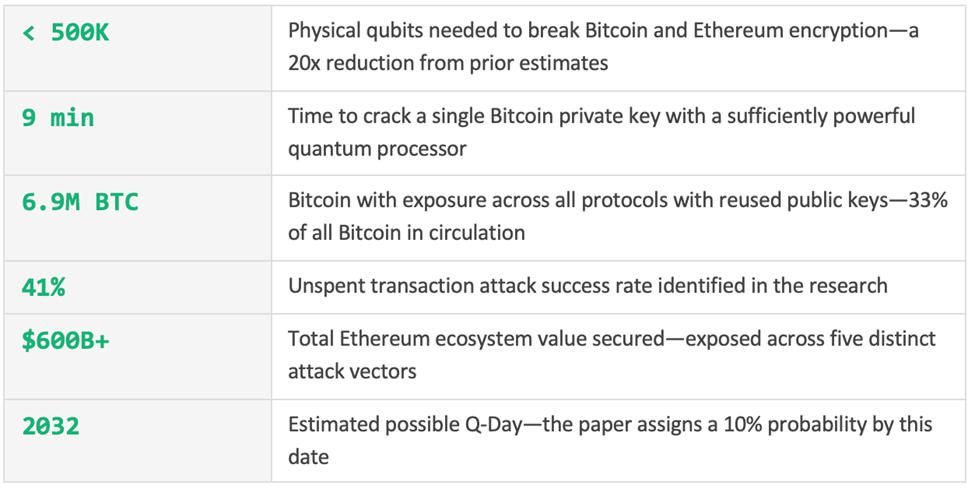
I went through all 57 pages and distilled it down to the figures that traders need to understand:
Why This Is Worse Than the Headlines Suggest
Current blockchain security relies on elliptic curve cryptography—the computational difficulty of solving discrete logarithm problems. Classical computers would need billions of years to crack a 256-bit key.
Quantum computers don’t play by those rules.
Shor’s algorithm, running on a fault-tolerant quantum machine, can theoretically reduce that timeline from billions of years to single-digit minutes.
We’re not there yet—current processors don’t have enough stable qubits. But the paper argues the gap is closing 20 times faster than the industry assumed. Just like AI is improving a lot quicker than people think, quantum is on the same trajectory.
The $2 Trillion Exposure No One Is Pricing In
The critical detail most people miss: 1.7 million Bitcoin sit in old Pay-to-Public-Key addresses where the public key is already exposed on-chain. These are old, old coins—keys likely lost forever.
At a $70,000+ valuation, that’s over $100 billion in exposed assets. A quantum attacker wouldn’t even need a man-in-the-middle attack—they could derive private keys directly from the blockchain’s public data.
Beyond that, 6.9 million Bitcoin across all protocols with reused public keys are vulnerable—that’s 33% of all Bitcoin in existence. Unspent attacks are possible: fast-clock quantum computers could intercept transactions in real time.
There’s one piece of good news: proof-of-work mining itself is safe.
The risk is in the signatures—the cryptographic locks that protect ownership. But that distinction doesn’t shrink the scale of what’s at stake.
Then there’s Ethereum, which faces five distinct attack vectors: account-level, admin-level, smart contract code, consensus mechanism, and data availability layer vulnerabilities. The entire $600 billion-plus Ethereum ecosystem is in the crosshairs.
— Directly from the Google DeepMind / Stanford paper
Let that sink in. The paper is suggesting that quantum computers may be used to steal crypto before anyone even knows they exist. That’s the world we’re walking into.
It all feels familiar – like we’re living through another Y2K moment.
Yeah, Y2K turned out to be nothing. But the world spent $300 billion preparing for it.
Companies that sold the solution made fortunes—not the ones who panicked on December 31st.
The same principle applies here.
Over $2 trillion in crypto assets are at risk. Unknown deadlines. The fix requires a global cryptographic migration. The money won’t be made when quantum breaks crypto. It’ll be made when the world starts preparing for it.
That preparation has already begun.
Panic Is a Strategy — Just Not Ours
When this paper hit, we didn’t scramble. We didn’t panic-sell. We asked a better question than everyone else in the room:
Which blockchain is already built for a post-quantum world?
The answer: Algorand (ALGO).
I’ll be honest—I wasn’t familiar with ALGO before I researched this piece.
But when you dig in, the picture is clear.
This is the first coin we’ve ever shared in a Masters in Trading Live broadcast, and there’s a reason for that.
Why ALGO Specifically?
Algorand was designed from the ground up by Silvio Micali, a Turing Award-winning cryptographer from MIT, with forward-looking security architecture baked into its core.
Algorand’s Pure Proof-of-Stake consensus mechanism doesn’t rely on the same computational assumptions that quantum computing threatens.
The Algorand Foundation has been actively researching and implementing post-quantum cryptographic primitives—hash-based signatures and lattice-based schemes—designed to resist exactly the kind of attacks this paper describes.
But here’s the part most traders miss: narrative drives price before fundamentals do. The moment “quantum-resistant blockchain” becomes a mainstream search term, capital floods into the chain that already has the answer.
ALGO is that chain.
There’s only one blockchain that’s already prepared for this. On the day the paper dropped, ALGO was up 20%. It was trading at 14 cents at the beginning of the year, rallied up to 30 cents in 2025. The market is telling you something. Smart money is already positioning—you can see the confidence just by looking at the chart.
The most efficient way to express this opining through coins is ALGO.
This is what separates us. Reading, doing the research, and then finding the most efficient way to express your opinion. That’s the game.
Where the Capital Is Going
Zoom out. The post-quantum cryptography market is currently valued at roughly $400 million.
The paper projects it will grow to $2.8 billion—a 46% compound annual growth rate. That’s not a typo.
Who needs post-quantum security? Everybody at risk. And that’s essentially everyone. The world needs to change as quantum comes on board.
NIST finalized its first set of post-quantum encryption standards in 2024. The U.S. Department of Defense, the NSA, and major financial institutions are actively auditing their cryptographic infrastructure.
Governments are moving. Institutions are allocating. Blockchains will be forced to adapt—or face existential questions from every institutional allocator on the planet.
How to Invest in the Quantum Security Shift
It’s not easy to get direct exposure. Here’s the landscape:
Private pure plays are still in the venture stage—these will eventually become massive IPOs.
On the public side, big cybersecurity companies are pivoting into this area: PANW (Palo Alto Networks), NXPI (NXP Semiconductors), and NET (Cloudflare) are all building post-quantum capabilities.
But for the most direct, highest-conviction expression of this thesis in crypto: ALGO is the play. Capital flows to solutions, not problems. ALGO sits directly in that path. And this may still be early innings.
Headlines Are Free. Edge Is Earned.
Anyone can scroll social media and catch the headline. That’s table stakes. The real question is: what do you do with it?
Very few traders can digest a 57-page technical paper, extract the second-order implications, map those implications to specific assets, and translate all of that into a conviction position—while the rest of the market is still processing the headline.
That’s what happens inside Masters in Trading Live. Every session. In real time.

The ALGO setup followed this framework to the letter. So does every trade we take. This isn’t about being smarter than the market. It’s about having a repeatable process that consistently puts you ahead of the curve—before the crowd arrives, before the FOMO kicks in, before the easy money is gone.
Stop Chasing Headlines. Start Building Conviction.
If you want to catch trades like this before they move, understand the “why” behind market shifts, and build the kind of conviction that lets you hold through the noise—it’s time to step inside the room where this work happens.
The Masters in Trading Challenge is designed to walk you through that process step by step. You’ll see how we identify catalysts, interpret the signals that matter, and translate those into real trades — all while managing risk in real time.
From identifying catalysts and unusual options activity… to translating that into trades… to managing risk and locking in gains.
You’ll see the process play out from start to finish in just seven days, follow along with real setups, and start building the framework that allows you to think and act like a trader — not a spectator.
No fluff. No noise. Just execution — built around a repeatable system you can actually use.


