
Listen to the audio version of this article (generated by AI).
Trump rejects Iran’s deal as oil spikes… the 10-year rockets up to 5.25%… what’s cracking beneath the surface?… the PCE double-whammy
As I write on Monday morning, stocks are selling off due to geopolitical disappointments over the weekend.
President Donald Trump rejected Iran’s latest proposal to wind down the roughly seven-month-old conflict and reopen the Strait of Hormuz. Iran’s offer, floated at the United Nations, would have reopened the strait within seven days if the U.S. lifted its naval blockade, waived oil sanctions, and agreed to a regional ceasefire.
The breakdown came down to two things: sequencing and scope. On sequencing, nearly all those U.S. concessions would have come first – before Iran reopened the waterway or committed to a nuclear deal. The Trump administration doubted Tehran would follow through once the pressure was lifted.
On scope, Iran wanted to keep talks narrow, focused on the strait and the blockade, while the U.S. is holding out for broader nuclear concessions, including limits on uranium enrichment that Iran has so far refused to give up.
Still, Trump said he expects negotiators on both sides to keep talking this week, so the door isn’t fully closed. However, without an immediate ceasefire, the investment markets are responding as you’d expect.
Stocks are down, and oil is up. But it’s the Treasury market – where the 10-year has jumped to 5.25% – that I want to dig into.
We’ve moved into dangerous territory
In our August 19 Digest, we shared a specific number from our technology expert Luke Lango, editor of Innovation Investor: “5%” – his line in the sand for the 10-year Treasury yield.
Below it, he argued, the AI bull market survives. Above it, the risks accelerate.
His rationale was that above 5%, the bruised consumer becomes a broken one. And a broken consumer eventually impacts Big Tech’s revenues, leaving hyperscalers with fewer dollars to fund their AI capex commitments and putting the whole trade in danger.
Last Friday, the 10-year Treasury yield hit 5.20%, its highest level since 2007. This morning, it’s even higher – 5.25%. And yet, even though stocks are down this morning, the S&P has edged higher since the 10-year shot past 5% roughly a week ago.
What gives?
First, 5% is not a light switch that flips the market from “fine” to “broken” the instant we touch it. It’s a bit like having your house tented and bug-bombed – then realizing you left your keys inside…
Dart in for 10 seconds to grab them, and you’ll be fine. Pull up a chair and binge-watch a season of your favorite show, and it’s a very different story. The poison isn’t about the instant you cross the threshold – it’s about how long you sit in it.
And let’s be clear about why the yield is where it is…
This isn’t the happy, growth-is-booming version of higher yields. Our growth investing expert Louis Navellier, editor of Growth Investor, has been clear that this is the bond vigilantes at work – a global revolt against runaway government debt, now with an oil supply shock and Middle East conflict layered on top. It all points toward fears of higher inflation to come. So, collectively, this represents the “bad reason” for rising rates.
Which brings us to an important question…
What’s the potential fallout of the 10-year at 5.25%?
Where the consumer will feel it
Whatever pain the consumer feels from the 10-year yield won’t show up right away. But there’s one area where we can see what’s coming – the mortgage, the single most rate-sensitive point in any household’s life. And that’s exactly where the strain is already visible.
Mortgage rates track the 10-year, so a yield above 5% means mortgages north of 7%. The 30-year fixed now sits at 7.03% – high enough to turn an already-frozen housing market into an icy tundra. Would-be buyers can’t afford to move; sellers won’t give up the cheap loans they locked in years ago. And homeowners sitting on adjustable-rate loans could feel the bite even harder as those rates reset at higher levels in the months ahead.
This is a quick glimpse of what “weight on the consumer” looks like at this stage – not an immediate collapse in retail sales or a spike in layoffs, but the rate-sensitive front line starting to freeze. The broader damage, which I’ll get to in a moment – credit card and auto delinquencies, softer spending, a weaker job market – is the part that lags. If it’s coming, that’s a Digest you’ll read closer to the end of the year or the start of 2027.
But that’s the whole point – the longer we remain above 5%, the more likely it becomes that we’re in the early innings of a slow-moving squeeze.
The second fallout area: the system
The consumer is only one front. The same rate shock is already hitting the parts of the market that move fastest – and there, the strain isn’t hidden at all.
But before I show you two, keep one thing in mind. Beyond the 5.25% level itself, the danger, as it relates to our economic system, is how quickly we’ve reached it.
Two weeks ago, the yield was below 4.8%. And earlier in August, it even dipped under 4.6%. The race to 5.25% represents one of the fastest moves in years.
22V Research’s head of technical analysis, John Roque, looked back at five decades of historical market data and counted 16 rapid spikes like this one. Every single time, there was some sort of fallout – from the short-lived Silicon Valley Bank scare in 2023 to the 1987 crash. As Roque put it: “Something always breaks.”
So, what signs are there that something is at risk of breaking?
First, look at the SPDR S&P Regional Banking ETF (KRE) – between mid-August and last Wednesday, it fell nearly 10% from its recent high, a hair from correction territory.
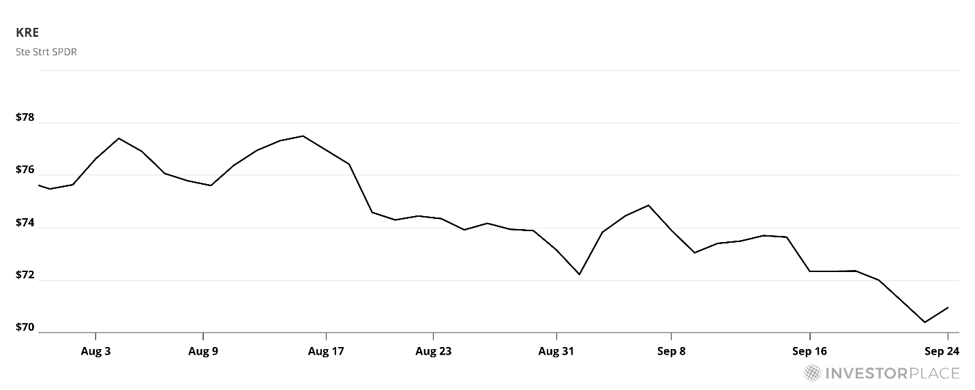
Regional banks are historically the first thing to buckle when yields spike this fast – the canary in the “something always breaks” coal mine.
Second, utilities tell a version of the same story. As a debt-heavy, rate-sensitive corner of the market, they were the worst-performing group in the S&P 500 last week.
These moves don’t directly reflect the consumer, the lagging indicator. But regional banks and utilities reprice in real time. So, what we’re seeing now could be what’s coming for the consumer since, ultimately, they’re being squeezed by the very same force.
One date to circle – and what to do about all of it
For the next clue about where this goes, watch the Personal Consumption Expenditures (PCE) report on Wednesday.
Now, Fed Chair Kevin Warsh has been clear he doesn’t put much stock in any single data point; he’s watching the trajectory, not one month’s print. But Warsh doesn’t vote alone. The rest of the Fed’s members are far more reactive to fresh numbers, and a hot PCE reading could stiffen their resolve for more hikes, which brings us back to the consumer.
A moment ago, I wrote that credit card and auto delinquencies, which lead to softer retail spending, are the part that lags behind higher rates. But let’s be clear about which rate.
While we’ve been looking at the 10-year yield, most of the debt that families carry day to day comes from the prime rate – the benchmark for credit cards, auto loans and home equity lines.
But prime moves in lockstep with the Fed. It’s the fed funds rate plus three percentage points. So, when the Fed hikes, prime rises with it, and the interest on hundreds of millions of credit card balances ratchets higher within a billing cycle or two.
So this leaves us with a potential double whammy on Wednesday…
If the PCE data come in hot, it could strengthen the case for more hikes – pushing the prime higher and squeezing consumers through their everyday debt. Meanwhile, it could also keep bond vigilantes leaning toward the long end of the yield curve, holding up the 10-year yield and affecting the housing market and AI lending.
Which brings us full circle to where we started today: a market under pressure, and the question of how much damage is building beneath the surface.
The bull market – the AI trade above all – ultimately rests on a healthy consumer. Squeeze that consumer from the 10-year and the prime rate and spending softens, which eventually reaches Big Tech’s revenues, which puts at risk the AI buildout the whole market is leaning on.
Wednesday’s PCE report won’t settle the matter, but it’ll tell us whether the pressure on both levers is easing – or tightening another notch.
We’ll report back.
Have a good evening,
Jeff Remsburg


