

Listen to the audio version of this article (generated by AI).
It’s 8 a.m. on a Monday, and you just ordered a hot coffee through DoorDash Inc. (DASH) to start your day. Only, the estimated arrival time keeps getting pushed later and later.
Your driver is stuck at a light. Then they hit traffic at another turn. Just when you think they’re heading to you, they make another stop first. By the time the cup finally reaches your door, that first satisfying sip has become a lukewarm disappointment.
When you used DoorDash, you paid a premium for convenience. Now you’re putting your coffee in the microwave.
The same frustration builds with every order of cold fries or late dinner that leaves your guests’ collective stomachs grumbling. Once an order leaves the kitchen, every extra minute can make it a little less worth waiting for.
But DoorDash is working on a way to shorten that wait.
How? By bypassing traffic and human decision-making entirely.
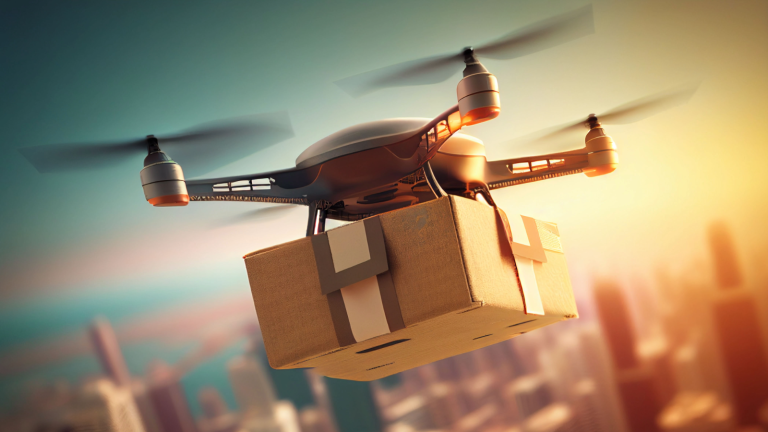
On Sept. 30, the company unveiled DoorDash Air, a new drone delivery system, with pilots planned in Northern California and restaurant partners including Chipotle Mexican Grill Inc. (CMG) and Popeyes.
DoorDash says initial tests produced deliveries from the restaurant to the customer’s door in under five minutes on average. Those results cover a limited sample of order sizes and distances, and delivery times aren’t guaranteed.
Still, you can understand the appeal. Your dinner could fly over the traffic that would otherwise hold it up.
For investors, though, the most revealing part of the announcement was where DoorDash began building the system.
DoorDash Air Shows Why the Hard Part Starts on the Ground
Of course, there are some logistics that need to be sorted out first.
Who loads the drone? Does the bag fit on it? What happens to the drinks?
Without changing a thing, you might save five minutes in the air but add ten minutes of work inside the restaurant.
DoorDash says it designed its loading options to fit existing restaurant operations. And that’s where this becomes an investment story.
A working delivery network needs manufacturers to build loading equipment, suppliers to provide sensors, and batteries that can carry an aircraft and its cargo through repeated trips.
As more machines go to work, those practical requirements can create demand for businesses far beyond the familiar AI names.
Someone has to make the loading equipment, supply the sensors, and provide the power. That’s why I’m watching the companies that can help turn a promising demonstration into equipment customers could use every day.
An AI system that can guide a drone or direct a robot opens similar possibilities. Turning those possibilities into thousands of working machines takes motors, sensors, specialized materials, and factories capable of producing them reliably.
That creates a challenge when choosing stocks: Which companies can turn growing demand into actual deliveries?
Physical AI Is Moving Into the Real World
I call what DoorDash is doing “physical AI”: machines that use artificial intelligence to act in the world around us.
That includes warehouse robots, vehicles that drive themselves, and drones that can navigate without someone steering every movement. Humanoid robots could eventually take on a wider range of jobs in spaces designed for people.
These machines have something in common. They have to work around real obstacles, with real consequences when something goes wrong.
A warehouse robot needs to move goods without damaging them or injuring someone. A delivery aircraft needs to reach the right address and get its cargo down safely. Being clever is only useful if the machine can also do its job dependably.
And there are already businesses earning money from this shift.
Consider Symbotic Inc. (SYM), which supplies robotic systems used to move and organize goods in warehouses. In its third quarter of fiscal 2026, it reported $721 million in revenue, up 22% from a year earlier, and $55 million in net income.
That gives investors actual sales and profits to examine. It’s one company worth researching if you’re interested in physical AI.
This is the kind of evidence I want to see: people paying for machines that do useful work. But there’s another requirement these machines can’t escape.
Power.
Battery Performance Could Become a Physical AI Bottleneck
A machine that moves freely through a warehouse or flies across town can’t drag a power cord behind it.
It has to carry its energy. And adding more battery adds weight that the machine must ferry along with everything else.
That creates a difficult trade-off. A bigger battery might allow longer trips, but it can also leave it with less carrying capacity. Charging takes time, too, and batteries wear down with repeated use.
Think about a delivery operator choosing between another flight and a return trip to recharge. Or a business paying for a robot that spends too much of the workday plugged into a wall.
Battery performance affects how much useful work the customer gets for the money. That’s why I see advanced batteries as much more than an electric-car story.
Solid-state batteries (SSBs) are one promising approach. They replace the liquid inside conventional batteries with a solid material. Depending on the design, that could allow more stored energy in a smaller or lighter package and reduce some fire risks.
Researchers at Oak Ridge National Laboratory are testing whether these battery advances can hold up outside small laboratory experiments. Their work specifically includes potential uses in drones and robotics.
There’s still work to do, though. A battery has to survive repeated use and be manufactured consistently at a price customers can afford. Solid-state designs also need careful safety testing; Sandia researchers are studying how they can fail and overheat.
But the opportunity is easy to understand. Help a machine work longer without making it heavier, and you could make that machine useful to more customers.
Scaling Physical AI Requires Manufacturing Capacity
Better batteries are one part of the job. Producing them in dependable quantities is another.
On July 14, Re:Build Manufacturing announced a line of U.S.-assembled battery packs for commercial and defense drones. It connected the launch to a broader expansion of drone manufacturing at its Pennsylvania facility, which was revitalized as part of an $81 million investment.
These are lithium-ion products. Customers need equipment they can use today while researchers work on what comes next.
And this is where the story becomes much bigger than dinner.
The ability to produce reliable machines in large numbers matters enormously to national defense. A promising design offers limited protection if the equipment takes too long to arrive or its parts are difficult to replace.
America needs manufacturers that can deliver, along with suppliers that can keep those manufacturers working.
As AI moves into drones and other physical systems, the stakes rise. A failure can mean more than a late delivery. Protecting people and essential services requires equipment that works when it’s needed… and enough of it to do the job.
Physical AI Is Becoming a U.S. Manufacturing Story
DoorDash needs more than an aircraft to get dinner to your door. It needs equipment, power, and a system that works reliably from the kitchen to the doorstep.
America faces the same challenge on a much larger scale: turning advanced technology into machines it can build, deploy, and depend on.
For investors, the question is concrete: Which companies supply the parts, materials, and production capacity that make those plans possible?
That’s the opportunity I’ve been researching.
At July’s Pennsylvania Defense and Innovation Summit, government, finance, technology, and military leaders gathered at the U.S. Army War College. Sen. Dave McCormick’s office reported more than $10 billion in new investment commitments spanning shipbuilding, advanced manufacturing, AI, and robotics.
The announcements included a new drone battery production line, expanded manufacturing facilities, and equipment to increase output. These projects still have to deliver, but they show investors where to start looking.
Consider what happens when a customer moves from testing a handful of drones to ordering thousands.
The manufacturer needs more batteries, motors, and specialized components. It needs dependable sources of raw materials. And it needs suppliers that can increase production without sacrificing quality.
A supplier that solves that problem can become essential to its customer’s expansion.
That’s why I’m following the buildout all the way down to the businesses that make it possible.
My latest briefing takes you inside the investment thesis behind America’s push to rebuild its industrial capacity.
I explain the companies I’m watching, what makes their capabilities valuable, and the developments that could bring them to investors’ attention.
You’ll come away with a clearer way to evaluate this opportunity… and specific businesses to put on your research list.


