


Editor’s Note: Successful investing isn’t about reacting to every headline. It’s about having a disciplined process you trust when volatility rises.
That’s exactly what we discussed during The Profit Surge Event, where I joined Jonathan Rose, Eric Fry and Luke Lango to share our highest-conviction ideas and explain how we’re positioning for the opportunities ahead. Jonathan also broke down how he applies his trading framework to our picks to help manage risk and improve timing. You can watch the full replay here.
I invited Jonathan here to pull back the curtain on how he formed that mindset. From the chaos of the Chicago trading pits to a real trade that looked nearly lost before turning around, he shows why conviction and discipline are often the difference between short-term panic and long-term success.
It’s a lesson worth keeping in mind as we move into a new trading year…
*****************
I had just graduated from the University of Miami, but the Chicago Mercantile Exchange was calling louder than any beach could.
The smell hit me first — sweat, paper, burnt coffee — then the sound.
A wall of voices shouting bids and offers, phones ringing, bells clanging, paper tickets flying like confetti.
I was 22, standing shoulder-to-shoulder with men who had been trading longer than I’d been alive. I was nervous, tie too tight, but exactly where I wanted to be.
Those first steps into the Chicago trading pits would shape everything that came after, teaching me what separates traders who survive from those who wash out.
That’s where I learned The Trader’s Mindset.
Any trader can catch a lucky break, but long-term survival depends on process, conviction, and discipline.
These are the principles that keep traders steady when markets turn volatile.
It all starts with process…
The Framework That Carries You Into the New Year
If you can’t explain why you’re in a trade, you don’t belong in it. This isn’t a gut feeling we get from some squiggly lines on a chart. We’re on the hunt for objective reasons to believe that an asset is mispriced.
Sometimes it’s as simple as spotting some unusual trading activity, or mispriced earnings volatility. Maybe we find a divergence between two highly correlated assets.
Even the strongest process doesn’t spare you from volatility — especially in the final weeks of the year, when volume dries up and emotion replaces information.
A trade can look perfect on paper and still go against you — that’s where conviction steps in. It’s the belief born from research and preparation that allows us to remain confident when things don’t go as planned.
While conviction is what carries us through the rough patches, it’s even better if you can avoid those patches altogether. That’s where discipline comes in.
Discipline is about setting the rules of the trade before you even put in your first offer. I’ve seen plenty of sharp traders self-destruct. And in every case, they made the same mistakes…
They chase hot trades, oversize positions, micromanage every tick, and break their own rules.
Discipline is the patience to wait for your setup, even when the market feels dull and your inner voice is screaming for action.
Without discipline, you’re swinging at every pitch. With it, you’re defending the strike zone long enough to capitalize on the right opportunities.
This singular strategy is what my Masters in Trading community uses to track hidden stock plays with confidence and pair them with a simple tweak that can multiply the payoff on great ideas.
Now, let’s look at a real-world example that brings it all together…
Process in Action
This wasn’t our biggest win of the year — but it might be the most instructive.
Back in July, we took aim at Lyft Inc. (LYFT). The rideshare company was set to release its next earnings report on August 6.
We came into earnings with a simple observation: The options market was underpricing any potential move. The market was implying around a 16% swing, but Lyft’s history told us the stock typically moves closer to 20% after earnings.
Even better, we also saw the company was lagging top competitor Uber Technologies Inc. (UBER), which gave us conviction that LYFT stock still had room to catch up.
That was the edge. We weren’t guessing or chasing a theme. We were playing the math and stacking reasons for the trade.
Because earnings are binary events, we traded volatility instead of direction.
We structured the trade as a straddle — buying bullish and bearish positions with the same expiration.
Discipline Over Emotion
Then earnings hit.
Lyft sold off on the news, but not far enough outside of the market maker’s expectations. That meant we were able to take profits on our bearish puts, but it wasn’t enough to cover the total cost of the strangle. Meanwhile the calls were close to worthless, which put us in a tight spot.
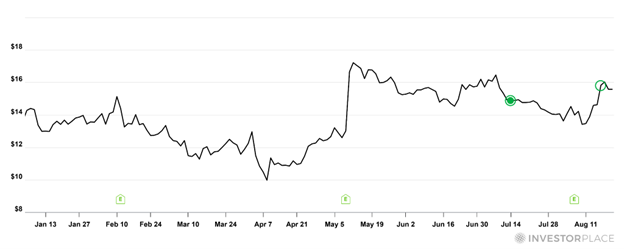
A lot of traders see red on one side of their trade and panic. It’s easy to react emotionally, cash out, and try to preserve capital. But doing so would have locked in a loss without changing the underlying setup. Even then, we would still have been underwater on the trade.
The situation didn’t look good, but this is where conviction and discipline come into play.
We knew the research. Sure, the earnings catalysts didn’t pan out. But that wasn’t our only reason to believe LYFT could move to the upside.
That conviction and discipline kept us from second-guessing the setup when the stock went against the calls.
Conviction Rewarded
And then, right at the last minute, the payoff came.
On Friday, August 15, LYFT started moving after announcing co-founders Logan Green and John Zimmer would down from the board in 2026.
That meant their Class B shares would turn into common stock, killing the dual-class structure and bringing our calls back from the brink. As a result, shares jumped more than 10% and brought our calls back in the money.
The straddle returned about 5% — a clean win built on process, conviction, and discipline.
Soon after Lyft’s run, I saw yet another opportunity to turn its short pop into a fresh win.
I told members of one of my Masters in Trading services to go all in on a bullish Lyft trade at the end of August.
In just two weeks, we netted over 200%.
Both trades on LYFT came from the same approach…
We found a setup with edge, trusted the research, and managed risk with discipline. That’s The Trader’s Mindset in action — and that’s how you stay alive long enough to hit the big ones.
This isn’t the only comeback story we’ve seen over the last year.
Consider Antero Resources Corp. (AR) and Coterra Energy Inc. (CTRA).
2025 tested a lot of traders’ patience. Energy was one of those areas where conviction mattered more than comfort.
Luckily for us, we never wavered in our conviction with these trades.
While The CTRA trade required patience – 91.6% gains in four months – our AR play paid off for 145.5% profits in just a month.
The lesson is simple: Don’t mistake short-term noise for a verdict on your trade.
If your process is sound and your discipline is intact, you don’t have to flinch when a position goes red.
It’s about trusting the framework you’ve built, leaning on conviction when the waves hit, and letting discipline decide the exit.
Train Your Mind to Think Like a Pro
The truth is, no one is born with The Trader’s Mindset. It isn’t some gift you’re handed when you open a brokerage account or read a book.
But you don’t have to spend years in the Chicago pits to build it.
I did – and that knowledge is what I teach in my Masters in Trading services.
That’s why I recently went live with my “Trade of the Decade” at The Profit Surge Event.
During that presentation, I and my InvestorPlace colleagues – Louis Navellier, Eric Fry, and Luke Lango – go over how to pair their top picks with a simple tweak that can multiply the payoff on great stock ideas.
Plus, I show how to get ahold of my “Trade of the Decade” and three more trades that I believe could be home runs based on my market forecast and unusual trading activity.
You can watch a full replay of our free event for a limited time.
As one year winds down and another approaches, this is when process matters most. Thin markets, fewer catalysts, and emotional decisions can do more damage than a bad trade ever could.
The traders who come back stronger each year aren’t the ones chasing every headline — they’re the ones who refine their framework, trust their research, and stay disciplined when it’s hardest to do so.
Remember, the creative trader wins,

Jonathan Rose,
Founder, Masters in Trading


