

In the 1970s, Tehran looked very different.
If you look online at photographs from that era, you see bustling downtown cityscapes with modern cars and advertising. Bellbottom jeans and miniskirts. Women and men studying at university. People dancing. The country was modernizing rapidly, and its economy was becoming more integrated with the rest of the world.
That all changed in 1979.
The Islamic Revolution reshaped Iran’s political system, its relationship with the West and its role in global energy markets. Over time, tensions increased, sanctions followed and Iran became a recurring source of geopolitical risk.
Fast forward to today.
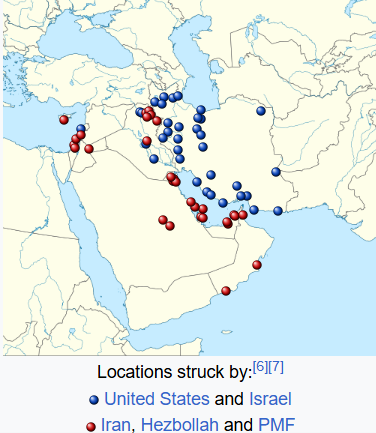
Negotiations between the U.S. and Iran reportedly broke down late last week. The U.S. and Israel initiated attacks over the weekend targeting Iran’s senior leadership as well as missile launchers, nuclear facilities and Islamic Revolutionary Guard Corps infrastructure. Iran retaliated with missile and drone strikes across the region. The U.S. has since closed embassies in Kuwait and Saudi Arabia and encouraged Americans to leave parts of the Middle East.
Source: Wikipedia
As expected, oil prices jumped and markets sank today as investors worried about the fallout.
In today’s Market 360, I’ll explain what this Middle East escalation really means for the stock market, why U.S. equities are holding up better than global markets and how to position yourself as volatility unfolds.
The U.S. Remains the Oasis
Now, you can get the rundown on exactly what has transpired over the last couple of days anywhere. So, here is what has caught my attention amid all of this…
A few corners of the market have been spared during the recent uptick in volatility.
- The U.S. dollar staged its biggest rally in more than nine months.
- Gold prices surged back above $5,300 per ounce on Monday and remain just below all-time highs.
- West Texas Intermediate crude oil jumped above $75 per barrel, while Brent crude rose above $85 per barrel for the first time since July 2024.
Also, if you think it has been bad in the U.S. equity market this week, it looks like a picnic compared to the rest of the world.
According to Bespoke Investment Group, since the joint U.S.-Israeli strikes on Iran, the SPDR S&P 500 ETF (SPY), which tracks large U.S. stocks, has declined about 1.7% through early Tuesday trading. Meanwhile, the SPDR MSCI ACWI ex-U.S. ETF (CWI), which tracks developed and emerging market stocks outside the United States, has fallen roughly 6.8%.
That is a performance gap of more than five percentage points in just two trading sessions. That kind of performance gap has occurred only twice since CWI began trading in 2007.
The reason comes down to one word. Oil.
Crude prices have posted back-to-back daily gains of more than 6%, pushing them to 52-week highs. Most major economies remain heavily dependent on Middle Eastern oil. The U.S. economy, however, has become far more insulated over the past 10 to 15 years, thanks to our abundance of oil and natural gas in places like the Permian Basin in West Texas.
Think about it this way.
We export crude oil. We export liquefied natural gas. Much of the developed world does not.
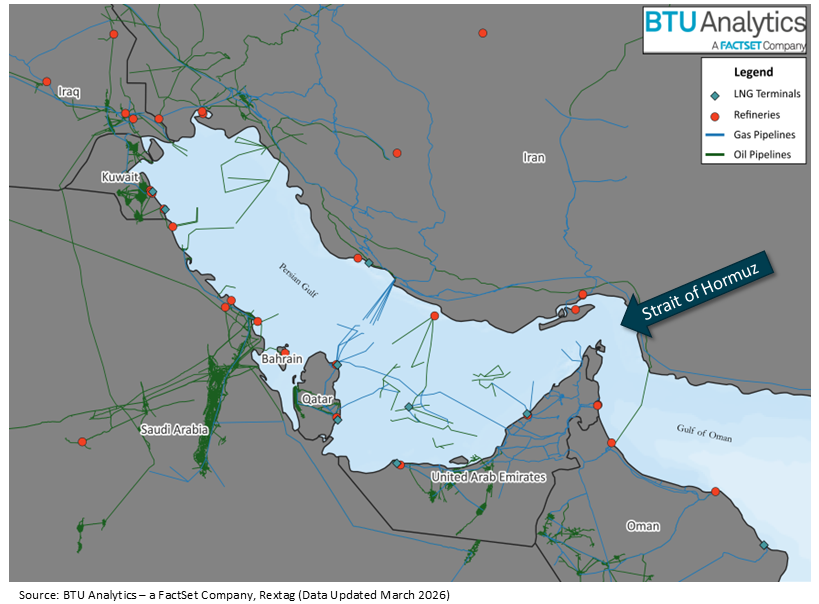
That narrow passage in the image above handles roughly a quarter of global crude and a fifth of LNG exports. That is why international markets are under far greater pressure right now.
By contrast, higher prices create windfall profits for U.S. energy companies rather than crippling the broader economy.
Now, military action typically does not affect the stock market. If anything, it often removes a level of uncertainty in the market, and I think that will be the case this time around, too.
Markets do not like unknown outcomes. Once objectives become clear and the path forward is better defined, investors adjust.
For decades, Iran has been a persistent geopolitical risk, and that gets priced into oil, currencies and equities. If long-standing tensions ease and energy flows normalize, that removes a lot of uncertainty from the global system. And when that happens, markets have room to grow.
But here’s what matters.
The United States is food and energy independent.
We are one of the world’s dominant energy producers. Higher crude prices may even help narrow the trade deficit and support GDP growth. And a stronger dollar reinforces America’s position as a safe haven during global stress.
In other words, while this conflict creates pressure overseas, it does not hit the U.S. economy the same way.
That is why I continue to say the U.S. remains the oasis.
The Bigger Opportunity Ahead
Volatility is uncomfortable. I understand that.
But this is exactly when discipline matters most. I urge you to block out the noise and not let near-term events derail your focus on the big-picture, long-term themes that are far more important for building wealth.
In fact, while headlines focus on oil tankers and missile strikes, a far larger shift is already accelerating inside the U.S. economy.
Despite what the worrywarts in the media might say, I believe a new phase of the artificial intelligence revolution is unfolding.
And it is being driven by someone Yahoo Finance once called “one of the most hated people in the world.”
Elon Musk.
He revived the electric car industry. He revolutionized private space flight. He built the largest satellite network on Earth.
Now he is preparing to ignite what I am calling Project Apex.
This initiative is designed to accelerate the next stage of AI – powered by a shocking level of computing power and infrastructure buildout.
All with one singular goal. An inflection point for AI where we don’t look back, and nothing is the same again.
I do not say this lightly. My firm has already staked $358 million on this technological shift.
Why? Because this is one of the biggest moneymaking opportunities of the decade.
As capital floods into new data centers, chips, energy infrastructure and AI systems, a small group of companies stands to benefit disproportionately.
That’s why I recently released a full presentation explaining:
- How Elon Musk is preparing to spark this next chapter in the AI revolution
- Why I believe it could create the potential for dramatic upside as this next phase accelerates
- Details of the A-rated company at the center of it
- And how you can position yourself before Wall Street fully prices it in
I even tested Elon’s newest AI breakthrough myself and walked through it in a live demonstration.
Geopolitical volatility will come and go. But if you are serious about capitalizing on the next wave of the AI boom, you need to see this now.
Take the time to watch the full briefing today.
Sincerely,

Louis Navellier
Editor, Market 360


