


Listen to the audio version of this article (generated by AI).
I can be honest about something the financial media won’t ever say out loud.
The game is rigged.
Wall Street has advantages over you that are real, significant, and permanent. More analysts. More data. More computing power. More access. Faster execution. Better technology. In almost every corner of the market, the biggest funds win before you even sit down at the table.
But there’s one advantage they will never have over you. Not ever. No matter how much money they raise, how many analysts they hire, or how much technology they deploy.
And it’s so powerful that Warren Buffett — the greatest investor alive — has publicly said it’s the single biggest edge in the market.
You have it. He doesn’t. And that gap is never closing.
The unfortunate thing is that most investors never use it. Not because they can’t — but because of something else working against them. Something that has nothing to do with Wall Street and everything to do with what’s happening inside their own heads.
Today, I want to show you the one place where your permanent advantage over Wall Street is most powerful — and how I’ve spent nearly 50 years building a system designed to exploit it.
I’ll also tell you why right now may be the most urgent version of this opportunity I’ve ever seen. I’ll be getting into all of it at my Fed Shock event next Wednesday, May 13, at 1 p.m. Eastern – including a free stock pick just for attending. (Click here to reserve your spot now.)
What Buffett Knows That Most Investors Don’t
In 1999, Warren Buffett said something that should have stopped the entire investment world in its tracks.
He said that if he were managing a million dollars instead of the billions he oversees at Berkshire Hathaway Inc. (BRK), he could guarantee 50% annual returns.
Guarantee.
Fifty percent. Annually. From the greatest investor alive.
Let that sink in for a moment. The greatest investor alive – a man who has compounded wealth at roughly 20% a year for six decades – is telling you he performs worse because he has too much money.
The opportunity he’s describing is completely out of his reach. Not because he doesn’t see it. He sees it perfectly.
It’s just that, when Buffett sees a stock he likes, he needs to buy a lot to really move the needle for Berkshire. And if he does that, the price moves. At his scale, the act of investing destroys the return.
But you don’t have that problem.
Why Their Size Is Your Advantage
When a $50 billion fund tries to buy a meaningful position in a small-cap stock, it’s like trying to drink from a fire hose with a coffee cup. Their own buying pressure starts moving the price against them before they’re even halfway done accumulating.
Every share they purchase pushes the price higher. The market sees the volume. Other traders front-run them. By the time they’ve built any real position, they’ve already paid a significant premium — and in some cases moved the stock so much that the original opportunity no longer exists.
So, they stay away. Not because the stocks aren’t attractive. Because they’re too big to play in the sandbox.
This isn’t temporary. It isn’t going to be solved by better technology or smarter analysts. It’s structural and permanent. The bigger a fund gets, the more locked out of this opportunity it becomes.
And that’s exactly where some of the biggest gains in the market are made. I’ve seen it for nearly 50 years. I’m seeing it right now.
The Other Thing Working Against You
Now for the second force I mentioned. This one isn’t Wall Street.
It’s you.
I don’t say that to be harsh. I say it because I’ve watched it happen over and over again.
Our brains are not wired for investing. They’re wired for survival. Avoiding a loss feels twice as urgent as capturing a gain. And we live in a media environment that has learned exactly how to exploit that – fear gets clicks, bad news travels fast, and uncertainty keeps people frozen at exactly the moments when they should be acting.
But here’s what the doom and gloom crowd never shows you: the scoreboard.
The U.S. economy keeps growing. American companies keep innovating. The stock market – through crashes, recessions, wars, and pandemics – keeps making new highs.
I’ve watched investors sit on the sidelines through some of the greatest bull runs in history because the headlines were too scary. I’ve watched people sell at the bottom of every major crash – 2001, 2008, 2020 – right before the market turned and handed massive gains to the people who stayed in.
You want to know what I’ve learned in nearly 50 years? It actually takes courage to be an optimist.
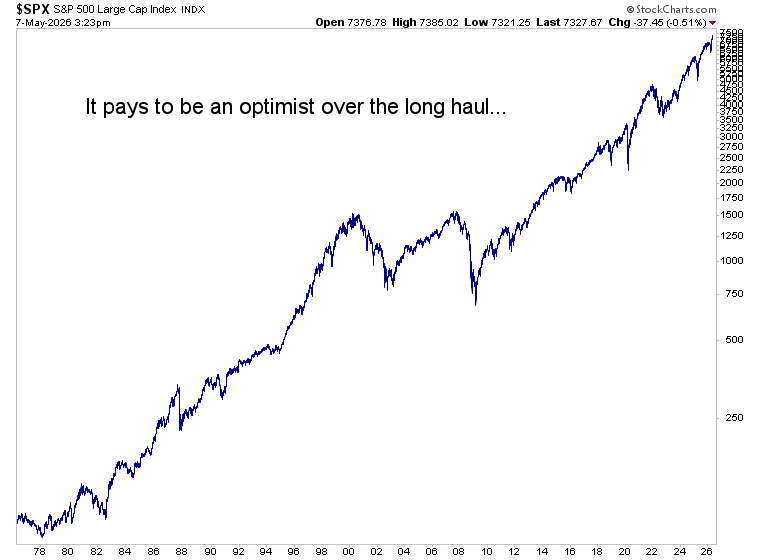
The long-term trend is clear. The S&P 500 is up about 7,300% over the past 50 years.
The investors who build real wealth are the ones with the courage to act while others hesitate. Lock and load while everyone else is reading scary headlines. That’s the game.
And when you combine that with the structural edge I described above – the willingness to act in the corner of the market where Wall Street literally cannot follow – you have something genuinely powerful.
Why Small Caps? Why Now?
But the money won’t be made in large-cap stocks. The real wealth opportunity will be in small caps.
They don’t always lead the market higher. In fact, for years they trailed behind the mega-cap tech giants.
But something has shifted. Over the last year, the Russell 2000 is up nearly 45% — compared to the S&P 500’s 30%.
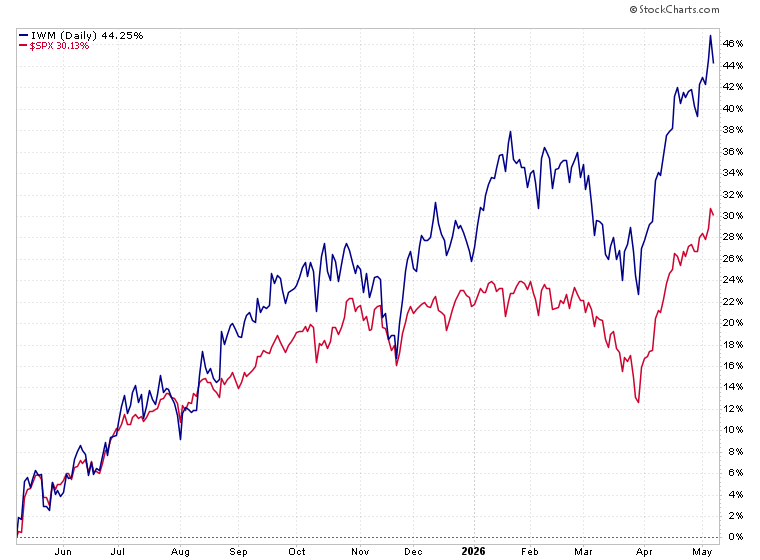
The rotation is real, and there are good reasons to believe it has a long way to run.
Small-cap companies are predominantly domestic. They benefit directly from U.S. economic growth. They’re more sensitive to interest rates – which means when rates come down, their borrowing costs fall and their earnings power expands fast. And they’re still cheap. After years of trading at a steep discount to large caps, small caps are only now beginning to close that valuation gap.
As confidence in the economy builds and earnings momentum broadens, leadership tends to rotate toward smaller, faster-growing companies. That rotation appears to be underway. And what comes next could make what we’ve already seen look like a warm-up act.
Here’s the history.
Every time the Federal Reserve has opened a sustained rate-cut window, small caps have been the biggest winners. That’s because lower rates directly reduce borrowing costs for smaller companies that carry more debt. Lower borrowing costs help expand their margins and make their future earnings worth more today.
I’ve seen four other windows of major rate cuts in my career. The last four times, small-cap stocks delivered extraordinary gains:
- Ascend Communications: +2,866% (1995 Fed pivot)
- Frontline plc (FRO): +1,513% (2001 rate cuts)
- Lithia Motors Inc. (LAD): +475% (2008 rate cuts)
- MARA Holdings Inc. (MARA): +1,800% (2020 COVID cuts)
Now consider where we are today. The Fed has already begun cutting. On May 15, a new Fed Chairman takes over — one who has publicly argued for more aggressive easing and has the full backing of President Trump.
The administration wants major cuts. Small caps are already on fire.
When it rains, it pours — and, folks, I think it’s about to pour.
The Exclusion List
I’m not saying buy small caps indiscriminately. That’s not how I operate. The key is finding the right ones – the ones where the fundamentals are already strong and the institutional money is already beginning to move.
That’s exactly what my Stock Grader system does. Every week, it scans thousands of stocks looking for those two signals firing together.
I found Bloom Energy Corporation (BE) this way – Stock Grader flagged it when the market cap was $5 billion, nobody was talking about it. Today we’re up over 1,100% in about 14 months.
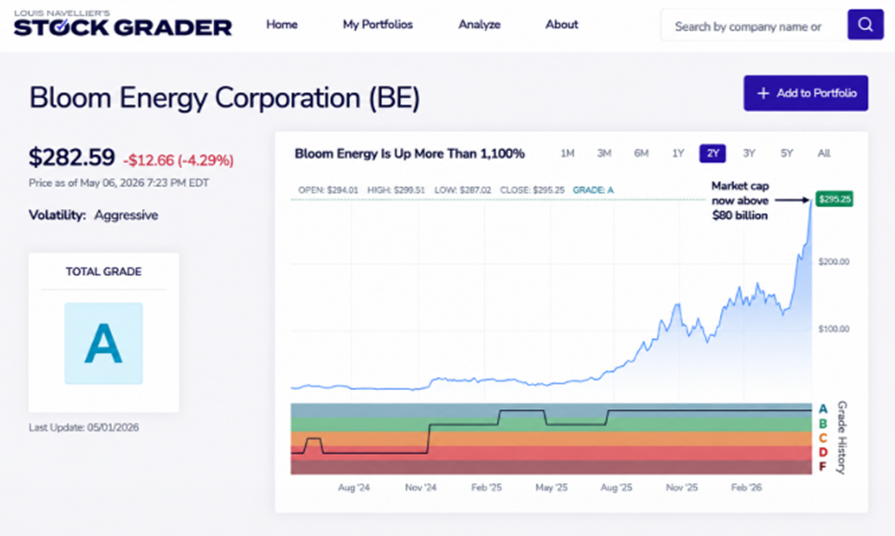
A $50 billion fund couldn’t have done that. But my subscribers did.
Right now, Stock Grader has flagged 53 smaller stocks that are flashing the same signals.
I call it the Exclusion List – because that’s exactly what it is. These are stocks that are too small for Wall Street to touch. Too small for the big funds. Not too small for you..
Small caps are already running. The Fed is about to pour fuel on the fire. And these 53 stocks are the ones my eight-factor model says are among those best positioned when it does.
On Wednesday, May 13, at 1 p.m. Eastern, I’m going live to share my highest-conviction picks from this list – the names I think have the best shot at being the next small-cap 10-baggers. You’ll get that Exclusion List immediately just by signing up. I’ll also give away a free stock pick just for attending.
Hang on, folks. The ride is just getting started.
Click here to reserve your spot now.
Sincerely,

Louis Navellier
Editor, Market 360
The Editor hereby discloses that as of the date of this email, the Editor, directly or indirectly, owns the following securities that are the subject of the commentary, analysis, opinions, advice, or recommendations in, or which are otherwise mentioned in, the essay set forth below:
Bloom Energy Corporation (BE)


