

Listen to the audio version of this article (generated by AI).
Editor’s Note: The stock market will be closed tomorrow, June 19, for the Juneteenth holiday. The InvestorPlace offices and customer service departments will also be closed.
***************
Every pilot takes off with a flight plan.
Before the wheels leave the runway, he knows where he’s headed, how he’ll get there and what conditions to expect along the way.
But as any good pilot will tell you, once the plane is in the air, sometimes you’ve got to adapt.
The skies can darken. Turbulence can hit. Rain can pound the windshield. And a sudden crosswind can force the pilot to adjust in real time.
Folks, that is exactly what happened this week. Kevin Warsh took the controls for his first Federal Open Market Committee (FOMC) meeting as Federal Reserve Chair.
Wall Street wanted a clean flight plan. Preferably one that pointed straight toward lower interest rates.
That’s not what we got. Instead, the Fed held rates steady… the “dot plot” showed more division than Wall Street wanted… and Warsh made it clear that this Fed will not spoon-feed investors with the same forward guidance they’ve grown used to.
The result? A late-day selloff…
Now, I heard from more than a few semi-panicked folks wondering if the flight was in trouble. But here’s what I told them:
Our stocks were actually up. In fact, we are largely immune from whatever Wall Street was panicking about.
So, in today’s Market 360, I’ll explain why Wall Street panicked over Warsh’s first Fed meeting… why I believe that panic is misplaced… and why the real story right now is not the dot plot, the inflation numbers or anything else Wall Street is worried about.
It’s earnings – powered by fundamentally superior stocks.
And at the head of the charge are the stocks tied to the AI Revolution. So, to wrap things up, I’ll tell you about what’s coming next in this powerful growth story – and how you can profit.
What the Fed Decided – and What Wall Street Got Wrong
The Federal Reserve did exactly what Wall Street expected: It left key interest rates unchanged.
The Federal Open Market Committee voted unanimously to maintain the federal funds rate in a range of 3.5% to 3.75%.
That part was not surprising. What spooked Wall Street was the message underneath the decision.
The latest dot plot showed that Fed officials are more divided than investors hoped. Several members now see the possibility of rate hikes later this year, and the Fed removed language pointing toward a rate cut.
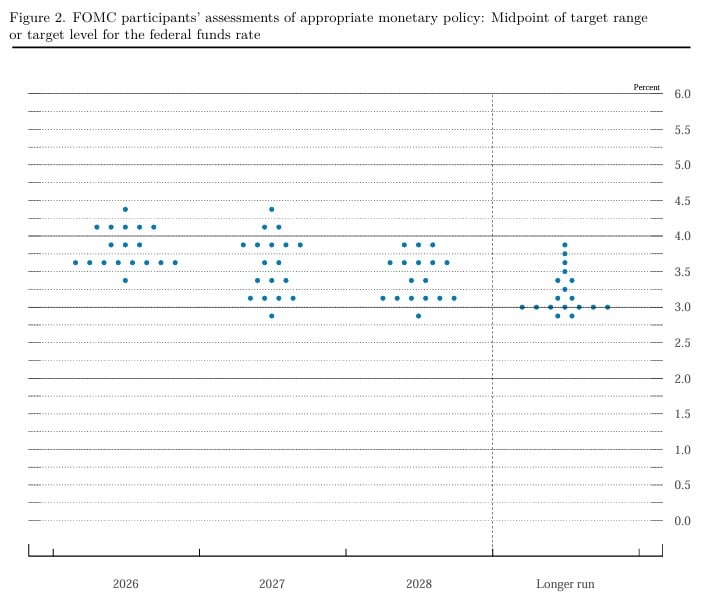
As you can see in the image above, nine Fed officials now expect rates to move higher this year, while eight expect rates to remain where they are. Only one official expects rates to move lower.
Yikes.
That was enough to send parts of Wall Street into a tizzy. But I think the reaction missed the bigger picture.
Yes, the latest inflation reports came in a bit hotter than expected. Producer prices rose 0.4% in May, which translates to an annualized rate of 4.9%, up from 2.5% in April. Meanwhile, the Consumer Price Index increased 0.3% in May, or 3.7% on an annualized basis, up from 2.2% in April.
But the inflation scare right now is largely tied to energy prices. And central banks cannot fix food and energy prices by raising rates.
So, when oil prices spiked because of geopolitical turmoil in the Middle East, hiking rates does not magically pump more oil out of the ground. Besides, now that a tentative deal is in place between the U.S. and Iran, crude oil prices are nearly lower than before the conflict began.
Folks, I cannot fix stupid.
Just like the European Central Bank was wrong to raise rates recently, the Fed would be wrong to tighten policy in response to temporary, energy-driven inflation.
The reality is that the inflation pressure that scared everyone is already easing.
Treasury yields are falling, too. Market rates are coming down because inflationary pressure is ebbing.
That is why I am still holding out for a rate cut later this year, even if I am in the minority right now.
What Warsh Revealed
Now, I do want to address what Kevin Warsh is doing. Because this was not just a routine Fed meeting.
Warsh is trying to remake the Fed from the bottom up. And it’s going to take some time.
He is starting with the analysts. He is looking at how the Fed gathers data, how it writes reports, how it prepares the Beige Book survey and how it builds its economic models.
That matters, because for far too long, the Fed has relied on outdated thinking about inflation. The old Fed was built around demand-push inflation – the idea that if GDP rises too fast, inflation automatically follows.
But that is not the world we live in today.
Warsh has said he doesn’t believe AI will create meaningful inflation. In fact, because it produces productivity gains, it may be disinflationary over the long run.
That is why the Fed needs better models. It needs to anticipate better. It needs to stop being the tail on the dog and start being the nose of the dog.
Warsh has already ended the Fed’s old approach to forward guidance. In other words, he is no longer handing Wall Street a detailed flight plan.
And frankly, that is how it should be.
A good pilot does not get on the speaker every two minutes to explain why he adjusted altitude or turned three degrees to the left.
He does not narrate every thought from the cockpit. Unless there is a real reason to speak up, he flies the plane.
To set the tone, Warsh didn’t even submit a projection for the Fed’s dot plot.
In his press conference, he even mentioned that there will not always be a press conference after every FOMC meeting, unless one is needed.
In short, Warsh is laying the groundwork for a different kind of Fed. A Fed that says and promises less, giving itself more room to adjust when the weather changes.
Block Out the Noise – And Enjoy the Ride
So, where does that leave investors?
In my view, Warsh’s first meeting did not close the door on lower rates. But it did make one thing clear: Investors should not expect the Fed to hand them a simple flight plan.
I understand why Wall Street got nervous.
Warsh did not promise easy money. The dot plot looked more hawkish than investors hoped. And the Fed did not acknowledge that inflation is largely transitory and energy-driven.
But investors need to look past the immediate turbulence. What matters most right now is that we sit back and enjoy the ride.
This is not the time to panic. We remain in a phenomenal earnings environment, with the S&P 500 set to achieve average earnings growth of more than 20% for the second-straight quarter.
This is the time to grow and prosper.
Because over the past few weeks, while the market has been worried about everything from Iran to the Fed or how the SpaceX IPO would go, I was watching our stocks continue to climb.
And that is why I recently recorded a special presentation showing you how I believe investors should prepare for the next step in this bull market.
You see, SpaceX may be grabbing the headlines right now. But I believe Elon Musk’s bigger market impact is happening in artificial intelligence.
That means AI factories. Data centers. Memory chips. Power systems. Cooling infrastructure. And the companies supplying the next great computing buildout.
That is where I see the real money being made.
So, while Wall Street panics over the Fed… and retail investors chase the SpaceX IPO… I want you focused on the companies supplying the next stage of the AI boom.
These are not Tesla. They are not SpaceX.
They are the companies powering the data-center revolution that I believe could define the next several years of market leadership.
Click here to watch my full presentation now.
Sincerely,

Louis Navellier
Editor, Market 360


