CPI inflation comes in below expectations… when we’ll get the next rate cut… Louis Navellier’s prediction… a horserace for the Fed Chair nomination… are we in for negative 10-year returns?… how to sidestep a lost decade
This morning, the Consumer Price Index (CPI) landed right in the bulls’ sweet spot.
No upside surprise… no ugly reacceleration… just in-line – and in some cases – below forecasted numbers that build confidence and keep the Federal Reserve on an expected path.
Here’s what the report showed:
- Headline CPI rose 0.3% on the month and 2.7% year-over-year – both as forecasted – confirming that inflation is not reigniting in runaway fashion.
- Core CPI, which strips out volatile food and energy prices and is the Fed’s preferred inflation gauge, increased 0.2% monthly and 2.6% annually – both were 0.1 percentage point below expectations.
Yes, the overall inflation rate remains above the Fed’s 2.0% target, but these are good numbers. They make a reasonable case that the pace of price increases is, at worst, not soaring, and, at best, slowly moving back to target as hoped.
So, what will this mean for the Fed’s interest rate policy now and as we head toward the spring?
With inflation running in line with forecasts, the Federal Reserve has little incentive to change course in the near term.
The Fed’s next FOMC meeting concludes on Wednesday, January 28, and today’s inflation report all but locks in the “wait-and-see” approach that Fed Chair Powell spoke to last month.
Fed members can point to today’s steady inflation numbers, as well as our economy that’s gradually cooling, though not falling off a cliff (remember, last week, the unemployment rate fell to 4.4% from 4.5%). These data points give the Fed cover to stay patient.
In fact, as I write on Tuesday, the CME Group’s FedWatch Tool puts 97.2% odds on the Fed holding rates steady in January.
However, looking further ahead, the focus shifts from whether rates will be cut to when. According to the FedWatch Tool, June is the first meeting when traders assign majority odds to at least a quarter-point cut.
As you can see below, markets are pricing 47% odds of a single 25-basis-point cut by then – with more than 20% probability of 50 basis points or more.
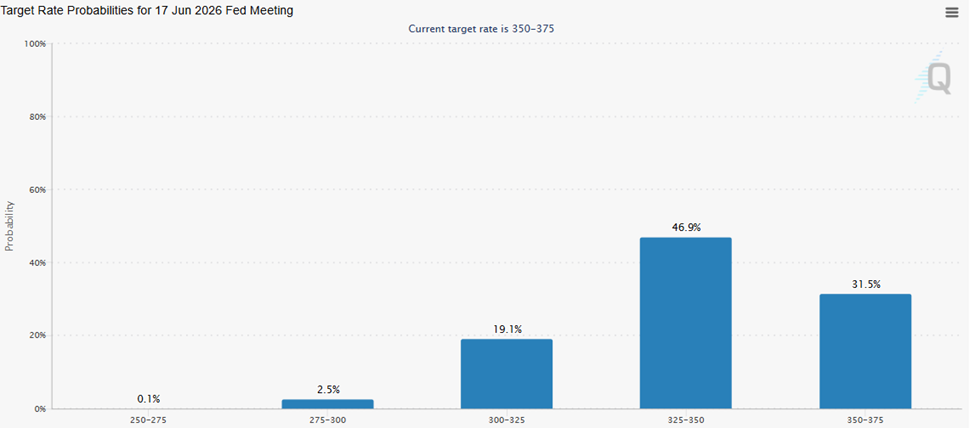
Source: CME Group
That timing fits a Fed that wants additional confirmation inflation is sustainably under control – and more clarity on how much the labor market is actually slowing.
It’s also in line with what legendary investor Louis Navellier expects
Last week, Louis unveiled five predictions for 2026.
Let’s jump to his forecast for rate cuts:
I expect at least two additional interest rate cuts in 2026.
Now, Louis’ prediction did come with an asterisk…
For these two cuts to materialize, Director of the National Economic Council Kevin Hassett must be confirmed as the next Fed Chair.
This outcome isn’t guaranteed.
As we’ve covered in the Digest, the race to replace Jerome Powell has become about far more than rate policy. It’s about credibility, independence, and optics – especially amid growing chatter that President Trump could jeopardize the Fed’s autonomy by installing a loyalist.
That fear has been a recurring theme in financial media: markets don’t want a “puppet chair,” and lawmakers certainly don’t want to confirm one.
And this brings us to the horserace between Hassett and former Fed Governor Kevin Warsh.
Becoming the next Fed Chair requires a tightrope walk
The candidate must successfully convince President Trump that he’ll deliver the rate cuts that Trump wants (to get the nomination) – while convincing markets and Congress that the Fed’s independence will remain intact (to get through the Congressional confirmation process).
In December, Warsh briefly surged ahead because he was viewed as the more “institutionalist” choice. The assumption was that Trump would pick him because he’d have an easier time getting the Congressional nod.
But Hassett quickly adjusted his messaging, offering up what confirmation-minded lawmakers wanted to hear:
The Federal Reserve’s independence is really, really important, and the voices of the other people at the [Federal Open Market Committee], they’re important, too…
The idea that someone isn’t qualified for the job because they are a close friend who’s worked well with the president is something that I think the President rejects.
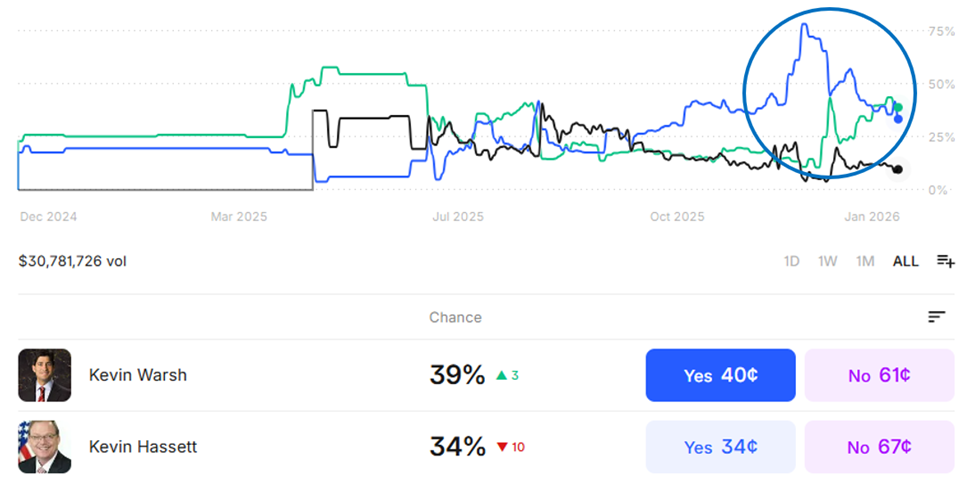
As recently as yesterday, the predictions platform Kalshi had Hassett in the lead at 44% to Warsh’s 37%.
But as I write on Tuesday, those odds have flipped. Warsh is back on top to receive Trump’s nomination at 39% compared to Hassett’s odds at 33%.
Below, I’ve circled how these odds have shifted since early December – now a toss-up.
Louis believes Hassett will eventually be the next Fed Chair due to his ability to walk this tightrope:
Publicly, Hassett has emphasized his independence, telling The Wall Street Journal he would rely on his own judgment and not bow to political pressure when setting interest rates – language that’s all but required to secure confirmation.
At the same time, Hassett has made clear there is “plenty of room” to cut rates in the months ahead, aligning with President Trump’s view that lower rates are needed to support housing and other interest-sensitive sectors of the economy.
We’ll see.
As we highlighted in yesterday’s Digest, the Justice Department has reportedly opened an investigation into Chair Powell, tied to potential inconsistencies in testimony about expenses associated with the Fed’s headquarters renovation. In response – based on concerns around the Fed’s independence – Senator Thom Tillis (R-NC) has said he would block any future Trump Fed nominees until the issue is resolved.
So, for now, whoever Trump picks faces headwinds.
Lots of moving parts here, but at a minimum, we can say that today’s inflation data isn’t a massive headwind for more cuts.
Switching gears to a market warning sign – and what to do about it
My friend Meb Faber of Cambria Investment Management is a respected quant analyst. Like Louis, he relies on historical data and trading algorithms to inform his market moves.
Yesterday, he posted a market warning related to the CAPE Ratio, which stands for Cyclically Adjusted Price-to-Earnings ratio. It’s basically your standard P/E ratio except it uses the 10-year average of inflation-adjusted earnings to smooth out booms & busts.
It’s not a precise market timing tool, but it is very instructive as a predictor of broad returns when based on a multi-year timeframe.
Here’s Meb:
The US CAPE ratio ended the year at 40.
Historical average 10-year real returns when CAPE > 40 across all counties = negative.
Never once has a country’s stock market ended the year above 40 and met the historical 10-year real return average.
This is exactly what Louis has been warning about here in 2026.
When valuations stretch this far, the risk isn’t always a dramatic crash. Many times, it’s something quieter – yet very dangerous.
Louis calls it a “Hidden Crash.”
Historically, when markets become dominated by a narrow group of mega-cap leaders, returns don’t necessarily collapse – they stall and just move sideways over long periods.
That’s what happened during the so-called “Lost Decade” from 2000 to 2009.
That framing lines up with Meb’s CAPE warning. When valuations are elevated and leadership narrows, long-term, buy-and-hold expectations deteriorate, even if prices don’t suffer a knife-edge crash.
Last week, Louis released a market briefing detailing the defensive action steps he’s taking today. If you’re still invested in many of the high-valuation market darlings that have done great over the last two years, I encourage you to check it right here.
Meanwhile, to play offense against a Lost Decade, there’s the Seasonality Tool from our corporate partner TradeSmith
TradeSmith is one of the most respected quant shops in our industry. They’ve spent over $20 million and over 11,000 man-hours developing their market analysis algorithms with dozens of staff working solely on developing and maintaining their software and data systems.
Today, instead of asking, “Is the market expensive?” they’re asking a different question:
Can I find stocks that history suggests are poised to surge, regardless of the broad market’s valuation backdrop?
According to TradeSmith’s CEO Keith Kaplan, the answer is “yes.” Here he is explaining:
Thousands of stocks have historically reliable windows – specific calendar days of each year – when they tend to rise and others when they tend to fall. That includes bull and bear markets, manias and panics, wars, pandemics, and more.
I’m proud to say that, at TradeSmith, we’ve built cutting-edge software to track those patterns.
We’ve also created a rapid-fire trading strategy based on these signals that can pinpoint bullish seasonality windows on 5,000 stocks – to the day. In our backtests, the system’s trades have won with 83% accuracy.
If we are entering a Lost Decade-style environment, shifting from a “buy-and-hold” market approach to a selective, “sniper” strategy could make all the difference to your portfolio.
On Tuesday, January 20, at 10 a.m. Eastern at the Prediction 2026 event, Keith will walk through all the details of the Seasonality Tool and show you exactly how it works.
But if you don’t want to wait, you don’t have to.
You can try it right now on over 5,000 different stocks. All you need to do is register for Tuesday’s event and you’ll get immediate access to the “unlocked” version of this Seasonality Tool.
So, play around with it, then join Keith next Tuesday for a walk through all the bells and whistles.
Putting it all together…
Inflation is behaving, and the Fed appears to be on a path toward potential rate cuts this summer.
At the same time, history shows that markets at today’s valuation levels face significant long-term headwinds – and added uncertainty around the next Fed Chair could introduce unexpected volatility in the near term.
That combination sets the stage for a stock picker’s market where a selective, sniper-style approach is likely to outperform broad index strategies.
Bottom line: staying nimble and opportunistic may be the difference between merely treading water in 2026 and making real progress toward your financial goals.
Have a good evening,
Jeff Remsburg


