Listen to the audio version of this article (generated by AI).
One of history’s greatest achievements depended on suppliers no one would have guessed
It was a life-or-death challenge.
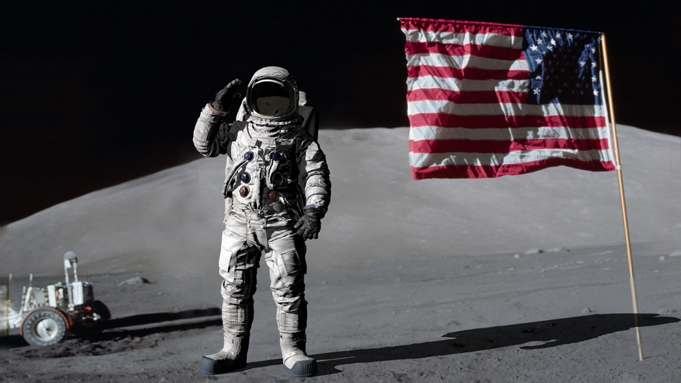
When NASA first aimed to land a person on the moon, they faced numerous challenges, but chief among them was how any person could survive for even a minute on the moon’s surface.
The Moon lacks any breathable air, of course, and surface temperature ranges anywhere between 260 °F during the day and -297 °F at night.
An astronaut’s suit had to supply oxygen, maintain pressure, and protect him from the extreme temperatures. But it also had to be flexible enough so the astronaut could walk, bend, collect samples and operate equipment.
Credit: Merlinus74
NASA’s industrial contractors struggled with the problem, so they turned to an unexpected source.
Playtex.
The International Latex Corporation, the company behind the Playtex brand, was better known for making bras and girdles.
But its engineers and seamstresses understood how to combine strength with flexibility in a way other industrial contractors didn’t.
The company’s seamstresses assembled the suits by hand, stitching together layers with extreme precision. After all, this was a life-or-death assignment.
Eventually, Playtex manufactured the suits worn by every astronaut during Apollo missions 7 through 14 – including the historic Apollo 11 mission, in which Neil Armstrong first walked on the moon.
Everyone remembers Armstrong and his famous first footstep on the moon. But that event wouldn’t have happened without the unexpected specialists who solved a problem NASA couldn’t solve alone.
The Critical Suppliers Behind AI
NASA didn’t turn to Playtex as a favor or a novelty. They did it because they had a specialized need that couldn’t be met in-house.
That situation occurs with nearly every major technological development.
Our technology expert, Luke Lango, has been tracking the suppliers of the AI buildout for his Innovation Investor subscribers.
The AI megatrend kicked off an infrastructure supercycle, which is a multi-year, multi-trillion-dollar transformation of the global computing stack.
The AI hyperscalers – Microsoft (MSFT), Amazon (AMZN), Google (GOOG), and Meta (META) – have committed to spending more than $700 billion in capital expenditures in 2026 alone, up from roughly $400 billion in 2025. That number is rising as the business case for AI investment improves in real time.
To get in on this megatrend, Luke has recommended several suppliers to the hyperscalers. These companies are critical to the AI Buildout.
Here is what Luke wrote about one of them – SandDisk Corp. (SNDK) – when he recommended it earlier this year:
Investors have focused almost entirely on compute — GPUs, accelerators, and custom chips. But the storage side of the equation is equally critical.
That is where SanDisk comes in.
SanDisk became a pure-play NAND flash company after spinning out of Western Digital in early 2024. NAND flash is the storage technology underlying nearly every modern digital system — from smartphones to enterprise data centers.
In the AI era, storage demand is exploding.
Training large language models requires storing enormous datasets that can reach multiple petabytes in size. Running those models requires rapid access to model weight files that can exceed hundreds of gigabytes.
As models grow larger and inference demand scales, storage demand grows alongside it.
The sector endured a severe downturn in 2023–2024 due to oversupply and collapsing prices. That cycle is now reversing as supply discipline improves and AI-driven demand accelerates.
This creates a powerful setup: a company benefiting from both cyclical recovery and secular AI demand growth.
Since the recommendation in March, the stock has more than doubled.
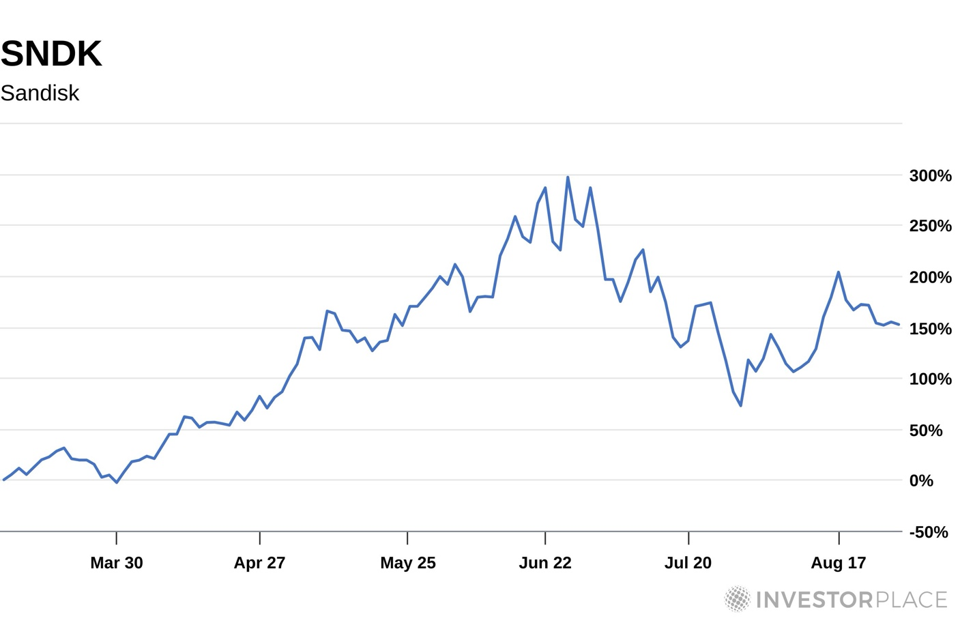
Despite that runup, it’s still trading below Luke’s buy limit.
That’s the kind of performance you can see when you own a critical supplier in the AI supply chain.
The Lesson for Investors Today
A company can have a bold vision and receive all the headlines. But behind all that stands a patchwork of people and brands supplying materials, equipment and knowledge to help make that larger vision a reality.
And now, Elon Musk is preparing what Luke believes could be the most ambitious undertaking of his career.
Luke believes Musk is moving toward a convergence of Tesla (TSLA), SpaceX (SPCX), xAI, X, and the other pieces of his technological empire.
He calls it “XPANSE.”
Musk’s larger goal is to combine his capabilities in artificial intelligence, rockets, satellites, robotics, energy, and manufacturing around one sweeping vision.
Part of that vision involves placing enormous AI data centers in orbit, where they could draw nearly continuous power from the sun without consuming valuable land or millions of gallons of cooling water.
Another piece is Musk’s proposed “Terafab” – a 100-million-square-foot semiconductor complex in Texas that could dramatically expand America’s ability to manufacture advanced chips.
Tesla’s Optimus robots could eventually help automate much of the work.
Still, for all his success as one of the true innovators of our time, even Musk cannot build this next technological empire alone.
Just as NASA needed an unlikely lingerie company to help put astronauts on the moon, Musk will need outside specialists to supply the aerospace hardware… semiconductor equipment… rare earth elements… and powerful magnets that his plans require.
And Luke believes those suppliers could offer investors an even greater opportunity than Musk’s famous companies.
After all, a new project of this magnitude would be enormous for Tesla or SpaceX. But a single major contract could completely transform a small, little-known supplier.
That’s why Luke recently recorded a special presentation revealing Musk’s larger plan and the three little-known companies he believes are best positioned to help build it.
He explains why Musk may be preparing to bring the major pieces of his empire together… why this could create an enormous new supplier pipeline… and why one $15 aerospace stock could potentially become a major SpaceX partner.
Click here to watch Luke’s presentation and discover all three companies.
Neil Armstrong rightfully earned his place in history – but without the unexpected specialists behind his spacesuit, he never takes that first step.
Similarly, Musk will undoubtedly receive glowing headlines if his sweeping vision becomes a reality. But he’ll only get there with the help of an extraordinary network of suppliers. And Luke believes some of the greatest investment rewards could go to those specialists quietly helping him build it.
Click here to see the presentation now.
Enjoy your weekend,
Luis Hernandez
Editor in Chief, InvestorPlace


