
Listen to the audio version of this article (generated by AI).
As I write on Thursday, Wall Street is under pressure again from several angles.
In bonds, the 10-year Treasury yield is up to 5.14% – its highest level in nearly 19 years. Meanwhile, the 30-year Treasury yield just notched its highest level since 2004 – 5.43%.
Over in the oil patch, Brent is up 3%, pushing toward $107, and West Texas Intermediate is 3.5% higher, trading above $95 once again.
Shifting to the Fed and rates, Philadelphia Fed President Anna Paulson is the latest in a growing number of policymakers to suggest more rate hikes could be coming. This morning, she said:
Looking ahead, if conditions evolve as I expect, some modest further tightening may be warranted.
And in geopolitics, there’s little evidence that talks between the U.S. and Iran are making meaningful progress toward ending the war in the Middle East. Earlier today, Houthi militants fired missiles at Saudi Arabia.
Put it all together, and it’s enough to get the bears salivating. A risk-off mood like this tends to hit the crowded trades first – the names that have run the hardest and drawn the biggest crowds. And no trade has run harder, or drawn a bigger crowd, than AI.
Which brings us to one bear in particular who’s likely enjoying this morning – Michael Burry.
The investor made famous by the movie The Big Short has spent more than a year building his case against the AI trade. A handful of names sit especially high on his hit list – and near the top is Micron Technology (MU), the memory-chip maker at the heart of the AI data center buildout.
He’s been shorting it…again. And as of this week, on an even bigger scale.
On Tuesday, Burry said he added to his Micron short “in some size.” His reasoning is that memory makers have gotten egregiously ahead of themselves and the cycle is about to turn.
Here’s Burry, from his Substack:
They really ran up to ridiculous prices for what they are and will sell down intensely on the other side.
He’s pointing to warnings of a coming memory glut – including comments from Acer’s CEO about rising Chinese supply – and arguing that the shortage driving Micron’s record profits was a temporary supply hiccup, not real, durable demand.
How do we respond when Wall Street’s most famous bear doubles down?
Now, Burry is a genuinely brilliant, deeply original researcher. His housing call wasn’t a lucky guess. He read the mortgage-bond fine print that no one else on Wall Street bothered to open, and he was spectacularly right.
But being right once, at the perfect moment, is not the same as being right on timing ever since.
Consider the track record since The Big Short:
He shorted Tesla (TSLA) in 2021, just as the stock kept climbing…
He posted a one-word warning – “SELL” – in January 2023, right before the market went on to gain more than 20% that year…
He loaded up on puts against the S&P in 2023 that he had to unwind as stocks kept rising…
And in late 2025, he closed his fund and returned money to investors, conceding his read on value had been out of step with the market – this after a stretch in which the Nasdaq had climbed nearly 70%.
To be fair, memory is a famously cyclical business, and his bearish call may be proven right. But as the legendary fund manager Peter Lynch put it:
Far more money has been lost by investors preparing for corrections, or trying to anticipate corrections, than has been lost in corrections themselves.
And that points us to the risk for investors listening to Burry…
Without a reliable way of knowing when, if ever, his loudly proclaimed reckoning will arrive, a phrase like “ridiculous prices” isn’t really a timing tool. It’s a disposition – a blanket posture. And a blanket bearish posture, however intellectually honest, has a poor track record of making anyone money.
So, is there a better way to decide what to do with a stock like Micron than betting on one man’s conviction, and then waiting – sometimes for years – to find out if he was right?
There is. But it doesn’t come from a Micron bull. It comes from a system.
What the numbers actually say
Regular readers know legendary investor Louis Navellier isn’t a “gut feel” kind of guy – he’s a quant.
For four decades, he’s screened stocks on one thing above all: measurable, fundamental strength. Strong earnings, strong sales, fat margins, rising analyst estimates, real buying pressure, and so on.
He hard-coded that discipline into a tool he calls Stock Grader, which runs more than 6,000 stocks through eight separate measures and boils each down to a single letter, A through F.
And here’s what Louis’ system says about the stock Burry is busy shorting:
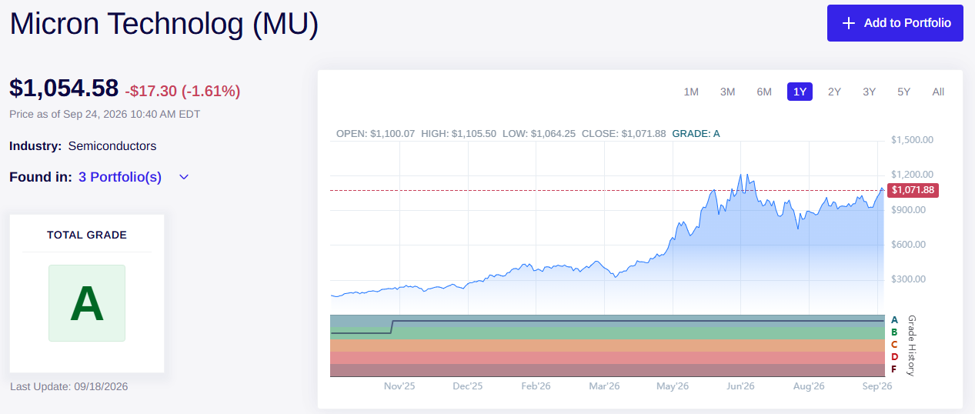
An A.
But let’s dig into why…
Part of this grade rests on fantastic fundamentals you’d expect from a booming company, driven by the AI buildout.
Louis’ research highlights that Micron’s fourth-quarter revenue is expected to jump nearly 349% year-over-year to roughly $50.8 billion, with earnings surging to more than $31 per share. And analysts have revised their estimates almost 34% higher over just the past three months.
But there’s also Louis’ Quantitative Grade – his measure of institutional buying pressure. Or, in his own words, “following the money.”
Burry’s valuation argument – even if we say it’s right – still can’t account for the money that’s been flooding in. For example, this past Tuesday, the very day he was adding to his short, Micron closed up 5% on the session and up 14% for the month.
Burry would likely brush that off, saying that eventually the market will face the harsh truth he’s arrived at already.
But such a perspective brings us to the core difference between Burry and Louis – it’s a difference that all investors will have to wrestle with…
Which market lens will you adopt?
Burry decides what the market should do, bets on it, then waits – sometimes for years – for the world to agree.
Louis doesn’t wait, and he doesn’t argue. He follows what the numbers are already doing, and he lets them tell him when to change his mind – if at all.
Speaking as someone who owns Micron, I’ve chosen Louis’ approach – mostly because I don’t want the burden of perfectly predicting whether this memory cycle busts like the ones before it or runs for years on the back of AI. I prefer to follow the evidence and adjust when that evidence changes.
If Burry is eventually right and Micron’s fundamentals and money flows start to crack, the grade will slip – and the system will tell me to step aside, no crystal ball required.
And if Micron keeps climbing? I’ll happily ride those gains while Burry keeps proclaiming the top.
That’s the whole point of trusting a disciplined process over any one person’s conviction, no matter how brilliant that person is.
Which dovetails into what Louis has planned for next Tuesday…
The engine gets an upgrade
You just watched Stock Grader do its job – rendering a cold, numbers-only verdict on the very stock Wall Street’s most famous bear is betting against.
But now, the Stock Grader is about to get even better…
As I introduced in yesterday’s Digest, next Tuesday, Sept. 29, at 10 a.m. ET, Louis is rolling out the biggest overhaul to Stock Grader he’s ever made – a change he believes could multiply the gains on his top-graded names by anywhere from two to six times going forward.
And he’s not doing it solo. He’s bringing in Marc Chaikin, founder of Chaikin Analytics and a fellow numbers-first investor, because the two of them are seeing the same rare setup taking shape before the Nov. 3 midterms.
Better still, you won’t leave their event empty-handed – Louis and Marc will hand you four names you can act on right away – two they’d buy, two they’d steer clear of.
You can reserve your seat for this free event right here.
But circling back to Micron, is Burry right about a glut of memory taking it down?
Let’s circle back to one piece of the Micron question – the memory glut that Burry points toward.
It’s real. Acer’s CEO isn’t wrong that commodity memory – the everyday DRAM that goes into laptops and desktops – is seeing rising supply, much of it from newer Chinese producers. That’s the classic PC-driven memory cycle, and it has always run boom to bust.
But that’s not the type of memory that’s minting Micron’s record profits.
The demand tied to AI runs through a different, higher-end product: high-bandwidth memory, or HBM – the specialized chips stacked inside AI accelerators. And on that side of the business, there is no glut.
Micron and rival SK Hynix (SKHY) have said their entire 2026 HBM output is effectively sold out. SK Hynix’s CEO has gone so far as to suggest the crunch could last for years – long enough that some in the industry now argue AI has broken the old memory bust cycle entirely.
And here’s the twist that makes it interesting…
Building all that HBM for AI eats up roughly three times the factory capacity of ordinary memory. So, the very AI boom Burry is betting against is part of what’s draining the commodity supply – and creating the glut he’s pointing to on the low end.
Now, Burry is far too smart to have missed any of this. He’d have a ready answer – probably, that “sold out” is exactly what the top of every cycle looks like, that HBM is still memory and memory is still cyclical, and that he isn’t really betting against one chip so much as the entire AI-demand boom he believes is built on sand.
He might be right.
Which leaves us with a question…
We have two very smart analysts making opposite bets, and no way to know how it resolves until…well…it resolves. So, which market stance do you want to guide your positioning? A conviction you must defend for years while you wait to be proven right? Or a system that simply follows the numbers and the money flows and adjusts when they adjust?
One final irony
Burry now publishes under the banner “Cassandra Unchained.”
But all you mythology lovers will remember that Cassandra was cursed to make prophecies that were true and that no one believed. Burry’s problem has been closer to the opposite. People listen to his market prophecies – the financial media loves to quote him. But he just keeps being early – sometimes by years. Of course, in investing, “early” can be a polite word for “wrong.”
So, will Micron and the memory cycle go bust? Or will Burry?
Time will tell. But I won’t make the mistake of trying to guess when. Instead, I’m letting Louis’ numbers tell me when to hold and when to fold.
If you’re interested in having that same edge, join us next Tuesday.
Have a good evening,
Jeff Remsburg
(Disclaimer: I own MU)


