
Core PCE runs hot… the Nasdaq is approaching a bear market… ANT follows the IPO pattern… where Eric Fry is investing today… Brian Hunt shows that the U.S. consumer is alive and well
Editor’s Note: Our InvestorPlace offices are closed tomorrow and Friday for the long Thanksgiving weekend. If you need help from our Customer Service team, they’ll be happy to assist when we reopen on Monday.
Here in the Digest, we’ll be taking off tomorrow, but we’ll return on Friday.
From all of us here at InvestorPlace, we hope you have a wonderful Thanksgiving with friends and family.
The October Personal Consumption Expenditures (PCE) report came in hot this morning
Headline PCE inflation clocked in at 3.8% year-over-year, right in line with what economists expected and up from 3.7% in September.
Core PCE, which strips out food and energy, came in at 3.3%, 0.1 percentage point hotter than the 3.2% economists expected. That’s the highest core reading since 2023.
The markets aren’t taking it well…
As I write on Wednesday, the Dow is down 1.6%, the S&P 500 is off 2.5%, and the Nasdaq is off almost 4%.
Hot inflation is only part of the story. The AI selloff is back (more on that below), and the Trump administration has proposed new 20% tariffs on China, the European Union, and 12 other trading partners. They’d take effect only after hearings and a comment period, probably not until January at the earliest, but they’re a new worry and potentially inflationary pressure – and another reason for Wall Street to press the “Sell” button today.
Meanwhile, a separate report this morning showed third-quarter GDP revised up to a 4.3% annualized pace, the fastest in three years.
So, a stubbornly hot core inflation number arriving alongside that kind of GDP growth is the combination the Federal Reserve least wants to see, which means one thing…
Get ready for another rate hike in two weeks
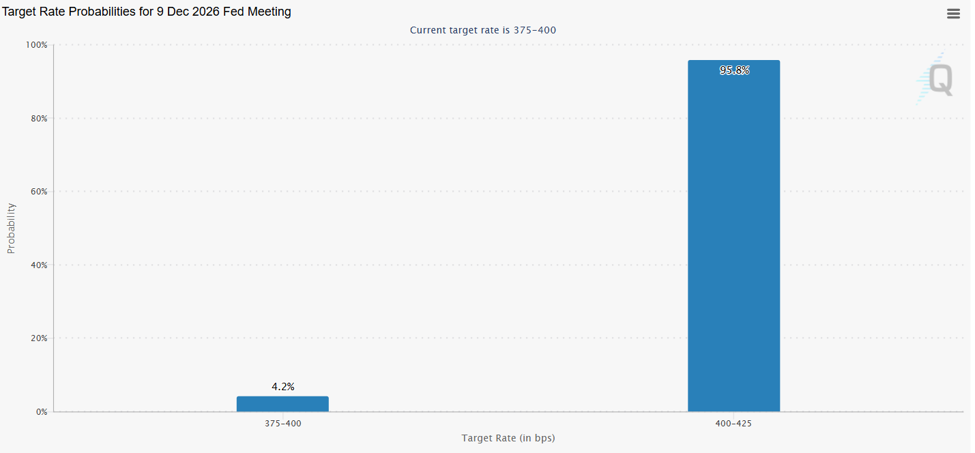
Policymakers raised rates 25 basis points in September, their first hike since July 2023, skipped October, and meet again on December 8 and 9.
As I write, CME FedWatch puts the odds of a quarter-point hike at about 96%.
Source: CME Group
The reality is that money is getting more expensive – and there’s nothing on the horizon pointing toward a lower-rate environment anytime soon.
The 10-year Treasury yield hit 5.31% on October 5, its highest level since 2002. Among the drivers were soaring energy inflation, heavy corporate debt issuance, and widening budget deficits. Though it’s falling on this morning’s report, it still sits at 4.82% as I write.
Higher lending costs matter most for borrowers who need enormous amounts of capital, and no group needs more cash than AI – a sector where many of yesterday’s darlings are already in a brutal bear market.
For example, Nvidia Corp. (NVDA), the poster child for AI, is down about 40% since its October high. Meanwhile memory giant Lam Research Corp. (LRCX) is down 59% since late June. And neocloud company Nebius Group NV (NBIS) has imploded 73% since mid-June.
The broad Nasdaq Composite is now approaching an official bear market (a decline of 20% or more since the most recent high), down about 18% from early October.
Higher interest rates will only add to the pressure. Elevated yields raise the bar for every dollar borrowed to fund it, which means the companies spending the most are the ones with the most to prove.
And that brings us to the biggest IPO of all time, which came just last week…
Checking in on Anthropic in the wake of its IPO
As I write on Wednesday, Anthropic PBC (ANT) is trading at $76.14. That’s 8% below the $83 IPO price and 22% below where shares closed their first day of trading.
Here’s a quick recap to make sure we’re all on the same page…
ANT priced last Wednesday night at $83, above its original $70 to $78 range, in a record $81.3 billion IPO. Shares opened Thursday at $111.50 and touched roughly $115 before fading to a first-day close of $97.17. By Friday, they were down to $88.30 – and have kept falling since.
That’s the pattern I flagged in last week’s Digest when we recommended readers be cautious about buying into ANT on its first day of trading.
Drawing on University of Florida Professor Jay Ritter’s 45-year IPO database, I noted that the average IPO closes its first day about 19% above its offer price, but that investors who buy at that first-day close have trailed the market by roughly 20.5% over the following three years.
Anyone who bought ANT at Thursday’s $111.50 open is now down about 32%. Anyone who bought at the $97.17 close is down about 22%. And even the institutions that got shares at the $83 offer price are now underwater.
Now, all that said, I’ll hold off on a full victory lap. Ritter’s figure is a three-year number and we’re basically one week into trading, so nothing is settled. But the early pattern is the textbook one, and ANT has now slipped below the very line I drew last week to separate a strong debut from a weak one: the offer price.
Some of the reasons behind the selling pressure aren’t hard to find
According to The Motley Fool, Anthropic’s third-quarter revenue reached $16.96 billion, up 47% from the prior quarter. While that sounds great, it’s slower than the previous sequential jump.
Meanwhile, the company has swung back to an operating loss, and it has committed to roughly $895 billion in spending, about half of it by 2030.
That’s a lot of future bills in a world where, as we just saw, money is getting more expensive. And it’s the exact tension our global macro investing expert Eric Fry, editor of The Speculator, just zeroed in on.
Here’s Eric:
In the first half of 2026, [Anthropic] spent nearly $9 billion on computing capacity and infrastructure – almost four times what it spent in the same period a year earlier.
Those costs continued to climb in the third quarter, when the company reported another $5 billion in computing expenses. Its operating results went from a $974 million profit in the previous quarter to a $567 million loss.
Pulling back to evaluate the wider AI landscape, Eric says that the question isn’t whether AI will change the world – at this stage, it’s who will get rich along the way and who will get stuck paying the bills. After all, building the AI Revolution and profiting from it are two very different things.
Eric’s concern is twofold: 1) the return on all that spending, and 2) the cost of financing it.
On the second point, he writes:
Even if demand for AI remains strong, companies still need to borrow money to build the infrastructure. But lenders are becoming more cautious about financing these projects…
If borrowing becomes harder or more expensive, some developers may have to delay or scale back projects. That could mean fewer orders for the chipmakers and equipment suppliers counting on the AI buildout.
So, what’s Eric’s preferred way to play AI today?
Eric’s takeaway isn’t to abandon AI. It’s to look beyond the companies building it.
As we’ve been tracking here in the Digest over the last week, Eric has been urging investors to recognize the difference between building AI and putting it to work.
He believes the next big winners could be the businesses using AI to improve operations, cut costs, and boost profits – not the ones spending billions building data centers or training massive AI models.
One example he’s found is in healthcare: a company that uses AI to pull together scattered patient records, lab results, and physicians’ notes, and that already has connections to more than half of all U.S. oncologists and more than 65% of the country’s academic medical centers.
Eric revealed the company’s name and ticker in his free Life After Nvidia presentation on Monday. If you missed it, click here to watch the free replay.
Returning to ANT…
Before we move on, let’s close the loop here.
I think ANT is a revolutionary company – and could be a fantastic investment in the years to come. The questions are about price and timing, and history offers two guidelines for us.
First, watch the supply of shares…
ANT’s lockups release in waves, starting on Day 1 for some insiders and running from about mid-December into early February for other holders.
A study of 1,948 lockup expirations in The Journal of Finance found stocks lagged the market by about 1.5% around expiration, with trading volume up roughly 40%.
Second, show greater patience than the average investor…
Meta Platforms Inc. (META) priced at $38 when it debuted as Facebook in 2012, bottomed at $17.55 that September, and didn’t climb back above $38 until July 2013. SpaceX Technologies Corp. (SPCX) fell more than 50% from its $226 peak to a low near $105 this summer.
This isn’t a call on when to buy ANT. It’s what history suggests watching as you make that decision considering your own temperament, timeframe, and goals.
We’ll check back in on ANT in a future Digest.
The consumers wrestling with this morning’s inflation data
Next to this morning’s PCE data, we also got color on the U.S. consumer.
The same report showed personal spending up 0.3% in October, which merely matched the pace of price increases, so inflation-adjusted spending was little changed. Income, meanwhile, surged 0.7% versus the 0.4% economists expected, and the personal saving rate rose to 4.1%.
In other words, households took a breather in October, pulling back on motor vehicles, furnishings, restaurant meals, and hotel stays, according to Bloomberg. But real disposable income jumped by the most since January, so they appear well positioned for the holidays.
That nominal-versus-real distinction matters right now. With inflation running at 3.8%, a healthy-looking spending number can partly reflect higher prices rather than more goods and services bought. October is a good example: Spending rose 0.3%, but so did prices.
It’s also a reminder of why the Fed has been hiking. Demand is running hot, with third-quarter consumer spending revised up to a 4.2% annualized pace. A resilient consumer and stubborn inflation are two sides of the same coin.
One of our experts who has been arguing the consumer is stronger than the headlines suggest is Senior Analyst Brian Hunt. And in yesterday’s issue of Money & Megatrends, he points to a fresh signal: Target Corp. (TGT).
The retailer hit a new one-year high on Tuesday, one of the few large-cap stocks to do so. Here’s Brian on why that matters:
Target’s ubiquitous presence in American shopping life makes its stock price trend a good “real world” economic indicator.
This is because Target’s fortunes rise and fall with America’s ability to make money and spend it on food, clothes, toys, electronics, and household goods.
Target isn’t alone. Over the past two months, Brian’s research notes have flagged strength in Visa Inc. (V), Mastercard Inc. (MA), Best Buy Co. (BBY), Williams-Sonoma Inc. (WSM), and the hotel and resort operators.
Put them together and here’s his read:
Right now, this indicator… says the American consumer is doing much better than the mainstream media would have you think.
Does the U.S. economy have imbalances, distortions, and risks?
Absolutely. It always does. But those big problems are currently being overwhelmed by the even bigger positives.
Brian isn’t ignoring the risks, and neither should we. A consumer who keeps spending is good news for earnings, but it’s also one reason the Fed may have to keep tightening. We’ll keep watching how the two interact heading into the December meeting.
In the meantime, if you’d like to see Brian’s full case, click here to read yesterday’s issue of Money & Megatrends.
And to catch more analysis and free stock recommendations from Brian, his Money & Megatrends issues deliver actionable insights loaded with stock ideas every day the market is open – all at no cost. You can sign up right here.
Wrapping up
Hot inflation and a Fed still on the hiking path mean money won’t be getting cheaper anytime soon – not good news for a shaky AI trade that’s already nearing a bear market.
We’ll keep tracking all of it when we return on Friday. Until then, from everyone here at InvestorPlace, have a wonderful Thanksgiving.
Have a good evening,
Jeff Remsburg


