Listen to the audio version of this article (generated by AI).
Before we begin, a reminder that our InvestorPlace offices are closed today in honor of Labor Day.
If you need help from our Customer Service Department, they’ll be happy to assist you when we reopen tomorrow.
Have a wonderful Labor Day!
Elon Musk doesn’t merely want to build a better robot…
He wants to manufacture humanoid robots by the millions.
Our technology expert, Luke Lango, believes the scale of that ambition may be more important than the robot itself.
Today, Luke explains why humanoids finally appear to be moving beyond impressive demonstrations toward something far more consequential: becoming useful workers. If that transition continues, companies like Tesla could eventually need to manufacture enormous numbers of them.
But here’s the twist for investors – every robot comes with a shopping list…
Cameras. Sensors. Chips. Motors. Actuators. Magnets. Batteries. Precision components. This has Luke hunting for the suppliers Musk will have to pay if Optimus moves toward mass production.
This is also a major focus of Luke’s free workshop this Wednesday, September 9, with Louis Navellier and Eric Fry. They’ll map Musk’s expanding empire, identify the technologies he still needs from outside suppliers, and reveal several companies they believe could benefit – including one ticker Luke will give attendees completely free. You can reserve your seat right here.
The robots may get the headlines. But if Musk’s vision works, some of the most interesting opportunities could belong to the companies supplying the parts. Here’s Luke with the details.
Have a wonderful Labor Day!
Jeff Remsburg
In 1961, a General Motors factory in New Jersey welcomed a new employee.
He didn’t take lunch breaks, call in sick, or complain about working next to molten metal all day. His name was Unimate, and he was the first industrial robot ever put to work on a factory floor.
“Robot” might actually be generous by today’s standards.
Unimate was basically a giant mechanical arm. The first ones followed instructions stored on a magnetic drum, grabbing scorching-hot pieces of metal from a die-casting machine and stacking them for workers farther down the line. Later deployments expanded into assembly-line welding and metalworking
It could perform these dangerous, repetitive jobs over and over again without getting tired, injured, or bored. That was enough.
General Motors installed more of them, other automakers followed, and today millions of industrial robots weld car bodies, paint panels, move pallets, package products, and assemble electronics around the world.
But there’s a reason most of them don’t look anything like C-3PO.
Source: iStock/imaginima
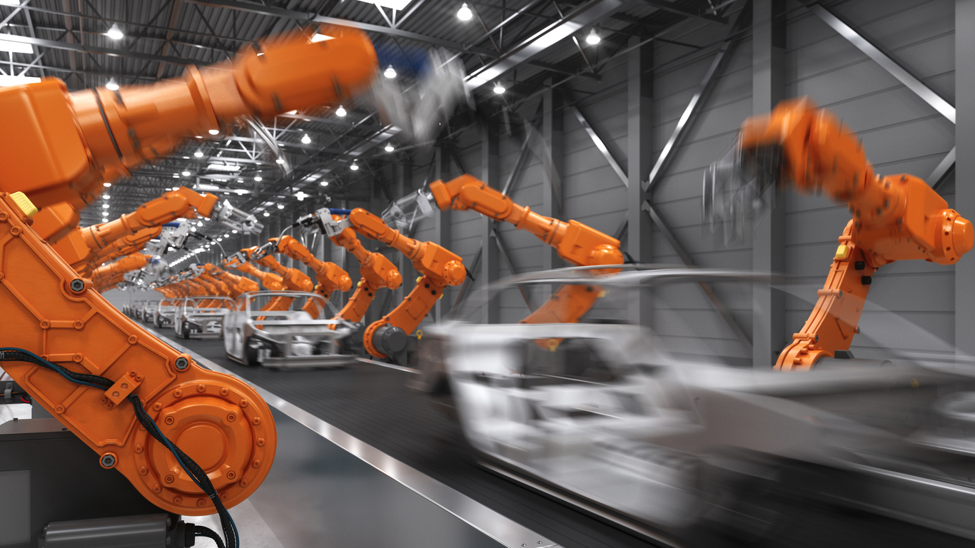
Today’s industrial robots excel at repetitive tasks in workplaces designed around them.
Industrial robots work because we build the factory around them. We bolt them to the floor and have them make the same movement thousands of times.
Change the job or the environment and things get much harder.
Humanoid robots flip that idea around.
Instead of redesigning the workplace around a specialized machine, engineers are trying to build machines that can operate in workplaces already designed for us – with our stairs, doors, shelves, tools, workbenches, steering wheels, ladders, and countless other things built for human arms, legs, hands, and fingers.
For decades, that was mostly science fiction, but AI is finally changing the economics. That’s why I want to talk to you about robots today.
I’ll show you evidence that humanoids are beginning to move beyond flashy demonstrations and into real factory work… why Wall Street believes the cost of using them could soon compete with human labor… and, most importantly for investors, why Elon Musk’s plan to mass-produce Tesla Inc.’s (TSLA) Optimus humanoid could create enormous opportunities outside Tesla itself.
Musk may want to build Optimus by the millions, but he can’t build everything that goes inside them.
And so, I’ve spent months figuring out who he’ll have to pay.
When a Robot Starts Earning Its Keep
This isn’t entirely theoretical anymore.
BMW recently spent 10 months testing a humanoid robot from Figure AI at its Spartanburg, South Carolina, factory. According to BMW, the robot moved more than 90,000 components and logged roughly 1,250 hours supporting production of more than 30,000 BMW X3 vehicles.
That doesn’t mean today’s humanoids are ready to replace people across the factory floor. They’re still expensive and slower than people at plenty of jobs. Their hands aren’t nearly as capable as ours, and they require maintenance, charging, software, training, and integration.
But they don’t have to be better than people at everything. They have to become economically useful at some things.
And that’s where the numbers get interesting.
JPMorgan recently estimated that a humanoid could eventually cost around $10 to $12 per hour to operate in an industrial setting.
Now, there’s an important catch. JPMorgan also estimates today’s humanoids are considerably less productive than people. It can take roughly two humanoids to equal the output of one human.
Even so, two robots at $10 to $12 per hour gets you to roughly $20 to $24, compared with the approximately $30 hourly cost JPMorgan assigns to a human worker.
And JPMorgan expects that productivity gap to narrow significantly by 2030. To me, that’s the potential crossover point.
We know engineers can make a humanoid walk across a stage, pick up a box, and dance for a YouTube video.
Now we need to find out whether a company can put one to work and save money. If the answer increasingly becomes yes, this market could move very quickly.
Nvidia Corp. (NVDA) CEO Jensen Huang recently said robotics used in manufacturing could eventually address a $50 trillion industry.
I have no idea whether the ultimate number will be $50 trillion. Neither does Jensen. But it doesn’t have to be.
If humanoids become economical for even a small fraction of the world’s factory and warehouse work, somebody is going to have to manufacture an enormous number of robot bodies.
And every one of those humanoids comes with a shopping list.
Elon Musk’s Robot Shopping List
This is where Elon Musk gets interesting to me.
He’s talked about eventually producing Optimus by the millions, with a long-term price target around $20,000 to $30,000 per robot.
While Musk has certainly missed ambitious targets before, think about what Tesla will have to do even to try.
Look at your own hand.
Picking up a coffee mug seems effortless. But your eyes first locate it. Your brain judges its distance and shape. Your shoulder and elbow move your arm into position. Your fingers adjust their grip. Nerves tell your brain whether you’re squeezing too hard or too softly.
A humanoid robot has to reproduce that process using cameras, sensors, processors, motors, actuators, chips, software, and precision mechanical parts. Then it has to do the same thing with its legs, feet, arms, torso, and head.
At mass-production scale.
Musk likes to talk about “the machine that makes the machine.” Inventing a great product is one problem, but figuring out how to manufacture millions of them quickly, reliably, and cheaply is another.
Tesla learned that lesson with electric vehicles. Now it’s going to have to learn it again with robots.
This is the part of the opportunity I believe most investors are missing.
Tesla can’t make every camera, sensor, chip, motor, rare-earth magnet, battery component, or piece of manufacturing equipment Optimus will require. Even a company as vertically integrated as Tesla has to buy specialized technology from outside suppliers.
If Musk wants to make millions of robots, those suppliers could suddenly find themselves selling into one of the fastest-growing manufacturing markets in the world.
We’ve seen this dynamic before.
Nvidia became the defining stock of the AI infrastructure boom because it sold the chips everybody needed to build AI. The robotics boom will create its own group of indispensable suppliers.
That’s why when I study Tesla, xAI, Space Exploration Technology Corp. (SPCX), and the rest of Musk’s empire, I’m always asking: What does Musk still have to buy… and who will be cashing those checks?
Following that question has been one of the best idea generators of my career.
Thirty-three recommendations I’ve made connected to Musk’s businesses went on to double or better at their highs, with a handful producing gains measured in the thousands of percent.
Of course, I’ve gotten plenty of calls wrong over the years, too. Every investor does.
But when Musk decides to build something at enormous scale, I’ve learned to pay very close attention to the companies supplying him.
And right now, Optimus is creating a whole new shopping list.
I’ve spent months mapping the pieces Musk controls, the pieces he still needs, and the companies I believe could benefit as his Physical AI ambitions move from prototypes and flashy demos toward mass production.
On Wednesday, September 9, at 8 p.m. Eastern, I’m going to walk you through that research at a special free InvestorPlace workshop. You can reserve your spot for that event by going here.
My colleagues Louis Navellier and Eric Fry will join me. And we’re going to work through Musk’s empire layer by layer, identifying the technologies he controls and the outside companies we believe are best positioned to fill the gaps.
I’ll also give you the name and ticker of one company from my research completely free.
More than 60 years ago, Unimate proved a robot could earn its keep doing one dirty, dangerous job at a GM factory.
The opportunity today is much larger.
We’re finally getting closer to robots that can work in environments built for people. And if Elon Musk succeeds in building them by the millions, he’ll need a supply chain capable of building millions of eyes, hands, joints, motors, sensors, and other components right along with them.
That’s the supply chain I want to own.
Reserve your seat for September 9 right here.
Sincerely,
Luke Lango
Senior Investment Analyst, InvestorPlace
P.S. Luke makes some very good points here. The robots may grab the headlines, but the bigger investment opportunity could belong to the companies supplying the parts Elon Musk can’t—or simply won’t—make himself. That kind of second-order thinking is one reason Luke has been so successful at spotting emerging technology trends early. I strongly recommend joining him on September 9. Click here to get on the list and reserve your seat.


