Listen to the audio version of this article (generated by AI).
AI’s canary starts coughing… Luke’s Peak Watch ticks higher… when the boom turns, who gets hurt?… Corning vs. Humana, revisited… the two-week gauntlet to November 4
Last week, Elon Musk summed up the AI trade’s latest scare in a single word…
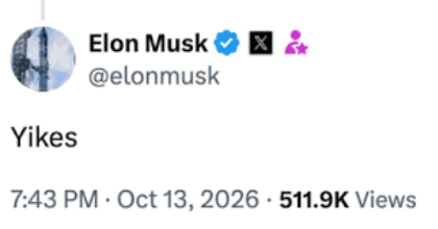
He was reacting to CoreWeave Inc. (CRWV), the “neocloud” that rents out banks of Nvidia (NVDA) chips to AI companies.
Within days, some of CoreWeave’s bonds traded below 80 cents on the dollar, and the yield on its 2031 notes briefly topped 16%. That’s distressed-debt territory.
The stock lost about a quarter of its value on the week as panicked investors fled.
So, what sparked the fear?
CoreWeave is funding its growth the way much of the AI buildout now is – with borrowed money. It’s carrying roughly $52 billion in loans and lease obligations.
Analysts expect CoreWeave to generate about $13 billion in revenue this year, against planned capital spending of $35 billion to $39 billion and a projected loss of more than $2 billion.
This isn’t great math for investors. And many on Wall Street fear that the company won’t earn enough on all that spending to service its debt.
Last Wednesday’s hot inflation report made it worse by raising the odds of another Fed rate hike – which means pricier borrowing ahead. By Thursday, the cost of insuring CoreWeave’s debt against default had hit a record. Protecting $1 million of its bonds would cost roughly $119,500 a year.
Stepping back, when lenders treat a prominent AI player like a credit risk, that gets our attention – and Luke Lango’s.
Here’s Luke, our technology expert and the editor of Innovation Investor:
Bond markets tend to sniff out trouble before stock markets do.
So, if the bond market is right, what comes next for the AI boom? And more importantly, how should you be positioned?
How late in the AI boom are we?
Last week in his Innovation Investor service, Luke introduced a tool designed to answer that question. Here he is explaining his rationale:
Every great boom ends. The railroads did, the dot-coms did, and someday the AI buildout will too.
The problem is that nobody rings a bell at the top.
It’s called the Peak Watch Checklist. It tracks 13 warning signals across three stages a boom moves through on its way down: Froth, Cracks, and Confirmation. Each signal comes with a specific “tripwire” that would flip it to red.
So, where are we?
Luke says the Froth stage is fully red. Big Tech is borrowing to fund AI spending, suppliers are financing their own customers, and stock issuance is setting records. And in Monday’s Daily Notes, the reading moved in the wrong direction.
Here’s Luke:
Our Peak Watch Checklist now has 7 of 13 signals lit, up from six last week.
Credit concerns have spread beyond CoreWeave, while TSMC’s selloff after strong results pushed “good news gets sold” into Flashing territory.
Most signals that would confirm a bust remain clear. We’re still in a late-cycle boom, where some of the biggest gains can happen.
As Luke clarified at the end, he isn’t yet calling a top…
Chips are still selling out, and North American data-center vacancy sits at just 1.4%. Luke’s own long-term math even gives a 60% probability that AI revenue ultimately justifies the spending – though his base case doesn’t see full payback until around 2039. That’s a long runway for financing scares that can rattle your portfolio.
So, perhaps the better question to ask isn’t “when?” but rather, “who?”
Specifically, when the boom turns, who gets hurt – and who survives?
Back to Luke:
We favor companies with pricing power, strong cash flow, and productive uses for AI.
Businesses borrowing heavily to build capacity for others face greater risk.
If revenue disappoints, spending will fall, and the damage will land hardest on those that overbuilt.
That last line is the bridge to today’s most important idea. It comes from our global macro expert Eric Fry, editor of The Speculator – who thinks we could be watching history repeat itself.
Corning built the internet – but Humana used it
Rewind to December 2000.
The dot-com bubble had begun to deflate, but investors still loved the companies building the internet’s plumbing. Corning (GLW), which made the fiber-optic cable carrying all that traffic, was a market darling.
That month, Eric warned investors away from Corning. Its stock went on to fall 87%.
That same month, he recommended Humana (HUM), a beaten-down health insurer that was quietly using the internet to make its business more efficient. Humana eventually gained more than 4,000%.
The difference between the two companies – and their ensuing returns – was simple…
Corning was helping build out the internet. Humana was putting it to work.
Eric believes the AI boom is about to split along the same line. He calls it “The Separation.”
On one side are the AI Builders – companies like Microsoft (MSFT), Meta (META), and Micron (MU) that are spending (or supplying) enormous sums on AI infrastructure. Eric believes some of these stocks could fall 50% or more.
On the other side are the AI Appliers – overlooked companies using increasingly cheap AI computing power to improve their businesses. Some of them aren’t even classified as tech stocks.
Now, it’s important to treat this carefully: Eric isn’t calling for a broad crash – he’s pointing toward a massive market sorting.
The vise closing on the Builders
Eric sees two forces squeezing the Builders like the jaws of a vise.
The first is the Revenue Jaw: computing power keeps getting cheaper as AI models and chips become more efficient. That’s great for AI users, but it threatens the economics of infrastructure built at yesterday’s prices.
It’s what happened to railroads in the 1880s and fiber in the early 2000s – new technology multiplied the capacity of existing networks, prices fell, and many of the companies that borrowed to build them went bust.
Luke’s checklist is already tracking this.
The price of AI tokens – the units AI models charge by – hit a record low in September, down more than half from its summer peak. But GPU rental prices are still rising, so the pressure hasn’t hit the infrastructure owners yet.
Luke’s tripwire is a sustained drop in those rents. That’s the moment the Revenue Jaw reaches the Builders.
The second is the Expense Jaw: data centers are getting more expensive to build. Communities and politicians in both parties are pushing back on new projects, tax breaks, and rising electricity bills.
In September, the House voted 417-3 for a bill pushing data centers to pay the full cost of the power upgrades they require. At least 20 candidates in this year’s governor’s races have promised some form of data-center moratorium. And Gallup found that 71% of Americans oppose a data center in their community.
Meanwhile, don’t forget where we stand with interest rates and the cost of money. September’s inflation came in hot at 3.7%, and futures traders see roughly 90% odds of a December rate hike.
Expensive money will hit the borrowers first – which is CoreWeave’s story in a nutshell.
Money is moving, not leaving
Eric points to an early example of how the Separation could play out by calling back to the “DeepSeek” scare.
On Jan. 27, 2025, Nvidia lost $589 billion in market value after China’s DeepSeek demonstrated what could be done with cheaper AI technology. Yet – that very same day – the Dow finished higher.
Money didn’t leave the market. It just moved.
Something similar has been happening recently…
The iShares Semiconductor ETF (SOXX) just fell more than 16% in two weeks, leaving it 25% below its June peak – firmly in bear-market territory.
And yet, last week, while the tech-heavy Invesco QQQ Trust (QQQ) suffered its worst week in more than a year, the Consumer Staples Select Sector SPDR ETF (XLP) rose 5% for its best week since February, while the Energy Select Sector SPDR ETF (XLE) climbed more than 4%.
That isn’t proof the Separation has begun – but it’s certainly what a beginning might look like.
Will the next two weeks bring fireworks?
The next two weeks will tell us a great deal more about whether this is playing out…
Meta reports earnings tonight after the close. The Fed meets next Tuesday and Wednesday. Microsoft and Alphabet (GOOGL) report next Wednesday, with Amazon (AMZN) expected on Thursday. Then come the midterm elections on November 3.
Basically, we have wave after wave of potential market-moving events.
Here’s Luke with what he’s watching for in the earnings reports:
The key is whether financing stress starts changing business decisions: fewer chip orders, more canceled projects, or cuts to capex.
As for Eric, he’s circled the day after all of it: November 4, the morning after the midterms.
That’s when he believes the Separation will accelerate – regardless of which party wins. With data-center backlash coming from both sides of the aisle, he believes the pressure on the Builders intensifies either way – which is why he’s getting into position now.
How to get on the right side of the Separation
Eric has been using his Apogee system – which scans roughly 14,000 stocks against nine factors – to find neglected companies whose businesses are improving.
Among his tests: the shares have fallen at least 40% from their highs, sales are growing, and the stock is cheap relative to those sales.
After his latest scan, four AI Appliers passed. And in a new presentation, Eric is revealing his No. 1 pick to buy ahead of November 4 – name and ticker included – for free.
There’s no sign-up required to access Eric’s research. Just click here to watch his presentation now – and get the free name.
Coming full circle
Luke’s checklist tells us how late in the AI boom we are. Eric’s framework tells us where to be invested when it turns.
While their market views diverge in some places, they both agree on the bigger picture: AI isn’t going away, but its rewards won’t be shared equally. Over the next two weeks, the goal is to make sure you’re on the right side of that divide.
Have a good evening,
Jeff Remsburg
(Disclosure: I own GLW, MSFT, MU)


