


Hello, Reader.
During the 2002 season, Oakland Athletics General Manager Billy Beane challenged baseball’s conventional wisdom. Instead of relying on traditional stats like batting averages and home runs, Beane focused on players who consistently got on base – a skill other teams undervalued. By looking where others weren’t, he found talent at a fraction of the cost.
Something similar is happening in the stock market. In a market obsessed with AI stocks, investors are fixated on the companies building AI… while overlooking an industry already putting the technology to work in potentially transformative ways:
Biopharma.
That oversight is exactly what creates opportunity.
Behind the scenes, biopharma companies are putting AI to work in ways that could make drug development faster, cheaper, and more precise. But investors may not be giving these companies credit for the potential to turn AI-driven innovation into stronger growth and profits.
In today’s Smart Money, let’s explore the potential hiding here – and one pharma giant that could be a bargain hiding in plain sight.
Then, I’ll share where to find even more opportunities before the rest of the market catches on.
A Pharma Giant Embraces AI at a Discount
The company I’m talking about is no longer just a drug maker; it is becoming a digital-first biomedical company. The company now uses AI to help design and evaluate nearly every drug program it runs – both small-molecule medicines and most of its large-molecule projects.
The company calls this approach “Predict First.” Before a single physical experiment runs, AI models assess the likelihood that a candidate drug will work, fail, or cause downstream problems. Virtually all of its small-molecule programs now run through this AI forecasting step before synthesis begins, up from just 5% as recently as 2021.
The benefits of the company’s “Predict First” approach are already visible. It has cut the time from lead optimization to toxicology work by 20%. It is on track to take two to three years off the average clinical trial timeline – a major strategic advantage in a business where a single Phase III trial can cost anywhere from tens of millions of dollars to several hundred million.
The company – Bristol-Myers Squibb Co. (BMY) – has also recently expanded its three-year partnership with Nvidia Corp. (NVDA) to build the most powerful AI infrastructure owned by any single life sciences company. By deploying a Nvidia “SuperPOD” of DGX Vera Rubin NVL 72 systems, the new platform will deliver up to 10 times more computing power per unit of energy than its predecessor.
Once operational, Bristol-Myers hopes to accelerate research across oncology, cardiovascular disease, immunology, hematology, and neuroscience. That hardware upgrade complements the company’s new enterprise-wide strategic agreement with Anthropic. Where the Nvidia deal supplies raw compute, the Anthropic partnership supplies the reasoning layer sitting on top of it.
Specifically, Bristol-Myers will deploy Anthropic’s Claude Enterprise platform across its global operations – reaching more than 30,000 employees. The agentic AI capabilities of this platform can take multistep actions, rather than just answer questions, across three priorities:
- Accelerating software and AI development with Claude Code.
- Embedding agents directly into the workflows that move medicines through research and development.
- Connecting decades of “siloed” institutional data so that scientists and operations teams can combine it and use it in real time.
The company’s second-quarter 2026 results demonstrate early signs of progress.
Revenue rose 6% year over year to $13 billion, while adjusted EPS jumped 40% to $2.04. Its Growth Portfolio — newer drugs replacing aging blockbusters — delivered another strong quarter, with sales up 14%.
Bristol-Myers has several potential growth drivers, yet its stock trades at just 10 times estimated earnings, as the chart below shows.
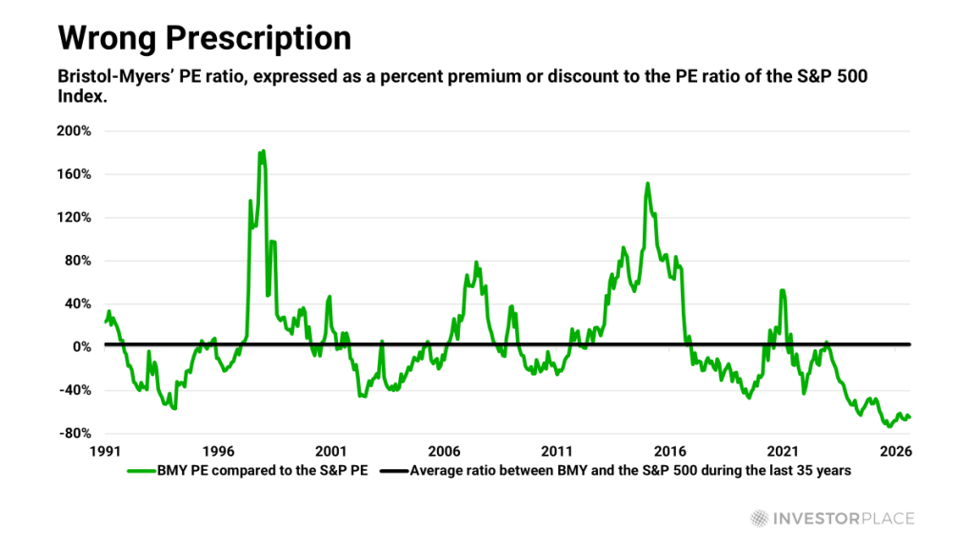
Last October, its price-to-earnings (P/E) ratio hit a record-low discount of 75% to the S&P 500 – the widest in at least 35 years. The gap has narrowed since then, but BMY still trades at a 65% discount, meaning investors pay far less for each dollar of its earnings than they do for the average S&P 500 company.
In other words, BMY continues to trade as though the company’s robust “Growth Portfolio” and promising AI initiatives barely exist.
Pharma’s Potential Comeback
Bristol-Myers’ valuation is part of a broader disconnect across the pharmaceutical industry – one I highlighted last November in Fry’s Investment Report:
Valuations across the pharma sector have tumbled to record lows relative to the S&P 500. You’d have to go back more than 30 years to find valuations this depressed.
Since the day I highlighted this remarkable anomaly, the epic valuation gap between the pharma sector and the overall market has started to close. If the past is prologue, pharma stocks could be on the cusp of delivering surprisingly strong returns.
Back in 1994, when BMY shares fell to a similarly extreme discount, its stock tripled within three years. Then, they continued climbing to advance 500% within five years, which was more than double the S&P 500’s gain over the same stretch.

In hindsight, that opportunity should have been obvious. Bristol-Myers was entering a new growth phase and was producing profit margins that were triple those of the S&P 500.
Today, the fundamentals of the pharma sector look even stronger than they did at that 1994 trough. Revenues and net profit are trending sharply higher, as operating margins approach a two-decade high.
Now, none of these virtues mean investors will rekindle a love affair with pharma stocks anytime soon, but they probably should.
The Overlooked 1,076% Pharma Play
I believe that some of the best investment opportunities will come out of the biopharma and medtech industries. And my colleague Jonathan Rose agrees. In fact, biopharma is one of his favorite industries to trade.
That’s because it fits his strategy: finding opportunities where the market isn’t looking. Like Billy Beane, Jonathan looks for value hiding in plain sight. And the market’s fixation on AI infrastructure stocks may be causing investors to overlook pharmaceutical and medtech companies already putting AI to work.
He also looks for disconnects between a stock’s price and its underlying fundamentals. Pharma stocks, as we’ve discussed, remain relatively inexpensive despite the potential for AI adoption to improve drug discovery, productivity and profitability.
That disconnect is the opportunity in the sector – and it’s why I recommended Bristol-Myers to my Fry’s Investment Report subscribers. I continue to view the company as a “Strong Buy.”
While I remain bullish on the fundamental case for pharma stocks, Jonathan took a different approach with BMY. By using a short-term trade, he achieved a 1,076% gain on the company in less than three months.
Jonathan uses an AI-powered system to spot unusual trading activity that may signal an impending move in a stock. He then uses those signals to capitalize on sharp price movements and issue short-term trades, without needing to predict the market’s next big winner.
Jonathan detailed how he uses unusual trading activity to identify potential big moves in his latest special broadcast, released just last night.
As he often says, “The creative trader wins.” And sometimes, the most creative trade is the one nobody else sees coming. Play ball!
Regards,
Eric Fry
P.S. In that new broadcast, Jonathan has an ambitious goal: to show folks how they can turn $10,000 into $100,000 using his trading strategy. Jonathan brings decades of professional trading experience — and a knack for making the lessons understandable. Go here to see how he finds opportunities, plans his trades, and decides what he’s willing to risk.


