


Why Financial Advisors Quietly Come to Me to Learn Options
For as long as I’ve been coming to you live with Masters in Trading, there’s one thing most people constantly get wrong about me.
Most people assume my work is aimed solely at individual traders.
Now, don’t get me wrong. That claim is half true.
Over the last decade alone, I’ve trained more than 100 professional traders and helped thousands of folks learn to trade options like pros with Masters in Trading.
And among those people I’ve helped are every kind of trader you can imagine – from total newbies to pro-level stock traders looking for an edge.
But you shouldn’t be surprised to learn that a meaningful number of the people I train are already professionals. In fact, many of them are financial advisors simply looking for an edge. So why do they come to me?
It’s simple. Think of the typical work a financial advisor does for their client.
A good financial advisor will find long-term investments where clients can feel safe parking their hard-earned cash. They discover ways for their clients to diversify their holdings and while reducing their exposure to risk.
Conservative. Reliable. Nothing left up to chance. Does that sound familiar?
As an InvestorPlace analyst, my focus is the same. I show you how to manage risk, volatility, and decision-making when markets don’t cooperate. I just do it with options.
It doesn’t matter who you are.Everyone needs that kind of intel from the freshest newbie to the most seasoned traders out there.
I don’t treat what I do as so different from professional planners. The biggest difference simply comes down to how we go about growing our clients’ money.
And here’s one thing that holds true for nearly every financial advisor I’ve ever met.
Options trading is a total no-fly zone. They all tend to feed me the same few lines…
It’s far too risky.
Options just don’t provide the stability my clients are looking for.
I’m afraid I’ll blow up my client’s capital with a single misplace options bet.
Look, I get it. These are real concerns for any investor – especially if you don’t know much about options trading in the first place.
That knowledge gap is where most financial advisors fall short. After all, you don’t learn how to become a master options trader in a Series 7.
That’s why financial advisors come to me in the first place. They’re looking for an edge in a profession that often leans too hard into a conservative investing methodology.
Now, I’ve talked to many advisors over the years – but one advisor I met a few years ago set me on a whole course that influenced the way I approach Masters in Trading.
Allow me to explain…
“I Was Frustrated With What I Was Being Taught”
A few years ago, I interviewed a financial advisor named Georgia. She’d been a financial advisor for many years, spending years inside a major wirehouse before going independent.
Like many advisors, she was trained to follow a formula — approved research, approved products, approved narratives. A conservative methodology that yielded conservative results.
On paper, it looked responsible. But in practice, it often fell short.
“I was frustrated with the information I was paying for and hearing,” she told me. “It wasn’t always the most profitable or useful for my clients.”
The issue wasn’t effort or intelligence. Georgia was more than capable of safely growing her clients’ money.
It all came down to how advisors are trained to think about markets in the first place.
So Georgia went independent. And that’s when she started looking for education that went beyond licensing exams, sales scripts, and long-term generalities.
That search eventually led her to join Masters in Trading. Before joining, she’d been warned by countless colleagues to avoid options trading.
She’d been told it wasn’t a meaningful way to make her clients money. And the risks? Too great to potentially tank her career over.
She’d been told repeatedly: don’t touch options, outsource them. You don’t need to understand the market.
In Georgia’s case, she wasn’t just trying to turn a quick buck in the options market. It was all about setting her clients up for success in the long term.
Georgia works with retirees and clients taking distributions now — not 20 years from now.
“I can’t just say ‘wait it out.’ That doesn’t work.” She was at an impasse, uncertain how to marry her conservative investing ethos with the more volatile world of options trading.
I understood her concerns. The framework I’ve built here offers something very different from the conventional wisdom behind financial planning. But in many ways, it delivers the exact same result.
So when I sat down with Georgia, I made one thing very clear… Trading options isn’t so different from parking your money in mutual funds or REITs.
The goal is always the same. Maximize your profit potential on every position you take.
That’s precisely what I teach every day I go live with Masters in Trading. My goal with Georgia was to show her that our goals were one and the same – even if the approach was different.
I want everyone reading this to have access to the same tools and insights I handed to Georgia. That’s why I put together The Masters in Trading Options Challenge.
The Challenge is where we take everything you’ve learned in my daily LIVEs — fixed risk, thesis-driven exits, laddered entries, defined-duration trades, and emotional discipline — and put it into practice in a structured, step-by-step environment.
For two weeks, we walk through the foundations of real options trading the way I learned them on the trading floor. You’ll learn exactly how I think, exactly how I build trades, and exactly how I manage both the winners and the losers.
You can click here to check out what the Masters in Trading Options Challenge has in store for you.
Now, let’s get back to Georgia’s story.
I knew I had to find a way to convince her of the power of options trading in isolation. That meant I had reach deep down and expose my own successes and failures in the options market.
We got into some of my early experience during our initial chat.
But eventually, I knew I had to get brutally honest with Georgia about how my unique background shaped my entire approach to options trading.
How I Learned the “Hard Way”
I have a confession to make…
For many years, I didn’t understand the first thing about trading options.
When I first started trading options on the floor of the Chicago Mercantile Exchange (CME) in my early 20s, I used to beat myself up over every trade I missed. I’d chase, overthink, and tell myself, “This one had to work.”
So much of my first year was about learning from one mistake after another. Often with thousands more on the line than I’d ever be willing to risk today.
My first year trading? I was that trader making all the wrong moves. And I didn’t truly understand how options were any less risky than flushing your money down the toilet.
No significant returns. Just frustration. Always wondering what I was doing wrong.
But all those losses during my first year weren’t in vain.
I was surrounded by so many older and wiser traders who helped me see the errors in my approach.
They helped me realize that professional options traders don’t lead with their gut. That was my first major lesson.
Any trader can catch a lucky break here and there. But on the floor you can’t survive on luck and gut instinct alone.
I know what some of you are probably thinking right now. “What was the tipping point for you? What finally clicked after months of bad trades?”
What It Really Takes to Succeed in Options
Without a doubt, process, conviction, and discipline are the rules of the game. These are the core principles all traders must fall back on. And only hard-won knowledge got me to understand the importance of each principle.
When I say process, it isn’t a gut feeling we get from some squiggly lines on a chart. We’re on the hunt for objective reasons why we should get into a trade.
It could be anything. Unusual options activity (UOA) sends a handful of stocks soaring in the near term.
Two mispriced but correlated assets like gold and silver start moving away from each other.
Maybe government-sparked volatility sends a group of mining or defense stocks higher.
We’ve had success with special situations like these, whether with KTOS and combat drones, QXO consolidating the retail building supply space, and mispriced stocks like BMNR with large Ethereum holdings.
Trades like these are based on a clear process. We’re finding opportunities in the market driven by real dynamics pushing and pulling assets around.
Now, even the most thorough process doesn’t spare you from the ups and downs of the market. After all, nothing moves up or down in straight lines.
A trade can look perfect on paper and not go the way you expected. And that’s where conviction steps in.
Conviction simply comes down to doing your research and preparing for any outcome in a given trade. That’s actually the beauty of trading options. We have the power to express our opinion on a stock rather than just betting on one direction.
Unlike stocks, options allow you to express a range of opinions about a stock’s future. Will it rise? Fall? Stay flat? With options, you can craft strategies to profit no matter the scenario. And you can always do so with conviction that a trade can go your way with the right research and risk management strategy.
It’s always great when a trade goes your way. But when it doesn’t, maintaining discipline becomes our lifeline. It’s all about setting the rules of the trade before you even put in your first offer. This is the biggest trap for investors.
They rely too heavily on technical analysis. They let excitement push them into chasing hot trades and oversized bets. They micromanage their portfolios within an inch of success – only to squander it all with a badly timed exit.
Strong process and conviction help you stay in the game. But without discipline, you’re breaking all the rules you’ve set for yourself.
Of course, it’s not enough to just have process, conviction, and discipline. You’ve got to pair that knowledge with a deeper understanding of the odds you’re facing.
And that’s where the most important part of my approach – exactly what Georgia came to Masters in Trading to understand – becomes clear.
How We Keep the Odds in Our Favor
You see, those years building a singular approach clued me into one lesson that completely changed how I trade:
Probabilistic thinking.
It’s all about knowing that every trade has a probability. You can’t know the result – only the odds.
I know that sounds obvious to most. And in many ways, it is. But in trading, so much of what we do is ruled by that “it’s gotta work” mentality.
Probabilistic thinking changes the game for us.
You always come in knowing the real underlying value of a trade doesn’t exist in isolation. Assets only have value in relation to each other.
The odds come from understanding the underlying dynamics between assets – whether it’s two correlated assets moving apart in price or key supply shocks moving entire sectors around.
The perfect example of all this knowledge at play? Just consider the commodities market over the last year.
While volatility sent equities in every direction, commodities became some of our most consistent earners here at Masters in Trading. And the setup for us was key.
Over the last year, the gold-silver ratio has flashed multiple warning signals that primed the pump for a rally in industrial metals.
For decades, these two metals have typically moved together.
But over the last year, silver started breaking away from gold in a big way – and that price action set up a whole series of winning trades for the Masters in Trading community.
Of course, those profits didn’t just come from pure gold or silver plays. It’s all in the metals the markets typically don’t pay much attention to.
Thirty-plus year relationships between metals like platinum and copper were breaking down and going absolutely parabolic.
Spreads always go back and forth – but it’s not a good sign when they go parabolic like we saw throughout 2025. At the same time, the dynamics behind this shift were clear.
Everyone was rushing to safe-haven assets like gold as the ultimate hedge against volatility.
And once gold got overloaded and oversold,the opportunity in cheaper metals like copper became too good to pass up.
Here, we had a clear setup based on deep research. Our process at work.
And we could see the odds were favoring a whole surge in industrial metals the markets were mispricing. Pure probabilistic setup that steered us away from overcrowded metals like gold to something less obvious.
All that’s to say… We did very well trading the price dynamic between metals like gold and silver throughout 2025 without gaining pure, direct exposure to either asset.
Our multiple doubles and triples in stocks like Freeport McMoran (FCX) and Pan American Silver (PAAS) prove that.
It’s the same story with assets like copper, lithium, platinum, palladium, and more.
One of our biggest all-time trades in the history of Masters in Trading? It was a single lithium name, Albemarle (ALB), that netted us more than 1,000% in total gains over the course of just six months — including maxing out our January $25 bull call spread for a spectacular491% return on Friday.
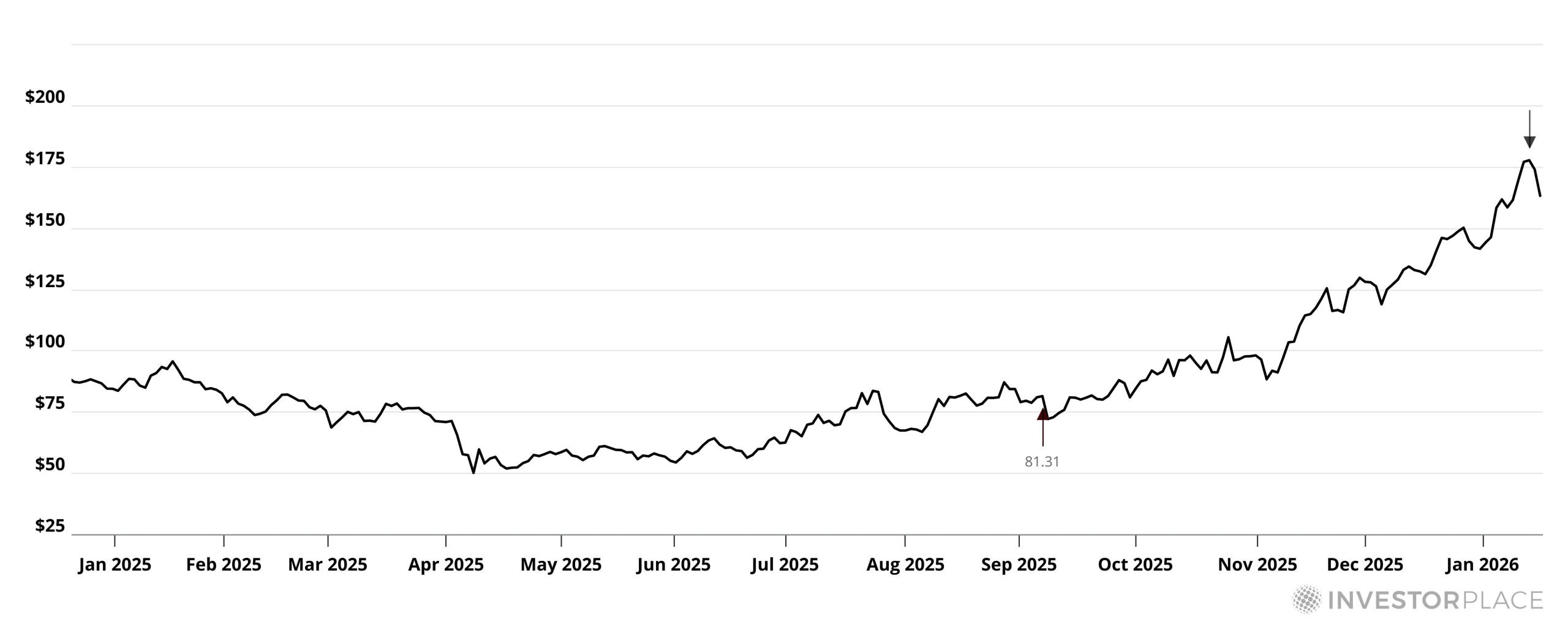
Those trades show just how effective putting a consistent strategy to work can be.
When you understand the key relationships between any related assets, you can spot opportunities others miss.
After our chat, I showed Georgia the exact same track record I’m sharing with you right now. Those gains? That’s when it all clicked for her.
And that’s when she truly started to understand the power of options trading.
Once you let go of all that common sense thinking and the emotional attachment to a trade, everything changes.
Suddenly, every trade becomes just another data point for us. It’s no longer love or hate, but binary.
That’s what a real options trader worth their salt does. They make bets where the odds are in their favor. And they always follow a plan based on conviction, process, and discipline.
Our Masters in Trading playbook is about finding those opportunities that tick all the boxes. And our strategy is designed to work in any market environment.
Remember when tariffs wreaked havoc earlier this year? That’s precisely when we pivoted toward commodities like precious metals, lithium, and ETFs .
When government-sparked volatility boosted miners and defense stocks? We swooped in with trades on all-timers like MP Materials that represent some of the strongest gains in our portfolio this year.
Once I made the connection between all those principles years ago, everything changed for me.
And once I shared those insights with Georgia, it absolutely changed the game for her clients as well.
What Georgia Learned From Masters in Trading
Joining Masters in Trading and our little talk completely tipped the scales for Georgia.
She began to see options differently — not as leverage or speculation, but as tools for managing risk and income.
Covered calls. Defined downside. Fewer, more intentional trades that have a higher chance of landing profits.
The first few months weren’t easy — and that’s important to say.
Georgia wasn’t just learning something new. She was unlearning years of conditioning.
Instead of worrying about what the market might do, the focus became simple:
Trade the market for what it’s doing right now — not what you think it should do.
That mindset applies just as much to advising as it does to trading. Fewer positions. More patience. Always aware of the risk you’re managing.
When I got back to her several months after our initial chat, she’d already begun working the options market for her clients. The results?
“I don’t have big gap-down days anymore,” she said. “It’s a more consistent way to manage accounts.”
That shift alone changed how she approached client portfolios. And one of the biggest changes had nothing to do with charts.
“I get fewer phone calls now,” Georgia told me. Not because clients were disengaged — but because they finally understood what was happening in their accounts.
Instead of reacting emotionally, she began explaining positions through relative value and simple analogies — like buying a house in the right neighborhood at the right price.
“That’s where I started adding real value,” she said.
I’m not sharing this to sell you anything.
I’m sharing Georgia’s story because it highlights something most people don’t realize about my work — and why it looks different from typical market commentary.
It isn’t about predictions. It isn’t about trading more. And it definitely isn’t about being right all the time.
It’s about thinking clearly during times of uncertainty — and having a framework you can rely on when markets get noisy.
That’s why financial advisors quietly come here. That’s why they stay. And that’s why this approach has remained consistent over the years.
For InvestorPlace readers who want to see this framework applied step-by-step, the Masters in Trading Challenge is the most straightforward place to start.
It’s not a signal service. It’s not a prediction engine.
It’s simply an introduction to how I think about markets, risk, and decision-making.
And if you’d like to hear Georgia tell her story directly, you can watch the full video below…
Remember, the creative trader wins,
Jonathan Rose,
Founder, Masters in Trading


