


“One small step for man, one giant leap for mankind?”
That line marked the moment ambition and technology collided – and permanently altered the course of history.
Are we entering another one of those iconic moments today?
If you follow the news, then you know a space race is ramping up again. The Artimis program aims to put Americans back on the moon. Elon Musk and SpaceX are helping the folks at NASA. China is trying to get there before us, though.
Other countries – and companies – are getting in on the act, too.
Of course, not to be outdone, there are plans to eventually make it to Mars. Before that, there are plans to build some sort of moon base.
The point is, at some point, maybe within the next decade, I have no doubt that our presence in space will look completely foreign to folks like me who can remember when we landed on the moon.
I bring this up because, if you’ve been paying attention to the headlines lately, you may have noticed something strange. The conversation around AI has started drifting off the planet.
Instead of talking only about faster chips or bigger data centers here on Earth, some of Silicon Valley’s biggest names are now looking toward space.
Now, before I go any further, let me just say that this is coming from the same tech leaders who built the platforms, networks and technologies that now dominate the global economy. The AI Revolution they’ve created is changing the world right before our eyes – and will for the foreseeable future.
So, when people like Elon Musk, Jeff Bezos and the leadership at Google start circling around the same idea, we need to pay attention.
And in today’s Market 360, we’ll explore why tech leaders are suddenly aiming for space, why a potential SpaceX IPO could tempt investors and how to avoid confusing bold ideas with sound investments in fundamentally superior stocks.
Tech Gurus Look to Space
The idea of pushing computing power into space may sound extreme, but it’s coming from serious players. For now, it remains firmly in the experimental stage. But maybe not for long…
In a November blog post, Google Research wrote that “in the future, space may be the best place to scale AI compute,” adding that the company is already “laying the groundwork for a highly scalable, future space-based AI infrastructure.” Alphabet Inc. (GOOGL) CEO Sundar Pichai later confirmed, quite matter-of-factly, that Google has begun working on AI data centers – in space.
The project, named Project Suncatcher, involves launching swarms of small satellites powered almost entirely by sunlight. These satellites would run AI workloads in orbit, potentially alleviating some of the pressure that AI data centers are placing on Earth’s energy grid. Two prototypes are reportedly scheduled for 2027.
But Pichai isn’t the only tech billionaire looking at the cosmos. According to The Wall Street Journal, Elon Musk and Jeff Bezos are also racing to develop AI data centers in space. Of course, both of them already have one major advantage – they build rockets.
Bezos’s aerospace company, Blue Origin, has reportedly been working on technology needed for orbital AI data centers, with the aim of putting AI compute power into satellites or space platforms. At the same time, Musk’s SpaceX is planning to upgrade its Starlink satellites to carry AI computing hardware.
Now, you maybe be wondering, why space? The logic behind all this is actually pretty straightforward.
Space is cold. So, if we can figure out how to scale data centers in space, it could significantly reduce what’s required to cool massive data centers. In theory, that could lower operating costs over time.
But there’s a catch. In my view, data transmission is going to be a big hurdle in this process.
Take SpaceX’s Starlink satellite internet service, for example. I’ve used it, and it’s a very nice service. However, it doesn’t run as fast as fiber-optic internet. So, if you’re going to have your data centers in space, you’re going to need something like the world’s biggest telescopes absorbing all that data and somehow putting it in a fiber-optic line to speed it up.
All in all, it’s a fascinating idea. But for now, it remains just that – an idea.
Big Ideas Don’t Always Make Big Investments
Now, this isn’t the only space-related headline this week. The other big one is that SpaceX is considering an initial public offering as soon as 2026 – potentially at a valuation north of $1 trillion.
That kind of headline will entice many investors. But I wouldn’t rush to buy SpaceX simply because it goes public.
Yes, the company has achieved remarkable engineering feats. But bold ideas and famous names don’t automatically make good investments… especially when many of SpaceX’s most ambitious plans, including space-based AI infrastructure, remain highly speculative.
Vision alone doesn’t determine returns, folks. Fundamentals do.
This is where investors often get into trouble. Instead of asking, “Is this exciting?” the better question is, “Does this make sense financially right now?”
This is also a good time to remind you of an uncomfortable truth about IPOs: The deck is rarely stacked in your favor.
By the time a company goes public, the earliest and biggest gains have often already gone to insiders, venture capital firms and institutional investors who bought in years earlier at far lower prices.
Big-name IPOs like this are usually priced to perfection. And on top of that, newly public companies often sell off when lockup expirations expire and insiders look to cash in their shares.
I could go on, but the point is that some of the worst returns investors experience come from chasing high-profile IPOs in their first year of trading. In many cases, patience pays. Waiting allows excitement to cool, fundamentals to emerge and valuations to reset to more reasonable levels.
That’s why I don’t rely on headlines or hype. I rely on my Stock Grader (subscription required) tool.
When I run space-related companies through it, the contrast is immediate. Let’s just look at two high-profile examples. Rocket Lab USA Inc. (RKLB), for example, ranks far better based on its fundamentals, while Virgin Galactic Holdings Inc. (SPCE) scores poorly.
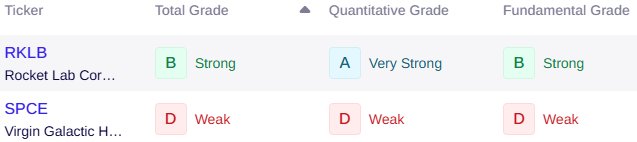
That doesn’t mean every highly rated stock is a buy – or that every low-rated stock can’t bounce – but it clearly shows why relying on data beats chasing headlines.
Where the Real Opportunity Is
When you step back, everything we’ve discussed today points to a much larger reality.
Artificial intelligence is moving out of the experimental phase and into an era of large-scale deployment. While the headlines may focus on moonshot ideas like data centers in space, the real story is unfolding much closer to home.
You see, massive amounts of capital are already being committed to the systems that enable AI to function in the real world: energy, infrastructure, manufacturing capacity and the physical backbone required to support increasingly powerful models and workloads.
In 2026, I predict this is going to shift into overdrive.
AI won’t just enhance productivity, it will become a primary driver of it across the economy. And as this phase accelerates, the gap between strong companies and weak ones is likely to widen faster than many investors expect.
The biggest winners won’t necessarily be the most talked-about names. They’ll be the businesses building and supplying the essential components behind the AI buildout – often well before Wall Street fully recognizes their importance.
That’s why I recently put together a special presentation where I walk through how this next phase is taking shape, what’s driving it beneath the surface and the types of companies I believe will benefit most as AI reshapes the economy.
If you want to understand where this transformation is truly headed in the New Year – and how to position yourself for it – I encourage you to watch it.
Because in this environment, big ideas may dominate the headlines. But it’s identifying the right companies early that makes all the difference.
Sincerely,

Louis Navellier
Editor, Market 360
The Editor hereby discloses that as of the date of this email, the Editor, directly or indirectly, owns the following securities that are the subject of the commentary, analysis, opinions, advice, or recommendations in, or which are otherwise mentioned in, the essay set forth below:
Rocket Lab USA Inc. (RKLB)


