


For the past few weeks, much of the worry on Wall Street has centered around talk of an “AI bubble.” This has been fueled by unscrupulous short sellers and members of the media with an axe to grind.
If you listened only to them, you’d think the sky was falling.
Take Andrew Ross Sorkin’s recent comments on “60 Minutes.” The New York Times columnist and CNBC talking head has a new book out about the crash of 1929. Naturally, he compared today’s market to the run-up to the Great Crash of 1929, warning, “I think it’s hard to say we’re not in a bubble of some sort,” and then added, “The question is always when is the bubble going to pop?”
He added that prices “may not feel sustainable,” and declared he was “positive” a crash is coming sooner or later. He also insisted that the current environment, fueled by the AI Revolution, was either a “gold rush” or a “sugar rush,” insisting that we won’t know for sure until a couple of years from now.
With all due respect, this is not helpful advice.
I have heard versions of that story for decades. And I want to be very clear about something… Pessimists make terrible investors.
Yes, corrections and crashes do happen – and I have no doubt we will have one at some point. When it happens, people like Sorkin can say “I told you so!”
But what they won’t tell you about is all the fantastic gains you missed along the way.
Seeing the downside is easy. Seeing the upside – recognizing genuine growth, real innovation and structural economic change – that takes work.
My advice to Sorkin and “60 Minutes” is to quit being such a sourpuss. It’s time to get happy, folks.
The holidays are around the corner, and yesterday, the Federal Reserve gave investors an early Christmas present in the form of a key interest rate cut. The markets took the news well, but this is just a taste of what’s to come.
Next year, I predict we’ll see a new leg of growth, propelled by one of the most powerful waves of capital we’ll see in my lifetime. I recently discussed the details with my InvestorPlace colleagues Luke Lango and Eric Fry in a special free broadcast earlier this week.
In short, it’ll be an opportunity for profits that the pessimists never saw coming. And yesterday’s rate cut only strengthens the setup.
So, in today’s Market 360, let’s walk through exactly what the Fed did – and why I believe it sets the stage for one of the most consequential years for investors in decades.
The Fed’s Early Christmas Present
On Wednesday, the Federal Reserve voted to cut key interest rates by 0.25% for the third time this year at its December Federal Open Market Committee meeting.
The vote, though, was far from unanimous. Of the twelve voting members, nine voted in favor of the rate cut, while three voted against it. Two (Kansas City Fed President Jeffrey Schmid and Chicago’s Austan Goolsbee) wanted rates to remain steady, while another (Governor Stephen Miran) preferred a deeper 0.5% cut.
Interestingly, four of the seven non-voting FOMC members also issued soft dissents. This widening divide reveals everything about the tension within the Fed right now.
In central bank-speak, that kind of split vote is a sign of serious disagreement about what matters more right now: stubborn inflation or a softening labor market.
The committee still expects inflation to remain above its 2% target until 2028, although it did lower its inflation forecast for 2026 to 2.4%, compared to previous estimates of 2.6%.
The official statement echoed language the Fed used a year ago when it signaled it was done cutting for a while. It said the committee will “carefully assess incoming data, the evolving outlook and the balance of risks” when considering future cuts. The last time the Fed used this language, it paused for nearly nine months.
The latest “dot plot” showed a projection of only one rate cut in 2026, with a median estimate of 3.4% for the federal funds rate. Four members expect one 0.25% rate cut, four anticipate two cuts and four believe rates should remain between 3.5% and 3.75% in 2026.
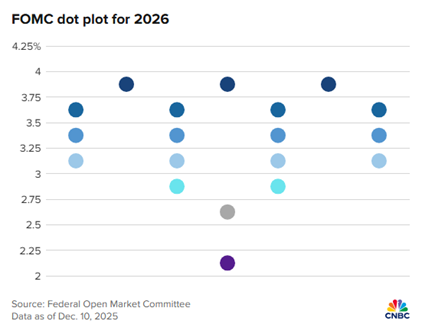
In other words, this is the most divided and uncertain Fed we have seen in years.
More Cuts Are Probably Coming
But here’s the silver lining, folks.
Powell noted in his press conference that “job creation may be negative” and added that “we think there is an overstatement in these numbers.” Personally, I do not think there is any reason for the Fed to remain restrictive when the U.S. economy is not creating many jobs.
The market cheered this news yesterday, largely because it has already priced in additional cuts. The futures market expects two rate cuts next year, and I also think the Fed needs to cut key interest rates at least two more times in 2026, moving toward a neutral rate.
I should also note that the Fed announced it is diverting more of its reserves to buy short-term Treasury securities. That caused the Treasury yield curve to steepen, which helped both the stock and bond markets to rally.
Now, we all know that President Trump is also pushing for more rate cuts in 2026, and he aims to make that a reality with a new Fed Chair. Jerome Powell has only three FOMC meetings left in his tenure, with a new Chair expected to be announced in January.
National Economic Council Director Kevin Hassett remains the frontrunner for the job. He recently stated that there is “plenty of room” to cut rates in the months ahead to stimulate housing and other interest rate-sensitive sectors of the U.S. economy, indicating that Hassett is aligned with President Trump.
On the other hand, he also reassured markets by saying that he would rely on his own judgment and not bow to political pressure. Either way, more rate cuts are likely in the New Year, especially if the labor market continues to struggle.
What Happens Next
The bottom line is that holiday cheer is spreading to Wall Street. So, I encourage you to ignore the naysayers and enjoy the ride.
We may see continued see-saw action in the coming days as tax selling and year-end pruning take place. But the fact is, right now is a great time to be an investor.
With lower interest rates, accelerating earnings momentum and positive economic growth, I see big things ahead in 2026.
That’s why Luke, Eric and I hosted a special broadcast earlier this week – to help investors prepare for what’s next.
We’re talking about nothing less than a rewriting of the American Dream. This American Dream 2.0 will be powered by trillions of dollars from corporations, foreign governments and Washington flowing into the United States to build AI data centers, energy systems, modern factories and the advanced supply chains our economy has lacked for decades.
This $11.3 trillion economic transformation is set to begin on January 2, 2026.
The winners won’t be the AI giants everyone’s watching. They’ll be the small, overlooked U.S. suppliers building the infrastructure behind it all – the companies landing billion-dollar contracts to power reshoring, nuclear buildouts, semiconductor fabs and next-gen automation.
To get more details, click here to watch the free replay of their American Dream 2.0 Summit.
Sincerely,

Louis Navellier
Editor, Market 360


