


Editor’s Note: As we head into the New Year, I wanted to share a timely piece from my colleague and friend Louis Navellier. Many of you already follow his work, and for good reason: His amazing track record when it comes to identifying major market inflection points and separating real growth from crowded trades.
In the essay below, Louis lays out his latest thinking on where the economy and markets will be headed in 2026, from interest rates and earnings to AI and economic growth.
Louis is also warning his readers about a lesser-known risk he calls the “hidden crash,” which he believes could quietly impact portfolios that appear diversified but aren’t. He explains this in much more detail in a new briefing, Hidden Crash 2026, which I recommend you watch after reading.
I think you’ll find Louis’ perspective both insightful and timely as we prepare for the next phase of the market cycle.
Wall Street is throwing out some big numbers for 2026.
One analyst says the S&P 500 is headed to 8,100.
Another says 7,000 might be a stretch.
Meanwhile, the market just wrapped up three straight years of double-digit gains.
So here’s the real question.
Are we about to pull off a rare “four-peat”… or are investors piling into the most crowded trade of their lives?
Here’s the thing. We all know the colorful saying about opinions, and how everybody has one.
Well, the same goes for market predictions.
I’ve been around the stock market a long time. I’ve seen bold forecasts come and go. And more often than not, they fade quietly once reality sets in.
That gap between lofty expectations and real-world results is exactly why I focus on data, earnings, and market structure – not noise.
Of course, I have made a few predictions of my own…
For example, in June of 2024, Nvidia Corp. (NVDA) surged to a $3.35 trillion market cap, surpassing Microsoft Corp. (MSFT) to become the largest publicly traded company in the world.
But I said the ride wasn’t over:
I expect Nvidia to blow through $4 trillion in market cap this year and then rise to a $5 trillion market cap in 2025.
That’s exactly what happened. Nvidia’s market cap quickly surpassed the $4 trillion mark – and by October 2025, it reached $5 trillion.
That experience shapes how I’m looking at 2026.
Because the next phase of this market won’t reward everything – only the right stocks.
That’s why today I’m sharing five of my predictions for 2026, developments I believe could help propel stocks higher in the year ahead.
But there’s also a sixth bonus prediction that may be even more important.
It has nothing to do with a sudden market crash and everything to do with a quieter risk building beneath the surface of today’s rally. A risk hiding inside portfolios that look diversified… but aren’t.
I’ll come back to that at the end.
First, here’s Prediction No. 1…
Prediction No. 1: The Next Federal Reserve Chair Will Boost Market Confidence
Federal Reserve Chair Jerome Powell’s final term ends in May 2026, and the president will likely name his replacement soon.
Several candidates have been discussed, but my money is on Kevin Hassett, Director of the National Economic Council.
Because the nomination requires Senate confirmation, the president will likely name his pick soon. Publicly, Hassett has emphasized his independence, telling The Wall Street Journal he would rely on his own judgment and not bow to political pressure when setting interest rates – language that’s all but required to secure confirmation.
At the same time, Hassett has made clear there is “plenty of room” to cut rates in the months ahead, aligning with the president’s view that lower rates are needed to support housing and other interest-sensitive sectors of the economy.
If confirmed, Hassett will likely strike a more optimistic tone than current Fed Chair Jay Powell – a “glass half full” approach that could help bolster market confidence in 2026.
Prediction No. 2: At Least Two More Interest Rate Cuts This Year
If Hassett is confirmed as the next Fed Chair, I expect at least two additional interest rate cuts in 2026.
The Fed already cut rates three times in 2025, including a 0.25% cut at its December Federal Open Market Committee (FOMC) meeting, which brought the fed funds rate to a range of 3.5% to 3.75%. While the Fed has signaled only one more cut in the year ahead, futures markets are pricing in at least two.
That expectation makes sense when you look at the data. Deflationary pressures are spreading globally, and we’re beginning to see early signs of lower prices in the U.S. housing market.
With inflation cooling, the Fed’s focus is likely to shift toward its second mandate: employment. The labor market continues to weaken, with unemployment rising to 4.6% in November and job growth remaining uneven.
Taken together, I believe the Fed will need to cut rates at least twice in 2026 as it moves toward a more neutral policy stance.
Prediction No. 3: AI Revolution and Data Center Boom Accelerates
There was no shortage of negative chatter around the AI Revolution and data center boom in 2025. At various points throughout the year, bearish bets piled up on AI-related stocks amid claims of a market bubble and fears that the aging U.S. power grid couldn’t support rising data center demand.
But the reality is far different.
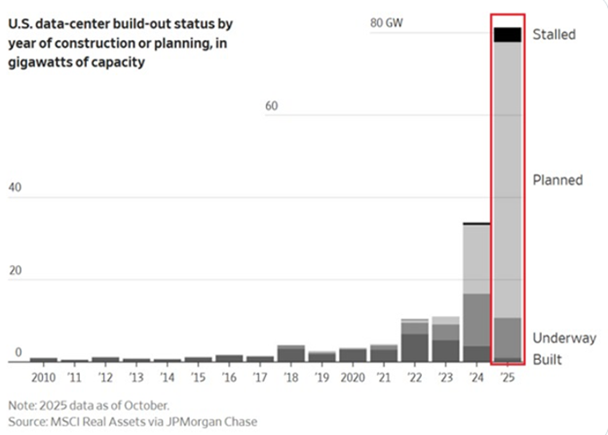
The AI Revolution is very real, and the data center buildout continues to accelerate. As you can see in the chart below, construction activity has surged over the past two years, underscoring the magnitude of this infrastructure expansion.
At the center of it all is Nvidia Corp. (NVDA).
Nvidia’s latest earnings report already silenced many critics. And AI demand will remain robust, with Nvidia expecting 65% year-over-year revenue growth in its fourth quarter of fiscal year 2026. So, it’s no surprise that Nvidia remains the most valuable company in the world.
While valuations across AI-related stocks have risen, I continue to see opportunities in this space.
Following the short-covering rally in October and November, analysts have revised earnings estimates higher for many of these stocks.
With earnings and sales momentum still accelerating, this remains exactly where we want to be invested in the year ahead.
Prediction No. 4: The U.S. Economy Will Achieve 5% GDP Growth
The U.S. economy is already growing at a solid pace. Recent data show annual GDP growth running between 3.5% to 3.8%.
Looking ahead, key interest rate cuts and the ongoing data center boom, coupled with a shrinking trade deficit and increased onshoring, could converge to boost U.S. GDP growth to at least 5% in 2026.
The trade data already support this view. Onshoring is also accelerating, particularly in the pharmaceutical industry.
So, when you add it all up, U.S. GDP growth of 5% or more in 2026 is no longer a stretch – it’s a very real possibility.
Prediction No. 5: Earnings Momentum Hits the Gas
Taken together, my first four predictions suggest an environment that remains highly favorable for stocks – particularly for companies with strong fundamentals and earnings momentum.
We’re already seeing this play out. The S&P 500 achieved its strongest revenue growth in three years and its strongest earnings growth in four years in the third quarter.
Importantly, earnings momentum is expected to accelerate further. Fourth-quarter earnings are now forecast to increase 8.1%, up from estimates for 7.2% at the end of September.
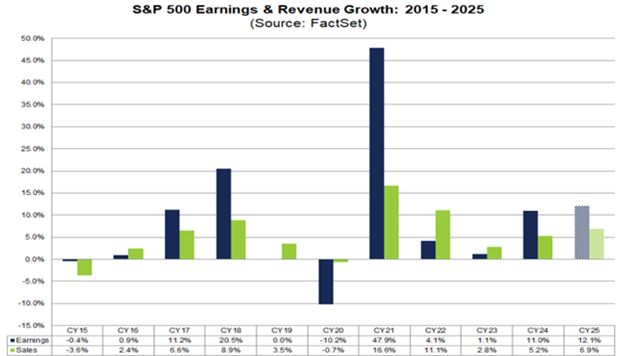
After that, earnings and revenue are expected to accelerate in 2026, driven by higher guidance, especially from data center companies with a growing order backlog. FactSet currently projects earnings will accelerate to a 14.5% annual pace in calendar year 2026.
This is the kind of earnings environment that allows the strongest stocks to continue leading the market higher.
Bonus Prediction: Portfolios Will Be Devastated by a “Hidden Crash”
When you step back and look across all five of these predictions, a clear pattern emerges.
Growth isn’t disappearing – but it is becoming far more selective.
In 2026, productivity gains, AI-driven efficiency, and scale advantages will matter more than ever. Some companies will continue to accelerate. Others will quietly fall behind, even as headline indexes push higher.
That split is already underway.
And it’s why simply “owning the market” is no longer enough.
That’s where my Stock Grader system comes in (subscription required). My quantitative system zeroes in on the companies delivering explosive revenue and profit growth – that are also experiencing a tidal wave of institutional buying pressure.
That’s how, in 2025 alone, we’ve closed out gains like:
- 555% on Sezzle Inc. (SEZL) (1/3 sell)
- 105% on Alamos Gold Inc. (AGI)
- 120% on SPX Technologies Inc. (SPXC)
- 153% on Robinhood Markets Inc. (HOOD)
- 102.06% on M-Tron Industries Inc. (MPTI)
Plus, many more. But the thing is, most investors wouldn’t have found most of these picks on their own.
Today, more than half of American investors are unknowingly concentrated in the same handful of mega-cap stocks through index funds and retirement accounts. On the surface, portfolios look diversified. Underneath, they’re anything but.
This creates what I call a “hidden crash” — not a sudden meltdown, but a slow, grinding period of stagnation where capital goes nowhere for years, even as select stocks soar.
We saw this before. The same kind of market concentration helped trigger the lost decade from 2000 to 2009. And many of the same warning signs are flashing again today — including collapsing earnings momentum at trillion-dollar tech companies and massive insider selling that rarely makes headlines.
At the same time, a very different group of stocks is already breaking away.
As the $2.8 trillion AI infrastructure buildout accelerates, capital is rotating beneath the surface into what I call Edge Innovators — companies positioned to capture Big Tech’s spending without carrying Big Tech’s valuations. Some of these stocks are already up 200%, 300%, even over 1,000%.
The next 60 to 90 days may represent a critical window — before institutional money fully floods into this space.
In my brand-new Hidden Crash 2026 briefing, I break down:
- Where the hidden concentration risk really lies
- Why broad market funds may disappoint for years
- How smart money is quietly rotating right now
- And how investors can reposition without touching options, crypto, or high-risk speculation
I strongly encourage you to watch this briefing now to understand how I’m positioning for this next phase — and how you can avoid being caught on the wrong side of the market’s most overlooked risk.
Sincerely,
Louis Navellier
The Editor hereby discloses that as of the date of this email, the Editor, directly or indirectly, owns the following securities that are the subject of the commentary, analysis, opinions, advice, or recommendations in, or which are otherwise mentioned in, the essay set forth below:
Alamos Gold Inc. (AGI), NVIDIA Corporation (NVDA), Robinhood Markets Inc. (HOOD) and Sezzle Inc. (SEZL)


