
The predictive “edge” Jonathan Rose is using today… watch for the “gaps”… our AI Revolution experts say more software pain is coming… where to hide out as AI ravages portfolios
In September 2024, Wall Street economists were split on what the Federal Reserve would do next.
Most leaned toward a modest quarter-point rate cut. Television panels debated it. Strategists hedged. Forecasts clustered around 25 basis points.
But one market wasn’t divided…
On Kalshi – where people risk real money on all sorts of different outcomes – the odds favored a larger, 50-basis-point cut.
When the Fed delivered the half-point move, many of the so-called “experts” were caught flat-footed.
It was not the first time this has happened…
What’s behind Kalshi’s “perfect track record” with the Fed
According to Fortune from last month, Kalshi “maintains a perfect forecast record” on recent Fed decisions – correctly anticipating rate outcomes while traditional forecasters remained divided.
It’s not magic. It’s crowdsourcing.
Prediction markets don’t reward loud opinions from financial talk show gurus. They reward accurate probabilities.
The scores of people making the various bets aren’t offering their expert opinions – they’re committing their hard-earned dollars. And when real money is on the line, the homework and research get done.
Plus, consider the numbers. Yes, one person can be wrong. But it’s much harder for thousands of individuals, who are risking real dollars, to be wrong at the same time.
And the data bear this out.
Here’s Fortune:
A 2025 study authored by Kalshi claims the platform is more accurate at forecasting inflation shocks than consensus estimates.
The study—conducted between February 2023 to mid-2025—found that Kalshi’s forecasts had a 40.1% lower mean absolute error than consensus forecasts, and that the platform outperformed during shocks.
Why investors should pay attention now
This dynamic is exactly why veteran trader Jonathan Rose has been studying and using predictive platforms in his trading.
For newer Digest readers, Jonathan earned his stripes at the Chicago Board Options Exchange, going toe-to-toe with some of the world’s most aggressive moneymakers. Over his career, he’s generated more than $10 million trading through bull markets, bear markets and everything in between.
And today, he believes the predictions markets are offering investors a real advantage. As he puts it:
Markets move when expectations shift – not when the headlines hit.
And over the past year, a new force has started accelerating those expectation shifts… combining retail speculation with actual gambling.
I’m talking about prediction markets such as Kalshi and Polymarket.
Jonathan explains that prediction markets don’t wait for headlines. They price probabilities before the news reaches the masses.
While sometimes subtle, these shifts can signal changes beneath the surface of the broader stock market or major indexes.
Back to Jonathan:
And when expectations shift before stock prices fully adjust, opportunity tends to follow…
If you want the fastest signal on rate cuts, trade deals, or sector rotations, it’s rarely the press conference. It’s the money positioning ahead of it.
How Jonathan is leveraging these probability shifts today
What these markets offer is instant repricing – that’s the real key.
You’re not waiting on headlines or commentaries. You’re watching belief move markets in real time.
Jonathan uses this information to find gaps – setups where there’s outsized daylight between updated probabilities and outdated stock prices.
Here he is explaining:
Here’s the framework my members and I have used repeatedly over the past year:
- Identify where expectations are drifting…
- Find where stock prices haven’t caught up yet…
- And position ahead of the adjustment.
Where this approach really shines is right now, during earnings season. This is when the difference between expectation and reality often results in big stock moves as traders who bet wrong are forced to play catch-up – or defense.
So far this season, Jonathan and his subscribers have locked in multiple double- and triple-digit percentage gains using this approach.
Right now, he says more setups are forming related to probability shifts and earnings catalysts. He just released a new research package that walks through three high-conviction opportunities developing in sectors most investors aren’t paying attention to yet. You can check it out for free right here.
I want to cover more ground in today’s Digest, but if you want to understand how this belief-gap framework works in real time – and how to take advantage in your portfolio – I encourage you to look into Jonathan’s research right here.
Here’s his sum-up:
The real edge isn’t predicting macro headlines.
It’s recognizing when belief has already started moving.
Who survives SaaSmageddon
While belief shifts can create bullish opportunities, they also create destruction.
After months of weakness, software stocks have been hit hard in February as investors grapple with what AI means for traditional Software-as-a-Service (SaaS) business models.
The iShares Expanded Tech-Software Sector ETF (IGV) has lost 33% since mid-October, and about 21% of that loss has come since late January.
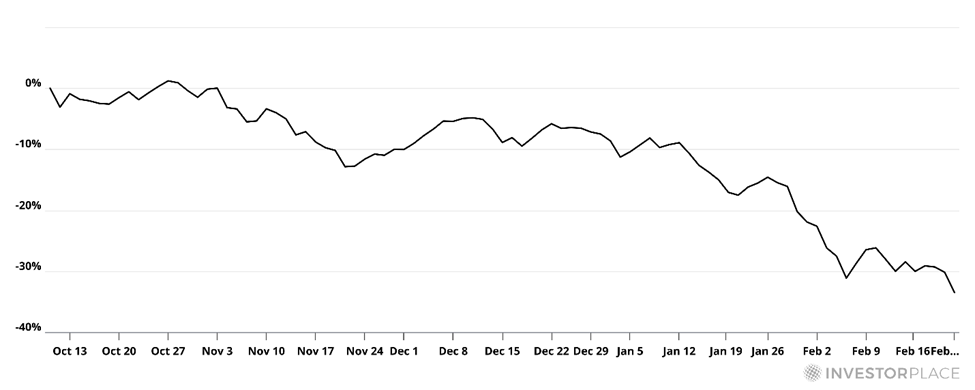
Now, some analysts argue the selloff is overdone. And perhaps that’s true – there could be a tradeable rebound ahead.
But our AI Revolution experts – Louis Navellier, Eric Fry, and Luke Lango – caution that more pain could follow.
From their monthly issue last Thursday:
AI threatens the very business model that made many SaaS firms profitable in the first place.
For years, many SaaS products have made money by being the screen employees use to work with company data. Think of Salesforce: It’s where a salesperson goes to look up a customer, log notes, update a deal stage, and generate reports.
But AI agents don’t need a dashboard. They can connect directly to the underlying systems, pull the information, update records, and trigger next steps automatically.
If more of the work happens machine-to-machine in the background, companies may need fewer people doing clicks — and fewer software “seats” to pay for.
The team has categorized vulnerable stocks into risk zones – with “Red Zone” companies most exposed to AI disintermediation. These are the businesses that act purely as the “middle layer” of management and could be replaced by AI agents coordinating directly with each other.
They go on to highlight additional dangers in generic customer experience, content and coding, legacy systems, and EdTech.
From the AI Revolution issue:
We are particularly worried about companies like Asana Inc. (ASAN), GitLab Inc. (GTLB), UiPath Inc. (PATH), and Chegg Inc. (CHGG) that have become faces of these five areas.
Even if they survive, they will find their earnings power vastly reduced by AI-native competitors that price aggressively and don’t need legacy SaaS margins.
If you’re a subscriber and haven’t read the February issue, click here to log in and read.
And if you’re still holding software stocks, please recognize the risk. As the team put it:
We think it’s inevitable that AI is reducing the value of software that simply helps humans move information around.
That doesn’t mean all software stocks are doomed.
But frankly, most are…
So, where do you invest?
Let’s pick up directly with Luke:
If you want to survive this “Great Decoupling” – where human cognition is no longer the primary value-driver – you have to own what AI cannot exist without: the Physical Layer.
You don’t want to own the app; you want to own the electricity, the silicon, and the land.
Yesterday brought a powerful real-world validation of Luke’s thesis.
Here’s CNBC:
Data center construction is expanding at such a rapid pace across North America that the majority of new build in the sector is now expanding beyond the initial, traditional markets.
Texas is about to unseat Virginia as the world’s largest data market.
Now, let’s go to Andy Cvengros, executive managing director and co-lead of U.S. data center markets at real estate research giant JLL:
The data center sector has officially entered hyperdrive.
Record-low vacancy sustained over two consecutive years provides compelling evidence against bubble concerns, especially when nearly all our massive construction pipeline is already pre-committed by investment-grade tenants.
Vacancy rates sit at just 1%. And 92% of the capacity under construction is already pre-committed.
That isn’t speculative enthusiasm – it’s pedal-to-the-metal contracted demand.
So, while SaaS stocks are getting crushed as Wall Street questions their business models, the physical backbone of AI is being built at full throttle.
Back to Luke:
Through executive mandates and fast-tracked megaprojects, the government has declared AI infrastructure a national security priority.
That means data centers, semiconductor fabs, transmission lines, natural gas pipelines, and critical mineral supply chains are now being treated as nationally significant infrastructure – increasingly fast-tracked under federal authority instead of dying in a maze of local permitting battles.
Luke points to companies such as EQT (EQT), Cheniere Energy (LNG), Cameco (CCJ), MP Materials (MP), and Lithium Americas (LAC) as examples of businesses positioned in this physical layer.
His summary says it best:
The Physical Layer is where policy, capital, and necessity converge.
That’s where you want exposure.
If your portfolio aligns with those currents, you compound. If it fights them, you stall.
If you’d like to go deeper into how this new AI capital cycle is unfolding – and which parts of the stack are likely next in line to benefit – Luke recently laid it out in a full briefing which you can watch here.
We’ll continue tracking this shift – from prediction markets to SaaSmageddon to AI infrastructure – right here in the Digest.
Have a good evening,
Jeff Remsburg


