Listen to the audio version of this article (generated by AI).
Nvidia says memory pricing is “extreme”… so why is the memory maker priced for a crash?… the bigger waves Wall Street can’t see… where Luke Lango is hunting
One week ago, Nvidia (NVDA) delivered a blowout earnings report, punctuated by guidance calling for another 70% of growth ahead.
If you were waiting for proof that the AI build-out is real, durable and still accelerating, that was it. It should have kicked off a new leg higher for the AI infrastructure trade.
Yet, despite a brief surge, the AI complex has gone nowhere since. Over this period, the Nasdaq 100 is down about 1.5% as of this writing.
We see this dynamic even clearer when we zero in on memory, a critical corner of the AI trade. To build its chips, Nvidia buys enormous quantities of high-bandwidth memory – the ultra-fast memory that sits next to an AI processor and feeds it data.
On Nvidia’s earnings call, CFO Colette Kress told analysts why the company’s profit margins are about to dip:
We are experiencing extreme pricing conditions in memory. The magnitude of the price increase has exceeded our prior expectations and are headed even higher into next year.
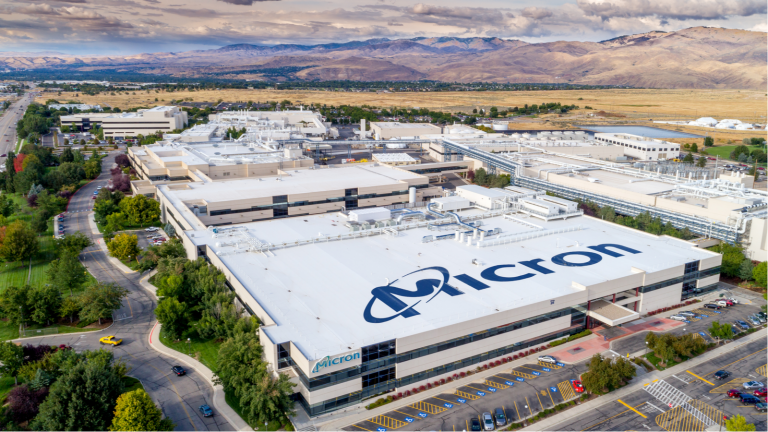
This is about as bullish a signal as possible for a memory maker like Micron (MU).
So, why did MU fall about 6% the day after Nvidia’s earnings, and remain down about 2.6% over the last week?
What Wall Street refuses to believe
As I write on Wednesday, MU is up 199% for the year. It’s one of the best-performing stocks of the entire AI bull market.
And yet it trades at only six times forward earnings.
Across the S&P 500, the typical stock gets somewhere around 20 to 25 times forward earnings. Anything touching AI usually commands far more.
Micron at six means it’s among the very cheapest stocks in the entire index – it’s basically Wall Street’s way of saying “we’re not willing to pay much for the earnings you’re suggesting are on the way.”
Why? After all, those forecasted earnings are enormous.
One word: cyclicality.
For decades, memory has been one of the most boom-and-bust corners of the entire economy. When memory is scarce, prices spike and profits explode. But those fat profits lure manufacturers into building new capacity. Supply floods in, prices crash, and profits collapse just as violently as they rose.
Investors learned the hard way not to pay up for memory earnings, knowing the crash was always coming.
So, even now – with memory profits at record highs – the market is looking past them to the bust it assumes is 18 months away.
Is the market right?
Wall Street can’t have it both ways
The bear case begins with Micron signing a wave of long-term contracts with its biggest customers. Those deals lock in prices within a set band – a ceiling and a floor. And the bears argue, reasonably, that the ceiling caps Micron’s upside: if memory prices go parabolic in this shortage, Micron can’t fully cash in, because it’s agreed to sell at capped prices.
Fair enough. But the bears aren’t being consistent…
The very same contract that caps the top also props up the bottom. A price floor doesn’t just limit the windfall – it guarantees a minimum.
And let’s be clear: these aren’t loose handshake deals. Here’s Sumit Sadana, Micron’s Executive Vice President and Chief Business Officer on the most recent earnings call:
…whether they want to purchase the bits or not, they are obligated to pay for the price times the volume…
The price cannot exceed the ceiling no matter what, cannot go below the floor no matter what.
Consequently, the value of these agreements can be readily determined.
“Whether they want to purchase the bits or not.” That’s huge.
These are what’s known as “take-or-pay” agreements – the customer is on the hook to pay for the volume it committed to, even if it decides it doesn’t want the chips.
Micron has signed 16 of these Strategic Customer Agreements, most of which run for five years through the end of calendar 2030. Together, they cover roughly 20% of Micron’s memory (DRAM) volume and about a third of its flash (NAND) volume – and once the planned deals are done, management expects half or more of the company’s total revenue to be locked under them.
Micron now reports about $100 billion in contracted revenue booked at those conservative floor prices, and it says actual revenue should run well above that. Customers have even put roughly $22 billion of cash on the table as collateral.
But here’s the kicker – Micron management says that even at the floor prices, these contracts would deliver gross margins above the peak margins Micron earned in any prior cycle. In other words, the worst case written into the contracts is better than the best case of the old world.
Bears cannot simultaneously argue that these contracts are binding enough to cap Micron’s upside – and pretend they do nothing to cushion its downside.
And that absurd 6x multiple only ever made sense because of the downside – the fear that profits would crater. Blunt that fear, and the discount loses its reason to exist.
Now, let’s be clear – these contracts don’t erase Micron’s cyclicality. Even when all the deals are signed, roughly half of Micron’s revenue still floats with the open market and behaves the old way. So, this isn’t “Micron’s profits can’t fall.” It’s more like “Micron’s profits are becoming less volatile than they’ve ever been – but the market is still pricing them as if nothing has changed.”
That alone is a case for a higher multiple – but it’s not the only reason…
Wall Street is staring at the wave directly upon us – and missing the set behind it
Picture a surfer sitting in the lineup, watching a big wave rise in front of him. He’s so fixated on that single wave – will it form? Will it break early? – that he’s missing what’s behind it…
Something even bigger.

That’s Wall Street with the memory trade right now. It’s fixated on the current wave, the AI-memory boom – data centers, AI servers, the memory feeding today’s chatbots – and bracing for it to crash.
It’s missing what’s coming.
Let’s return to Micron’s last earnings call. Here’s CEO Sanjay Mehrotra:
Humanoid robots carry 10 times the amount of memory as an average L2+ vehicle, and we expect a sustained, substantial multi-decade memory demand cycle to begin in the latter part of this decade.
First, let that 10X number sink in. Then recognize that Mehrotra isn’t describing a one-year bump. He’s describing a multi-decade demand cycle – not one, but a series of larger waves rolling in behind the data-center boom.
He also made clear this isn’t a supply problem that fixes itself soon:
We currently do not have line of sight as to when memory supply will be able to catch up with increasing demand.
I don’t want to overhype the upside, so let’s rein it in and just ask one question related to the downside…
Do Mehrotra’s comments sound anything like a traditional memory cycle that’s about to go bust?
Micron is just one example
Now, maybe you don’t own Micron, so you’re wondering about the relevance of today’s issue. Fair enough.
But strip the whole AI build-out to its studs and it comes down to three scarce things that you probably do have exposure to: compute, memory, and power. The chips that do the thinking, the memory that feeds them, and the electricity that runs it all. Wall Street’s doubt isn’t really about one memory maker – it’s doubt that demand for those three holds up.
Now, look at what a robot actually is. It’s those same three things – a brain, memory, and power – stood up on two legs and sent out into the world.
Not everything crosses over from today’s AI to tomorrow’s robotics – the data-center cooling names don’t have an obvious robot to sell into. But these three do. And that means the same companies Wall Street is discounting today get a second demand curve tomorrow, from an army of machines that haven’t been built yet.
While Micron is the clearest example of that mispricing, it isn’t the only one. Across compute, memory, and power, the market has met record demand with a shrug – good news, ho-hum stock reactions – as if the whole trade is one bad quarter from unraveling.
I can’t promise you every AI stock will make you money. But the malaise in leading AI stocks isn’t necessarily the trade breaking down – rather, it feels more like an opportunity hiding behind an outdated fear.
So, if this bigger wave really is building – across all three – who gets paid as it rolls in?
For that, I’ll hand you over to a colleague who’s spent months mapping exactly that.
Enter Luke Lango and the “Physical AI” build-out
Our technology and hypergrowth expert Luke Lango, editor of Early Stage Investor, has been all over “Physical AI” – the moment intelligence steps out of the cloud and into machines that move, lift, and work in the real world.
He recently wrote a piece noting that the economics of robots is about to cross a line that matters – about “$10 an hour.”
Here’s Luke:
That is roughly what [JPMorgan] believes a humanoid robot could soon cost to operate inside a warehouse or factory. A human worker performing similar work costs closer to $30 per hour.
But the takeaway of Luke’s analysis wasn’t to push readers toward companies that are likely to be selling these robots. Instead, he likes the suppliers underneath them.
For example, he highlights Elon Musk’s Optimus robot at Tesla (TSLA):
Optimus gets the demo-day applause. But watch what Musk is actually assembling around it…
Piece by piece, he’s pulling the entire Physical AI stack under one roof.
And that brings us full circle…
Micron (and much of the AI infrastructure trade) is one of those pieces being assembled – memory is a component no robot empire can build for itself.
Now, “following Musk’s suppliers” has already been lucrative for Luke’s subscribers. By his count, he’s recommended 33 stocks tied to Musk’s businesses in one way or another that later doubled or more – Micron among them.
Today, Luke thinks Musk is opening a brand-new frontier – one big enough to demand a whole new shopping list of suppliers. He’s spent months mapping out who’s on it, and he’s revealing more details in a live presentation one week from today – Wednesday, Sept. 9 at 8 p.m. Eastern, alongside Louis Navellier and Eric Fry. He’ll even give away one name and ticker for free.
I’ll bring you more on this over the coming days, but you can reserve your seat right here.
Looking at the big picture, the risk is that we act like the surfer staring only at the wave that’s right upon us
That’s what Wall Street is doing – bracing for a break that Micron’s own contracts are built to prevent, while even bigger waves stack up on the horizon.
I’m not telling you to go all-in on memory or MU. But while Wall Street frets about a potential AI cycle bust, look beyond.
It won’t be a smooth ride higher, but the peak wave of this cycle appears to be far off in the distance.
To see Luke’s full map – and the free name he’s putting on the table – reserve your seat for his September 9 presentation right here.
Have a good evening,
Jeff Remsburg
(Disclosure: I own MU)


