
Listen to the audio version of this article (generated by AI).
Nasdaq 100 down 5%+… Luke Lango’s AI game plan… why Louis Navellier is urging calm… Eric Fry and Jonathan Rose: two different paths, one destination
As I write on Thursday morning, the AI unwind that started quietly yesterday has turned into a full-blown rout.
All three major indexes are down sharply, with the Nasdaq leading the way lower, off more than 5%.
Yesterday, much of the damage was hidden beneath a rising market. The broad indexes climbed as Wall Street cheered the end of election uncertainty, but the companies building America’s AI data centers were getting crushed.
For example, Comfort Systems USA, Inc. (FIX) fell 15%, while Modine Manufacturing Co. (MOD) and Sterling Infrastructure, Inc. (STRL) each plunged 21%. Meanwhile, the Philadelphia Semiconductor Index (SOX) dropped to a six-month low.
Today, there’s no hiding it. Those same builders are bleeding again, but this time, the selling has spilled into the broader market.
The catalyst, of course, is Tuesday’s election. For months, we’ve flagged legislative risk as the most likely threat to the AI trade – we just expected it to show up in 2028, not here in 2026.
But is that characterization fair? Is the AI trade now over?
Let’s turn to the analyst who’s been at the forefront of it since ChatGPT launched in November 2022: our technology expert Luke Lango, editor of Innovation Investor.
His bottom line is that the AI trade isn’t ending; it’s just changed dramatically.
The closer to the job site, the worse the day
Democrats didn’t just win both chambers of Congress. They also flipped governorships in Texas, Georgia and Ohio, three states that, by Luke’s rough count, hold nearly half of the planned U.S. data-center pipeline. All three incoming governors have promised some form of data center regulation.
Luke’s conclusion is that the buildout slows from here. In his base case, new U.S. data center capacity comes in about 3% to 5% below plan in 2027 and about 15% below plan in 2028.
But slower doesn’t mean stalled. Even in that base case, U.S. capacity still grows about 45% in 2028, and most of the delayed capacity simply shifts into 2029 rather than disappearing.
What’s most useful for your portfolio is how yesterday’s selling broke down by layer of the AI stack. Now, we’ll need to update this after today’s dust settles, but this will give you an idea of where the pain is concentrated.
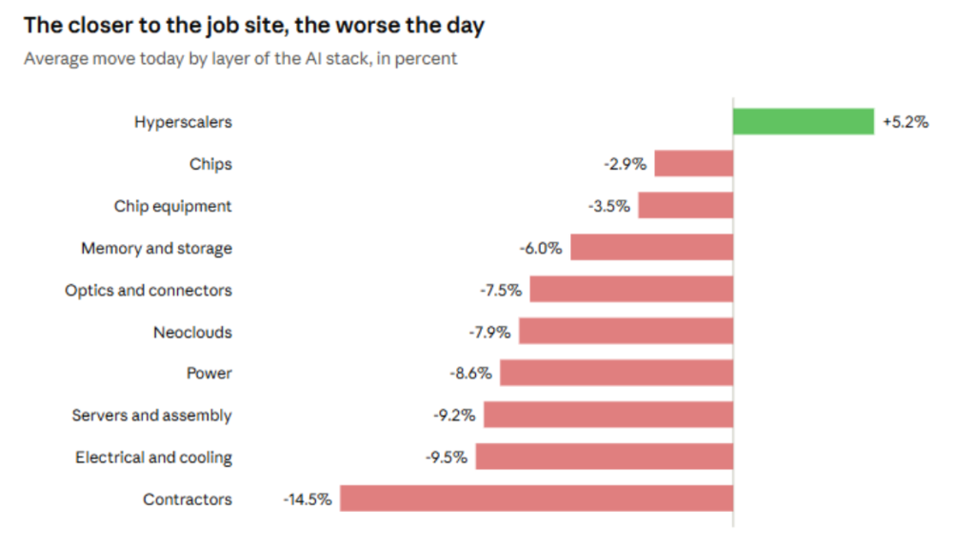
As you can see, the damage maps almost perfectly onto distance from the construction site.
The hyperscalers were the only layer in the green, up 5.2% on what Luke calls the “capex cover” trade, the bet that Washington just gave Big Tech an excuse to rein in its massive spending.
That cushion didn’t last. Today’s Nasdaq 100 slide shows the selling has now caught up with the megacaps, too.
Chips (down 2.9%) and chip equipment (down 3.5%) held up best within the supply chain because they can ship to whichever site is ready, anywhere in the world. Meanwhile, the contractors who pour the concrete fell 14.5%. That pain is back this morning, only worse.
Here’s Luke on why he thought the selling had gone too far – and that was before this morning’s bloodbath:
Compare that with our estimates of the 2028 earnings hit: about 6%–12% for contractors and only 2%–4% for chipmakers.
In both cases, the market has already moved to price in more than our base case, which is why we think the selling is overdone, especially for the layers furthest from the job site.
If your AI holdings lean toward builders, power, and cooling, that’s likely where you felt the most pain yesterday – and again today – and where a portfolio review makes the most sense.
Why a slower buildout may be a better one
Now, Luke is very clear about a critical point – demand hasn’t changed.
Capacity is sold out, cloud growth is surging, and the big four hyperscalers are still expected to spend more than $1 trillion next year. So, with demand still strong, Luke sees a silver lining to the political brakes that the market may be missing:
A slower build-out may be a longer one.
The biggest fear hanging over this trade has been overbuilding into a 2028 peak; a political speed limit makes that outcome less likely and keeps capacity tight for longer.
Luke adds that a more measured pace could also ease shortages and reduce pressure on these companies to borrow heavily, helping the expansion last longer. As he puts it, “a more measured buildout is a more sustainable buildout.”
So, Luke’s AI bull thesis is “bent, not broken.” Still, the SOX semiconductor index broke below the key support level Luke had flagged, so he’s tightening up per his game plan. That means trimming buildout exposure, concentrating on his highest-conviction names, and upgrading away from companies that depend on outside funding.
Luke is releasing a detailed roadmap of these action steps, including which AI positions he’s trimming and where he’s doubling down. If you’re an Innovation Investor subscriber, click here to log in and see Luke’s full game plan. If you’d like to learn more about joining Luke in Innovation Investor to access this roadmap and Luke’s official portfolio, click here.
Louis Navellier: “Hang in there, everybody”
Luke isn’t the only one who thinks the selling has gotten ahead of the fundamentals.
Legendary investor Louis Navellier, editor of Growth Investor, released a Special Market Podcast this morning addressing the rout, and his message to subscribers is even more direct: don’t panic.
He quickly zeroed in on the primary fear in today’s market – that the incoming Democratic governors will choke off AI data center construction. He notes that data centers go where energy is cheap and fiber-optic lines are plentiful, and states have every financial reason to keep them:
The narrative that AI is going to slow down because Democrats got elected is a false narrative…
So, the data center boom is not going to slow down…
What the politicians will do is they will assure everybody their electric rates aren’t going up because of the data centers. They will accept the property tax revenue and the jobs that data centers create, and that’s that.
Most important for Louis, the fundamentals haven’t budged. He notes that there have been no meaningful analyst earnings cuts among the AI companies he follows, and that some of the hardest-hit names now trade at remarkably low valuations.
For example, Super Micro Computer, Inc. (SMCI) trades at barely five times forecasted 2027 earnings.
Here’s Louis’ overall take:
The bottom line is the U.S. is the AI leader, and all the AI-related stocks will firm up.
Good stocks bounce. Bad stocks bounce like rocks, but good stocks bounce like fresh tennis balls…
It’s time to back up the truck on these kinds of stocks, but you have to be patient and you have to let the earnings do their thing.
If you’re a Growth Investor subscriber, click here to listen to Louis’ full Special Market Podcast. And if you’d like to learn more about joining Louis in Growth Investor, click here.
From what got hurt to what soared yesterday: solar
Now, not everything got hit on Wednesday.
While the election results kneecapped the AI infrastructure trade, solar stocks soared – and as I’ll show you in a moment, two of our analysts were already in position.
First, as for the rally’s logic, it’s straightforward…
President Donald Trump’s 2025 tax law cut key incentives for most new solar projects that begin operating after 2027. With Democrats now controlling Congress, investors are betting that political pressure on renewables will ease and that some of those incentives could eventually be restored.
We can see this in the Invesco Solar ETF (TAN). It jumped nearly 6% yesterday – a big move for an ETF that holds dozens of stocks. But individual solar plays climbed even higher. For example, Nextpower Inc. (NXT) closed nearly 12% higher.
To be clear, that rally was built on expectations, not legislation. The new Congress isn’t seated until January, and President Trump can veto any attempt to restore the credits. But many of these stocks were so beaten down that it didn’t take much to send them higher.
That’s exactly the setup our global macro expert Eric Fry was targeting when he recommended long-dated call options on TAN in his Leverage service on Tuesday.
Here’s Eric:
The renewable energy sector does not need an overwhelmingly favorable political tailwind in the U.S. in order to thrive; it merely needs a less hostile one…
The TAN portfolio, for example, is trading for just five times estimated gross earnings (EBITDA) – or 30% below its 10-year average valuation.
For additional perspective, the S&P 500 is trading for nearly 12 times estimated EBITDA. Therefore, at TAN’s currently depressed valuation, merely less-bad news could give the stock a boost.
Now, solar is giving some of that back today. As I write, TAN is down about 4% in the broader selloff, but yesterday’s surge is likely a preview of what could be in store for the sector over the coming months.
Another solar trade…with nearly all the risk removed
Our options expert Jonathan Rose, editor of Advanced Notice, also jumped on TAN on Tuesday after spotting enormous unusual options activity in solar.
Traders had piled into more than 12,500 contracts of one TAN call option, against fewer than 500 contracts already open. That’s more than 25 times the existing open interest, and as Jonathan put it, “Where there’s smoke, there’s often fire.”
Then, with TAN surging more than 8% on Wednesday morning, Jonathan used the strength to take his subscribers’ original capital off the table while keeping their upside intact:
That means we can let the trend work in our favor without worrying about losing our original investment. We may sacrifice some upside in exchange for eliminating our risk, but that’s a trade-off I’m more than happy to make.
One day in, it’s close to a free trade – and today’s pullback shows why that matters. Because Jonathan’s subscribers are already playing with house money, a down day like today stings far less. It’s a great illustration of how a trading veteran handles risk.
Two different roads to the same trade
What I find most interesting about this solar trade is how Eric and Jonathan arrived at it.
They look at the market in very different ways. Eric is a big-picture macro investor who builds his case from valuations, policy shifts and long-term trends. Jonathan is a trading veteran who follows the money, watching for unusual options activity that suggests big players are positioning ahead of a move.
Different toolkits, different time frames – yet both landed on solar on the very same day.
Our Editor-in-Chief and co-Digest writer Luis Hernandez just sat down with both to dig into exactly that. In the interview below, Eric walks through his specific case for the solar trade, while Jonathan explains how he reads unusual options activity and what it’s telling him right now. Along the way, they compare how their approaches differ, and why they came to the same conclusion.
With solar pulling back today, it’s a timely conversation. Click here to watch the full interview, or click on the thumbnail below.
Coming full circle
Days like today are why having an investment plan is so important.
Luke is trimming around the edges while keeping his core AI thesis intact. Louis is urging patience with fundamentally superior stocks that he believes will bounce “like fresh tennis balls.” And on the solar side, Jonathan already took his risk off the table before today’s pullback. They’re three different approaches, but none of them involve panic-selling into a rout.
The election has handed Wall Street a new set of rules for the AI trade, and it will take some time for the market to sort out who wins and who loses under them. We’ll keep you updated as our experts weigh in.
Have a good evening,


