Who benefits from the fallout at Nvidia?… which companies face fresh headwinds?… Luke Lango names names… Louis’ take on Nvidia… why Louis’ newest investment service is built for today’s market
With Jensen Huang out the door at Nvidia Corp. (NVDA), investors have been scrambling to work out the impact on the broader AI ecosystem.
Which companies could benefit? Which could face new headwinds? And is the overall tech fallout nearly over – or just beginning?
Last week, our technology investor Luke Lango, editor of Innovation Investor, handed his readers a roadmap for answering these questions. Let’s start with the potential winners…
Who benefits from the Nvidia shakeup?
Luke is clear that Nvidia isn’t disappearing, but the Huang scandal hands every major chip buyer a fresh reason to diversify away from it:
Custom chips are the biggest winner. Inference already makes up about two-thirds of total AI compute, and custom chips do it cheaper.
The two companies controlling roughly 95% of that design market are Broadcom (AVGO) and Marvell (MRVL) – and each owns a different piece of the shift.
One tier lower, Luke points to Advanced Micro Devices Inc. (AMD), which already serves as Nvidia’s backup supplier.
Other companies that could either benefit or are insulated include the picks-and-shovels names that don’t care who wins the share battle, such as Taiwan Semiconductor (TSM), ASML (ASML), and FormFactor (FORM) that:
…make or equip every company’s chips, so share shifts don’t matter to them.
Also, look at connectivity, testing, and system assembly companies that are levered to custom chips, such as Celestica (CLS). (Celestica is heavily tied to Google’s TPU.)
The part of the AI trade that gets dinged
We’ll turn to specific companies that are likely to face headwinds in a moment. But first, let’s look at the bigger picture.
Nvidia hasn’t simply been a chip designer – it’s also become one of the key financiers of the AI buildout. It invests in its customers, guarantees their capacity, and backs their borrowing so they can keep buying its chips. Luke cites a Bank of America estimate that pegs those backstop commitments at roughly $230 billion.
Here’s Luke with what this means:
Jensen Huang personally drove these deals. An interim CEO reporting to a board under investigation is not going to sign new multibillion-dollar guarantees. Existing contracts get honored, but new ones freeze…
That matters because Nvidia’s backing lowers the cost of borrowing for smaller AI cloud companies. Take it away, and some projects stop making financial sense.
So, who feels the squeeze?
Not Big Tech. Most of their funding comes from their own enormous cash flows, and if anything, they’ll steer more dollars toward their own chips.
The pain lands on the independent AI cloud providers like CoreWeave Inc. (CRWV) – what Luke calls “the pressure point.”
AI labs are a mixed bag, with OpenAI more exposed than many.
Specific companies facing headwinds
Beyond CoreWeave and other neocloud providers, who else faces headwinds?
The second tier includes companies that are heavily exposed to Nvidia’s systems. An example is Astera Labs Inc. (ALAB), where one end customer was more than 70% of 2025 revenue, widely believed to be tied to Nvidia’s ecosystem.
Shifting to companies with more moderate exposure, we have names like Monolithic Power Systems Inc. (MPWR), which supplies power chips for Nvidia GPUs, and Vertiv Holdings Co. (VRT), which is partly tied to Nvidia but sells into every kind of data center.
Stepping back, Luke views what’s playing out as a slowdown rather than a complete stall. The AI lending market is maturing on its own. CoreWeave, for example, has already tapped investment-grade financing and syndicated loans without leaning on Nvidia’s guarantee.
Here’s Luke’s bottom line:
Any Nvidia CEO has a strong incentive to keep funding its customers because that funding creates demand for Nvidia’s own chips.
This is a pause and a tightening, not an exit.
The question is whether you have the stomach and patience to sit through this tightening. Which leads us to our next question…
Have we already seen the worst, or just the first act?
If you’re looking to protect your AI stocks – or potentially take advantage of the recent sector pain – the bigger question is whether this is the end of the selling or the start of something worse.
Here’s Luke:
A scandal marks the bottom when it’s the last shoe to drop, and marks the middle when it’s the first sign of deeper problems.
Self-contained scandals clear out sellers. Scandals that reveal problems across the whole system lead to more bad news.
Luke gives 65/35 odds to this being a self-contained scandal that doesn’t widen. But many factors are influencing those odds. He’s tracking the board’s search for a permanent CEO and any regulatory follow-through on export controls:
A quick, credible appointment limits the damage…
Any sign of Justice Department or Commerce Department action on export controls changes our verdict fast.
And that second item may already be in play. The Commerce Department announced a new rule today requiring licenses for advanced chip exports to Singapore, Malaysia, Thailand, Indonesia and Brazil, and chip stocks fell on the news. We’ll take a closer look in tomorrow’s Digest.
The biggest swing factor, though, arrives tomorrow, when Nvidia reports earnings after the close. The management call, set for 5 p.m. ET, will be especially important.
Luke’s take:
The single most important event: guidance, Megaspeed, Singapore revenue and leadership.
Legendary investor Louis Navellier – a longtime NVDA bull – is homing in on one of Luke’s variables
Revenues. Or more broadly speaking, its financial performance at large.
Here he is with more:
I want to stay focused on the fundamentals.
Nvidia is still expected to deliver about 91% sales growth and 90% earnings growth in its upcoming report…
That’s why I’m not interested in making an emotional decision before we see the numbers and, most importantly, the company’s guidance.
Notice what Louis isn’t doing…
He’s not predicting how the stock will react or buying/selling today based on a hunch of how the leadership situation will play out.
He’s pointing to numbers – growth, earnings and, above all, guidance – that give an investor something concrete to evaluate.
That distinction is the heart of a bigger lesson…
The danger of owning a narrative
Stepping back, the fallout in the AI sector from Huang’s departure shows what can happen when an investment strategy rests on a narrative rather than fundamentals.
Narratives can work wonderfully for a while. They’re easy to understand, easy to repeat, and, in a rising market, easy to believe. But when anything challenges the story, the question is what will hold up the stock price then.
To be clear, strong fundamentals don’t make a stock immune to a selloff. Nvidia itself has shed more than 30% of its market value since its early-October peak as scared investors have bailed, even though its business is still growing at a blistering pace.
But strong fundamentals provide a buoy that narratives alone don’t possess.
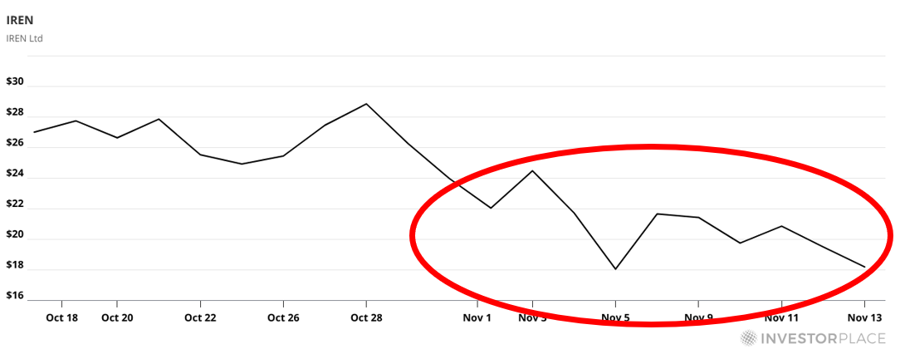
For example, take IREN Ltd. (IREN), one of the AI cloud companies on Luke’s most-exposed list, which he describes as an “all-Nvidia AI cloud.” Its growth runs on Nvidia’s chips, and Nvidia is even one of its customers under a five-year, $3.4 billion contract.
IREN has spent more than it has generated from operations every year since fiscal 2022 – last year alone, $4.33 billion in capital spending against $2.10 billion in operating cash flow.
Since The New York Times first reported on Oct. 29 that U.S. officials had linked Huang’s alleged paramour to Chinese intelligence, IREN has crashed 39%.
But that’s just the recent price action.
If we go back to its spring high, IREN is down 76%.
That’s the trap that Louis has spent nearly five decades avoiding
His approach to the market has always been built on fundamental strength rather than stories.
Emotion can push and pull a stock’s price for weeks or even months. But a company with growing sales, expanding margins, and rising earnings has something real to stand on when narratives change and sentiment turns, and that’s what Louis wants investors to own.
That’s why we think Louis’ brand-new service, Prime Portfolio, is so well timed.
It’s built around his 25 highest-conviction stocks, drawn from the top of his Stock Grader system, which grades more than 6,000 stocks on a scale of A to F. It uses the same eight fundamental factors Louis has always relied on.
What’s new is the rhythm. Louis reviews the portfolio every month and issues fresh buy, hold, and sell calls, so the list is constantly tested against new opportunities rather than left to drift. That keeps the portfolio anchored in stocks that currently grade out as fundamentally strong – not in hype-driven narrative plays.
For more on Prime Portfolio, check out the free replay of last Thursday’s live presentation right here. It also includes two free stock recommendations – one he’d consider buying and one he believes investors should avoid heading into 2027.
As for where the AI trade goes next, all eyes are on Nvidia’s earnings tomorrow. We’ll report back.
Have a good evening,
Jeff Remsburg
(Disclosure: I own AVGO, AMD, TSM, ASML)


