

Hello, Reader.
Pop quiz: Who said it?
This generation does not intend to founder in the backwash of the coming age of space. We mean to be a part of it — we mean to lead it. For the eyes of the world now look into space, to the moon and to the planets beyond.
If you guessed President John F. Kennedy, during a 1962 address at Rice University, you’d be correct. His moonshot ignited an era of American ambition and industrial investment that helped define the original American Dream.
Now, how about this quote?
In the future, space may be the best place to scale AI compute…
We are laying the groundwork for a highly scalable, future space-based AI infrastructure.
That’s not JFK.
That’s a November 4 blog post from Google Research.
And just this past Saturday, Alphabet Inc. (GOOGL) CEO Sundar Pichai said on TV, quite matter-of-factly, that the company has begun working on AI data centers –in space.
In an endeavor called Project Suncatcher, Google aims to launch swarms of small satellites powered almost entirely by sunlight. These satellites would run AI workloads in orbit, relieving pressure on Earth’s energy grid.
Two prototypes are scheduled for 2027.
Maybe they get there. Maybe they don’t.
What is certain is this: You don’t need to watch the sky to see where the real money is being made.
Back on our “pale blue dot,” AI data centers are springing up like dandelions. The hyperscalers are spending trillions, literally, to construct, equip, network, and power these computational fortresses.
Today, a new moonshot is underway — and like the first one, it’s setting off a massive economic shift. This is the early, structural phase of what my colleagues and I call American Dream 2.0.
It’s a shift from a labor-driven economy to an ownership-driven one… and a seismic break from the last 40 years of economic dependence on foreign production.
The companies supplying this buildout are starting to see it in their earnings right now.
So, today, I’d like to plant our feet firmly back on the ground. While the data revolution will always have its dreamers, the owners of this transition — the ones supplying the must-have materials and infrastructure — are already cashing checks.
Let’s break it down…
The Paradox of Hyperscale AI
McKinsey estimates that data center investment will hit $6.7 trillion over the next five years – with $5.2 trillion earmarked for AI-specific infrastructure.
So what are the hyperscalers doing?
They’re torching cash like it’s kindling.
Google, along with Amazon.com Inc. (AMZN), Microsoft Inc. (MSFT), Apple Inc. (AAPL), and Meta Platforms Inc. (META), have decided that the only way to survive the AI era is to spend into it, even if the economic payoff seems highly uncertain.
Their once-mighty $300 billion cash fortress has dwindled dramatically. Years of outspending free cash flow have turned these giants into heavy borrowers.
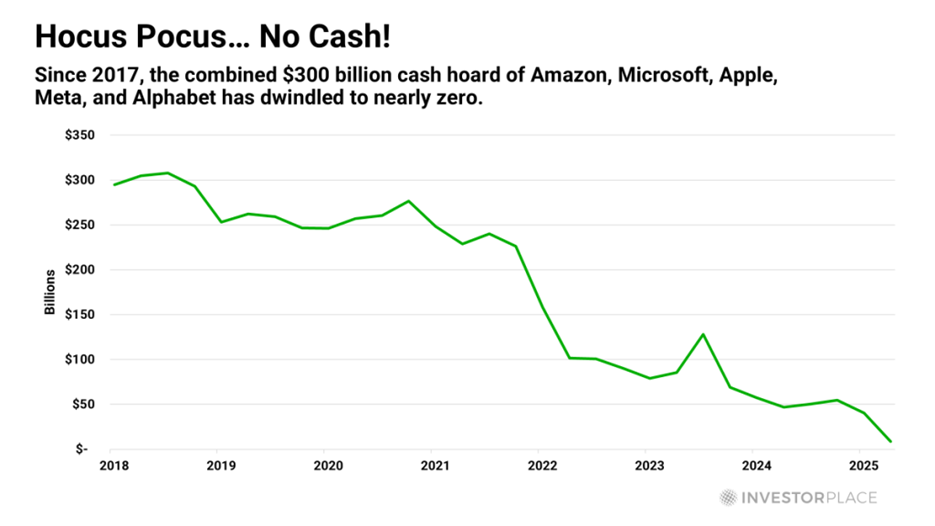
This is the paradox of hyperscale AI: The technology may deliver epochal gains over time, but paying for those future gains could crush shareholders in the near term.
Legendary hedge fund manager David Einhorn has called this a potential era of “tremendous capital destruction.”
And the hyperscalers know it. They admit the returns are uncertain. They admit the payback horizon is murky.
Meanwhile, all this spending is doing something else — something far more immediate and far more relevant to the idea of American Dream 2.0.
It’s enriching the companies supplying the materials, hardware, energy, and infrastructure.
Which brings us to the real story…
Forget Outer Space – Go Underground
Every ton of metal pulled from the ground is a claim on the AI buildout.
Unlike software vendors or chip designers, metals companies don’t need to guess which AI model wins or whose AI agent becomes standard. They just need to deliver the raw materials that make it all possible.
Take aluminum.
Every high-voltage line that feeds an AI data hub consumes one to two tons of aluminum per megawatt delivered.
Building the grid that AI requires means a surge in demand. From 104 million tons of demand in 2024 to an estimated 120 million by 2030.
That’s relentless, structural growth.
The market has noticed. Aluminum prices are up roughly 10% year to date, a new three-year high.
“In a world in which we are more energy intensive… it’s going to be built with aluminum,” says Charles Johnson, the president and CEO of the Aluminum Association trade group.
In the race for AI supremacy, the hyperscalers may scorch their balance sheets, but the miners will still be cashing the checks.
Copper is on a similar trajectory.
And then there’s the most strategically important category of all: rare earths.
Rare earth elements are essential for the core components of AI data centers: hard drives, cooling systems, networking hardware, fiber optics, and power systems.
Without them, the AI boom doesn’t just slow down — it stops.
So as demand for data centers grows stratospherically, so does demand for rare earths.
In fact, the scramble over rare earths production is signaling a $11.3 trillion economic shift, involving 127 companies and multiple sovereign nations.
It’s one of the clearest examples we’ve seen of our American Dream 2.0 thesis: The wealth flows not to the tech giants building futuristic platforms, but to the foundational suppliers making it possible.
And that shift is about to accelerate dramatically on January 2.
That’s why Louis Naveller, Luke Lango, and I have joined forces to identify a handful of small U.S. companies positioned at the center of this transition – companies directly tied to AI infrastructure, advanced energy, and rare-earth supply
Some of these players have potential upside of 2,400%… 3,500%… even 8,500% if this buildout unfolds as we expect.
We’ll share everything at our upcoming event…
On Monday, December 8, at 10 a.m. Eastern time, the three of us are hosting the American Dream 2.0 Summit (click here to save your seat for this free event).
We’ll detail a rare-earths miner sitting on a massive U.S. deposit, plus several other companies positioned to benefit as America rebuilds its industrial base.
Plus, we’ll show you why January 2 could be the day this entire $11.3 trillion realignment goes vertical…
And reveal the name and ticker of the tiny company at the center of this January 2 catalyst as a free pick at the Summit.
This structural transition to the American Dream 2.0 will define wealth creation for the next decade — the shift from labor-driven prosperity to ownership-driven prosperity.
You can click here now to reserve your seat.
No astronaut training needed.
Regards,
Eric Fry
Editor, Smart Money
P.S. I’ve spent decades analyzing global market forces — macro trends so powerful that they create winners that can span a decade or more. As I’ve just laid out here, one of those forces is forming again. So, the next time I join you here at Smart Money, I’m diving much deeper into this shift in a video conversation with InvestorPlace Editor in Chief Luis Hernandez.
This is not a subtle shift. It’s a seismic break from the last 40 years of economic dependence on foreign production. That’s why Louis, Luke, and I are hosting the American Dream 2.0 Summit this coming Monday morning. Reserve your spot now.


