
Tom Yeung here with your Sunday Digest.
Perhaps the two most terrifying words in investment is the term: “Everyone knows.”
To growth investors, it represents the moment when a promising trade has become too crowded.
- “Everyone knows that internet stocks are the next big thing…”
- “Everyone knows Florida real estate can only go up…”
- “Everyone knows that crypto will take over banking…”
Meanwhile, contrarian investors understand that markets don’t reward what is obvious… only what is misunderstood. If an investor were thrown back in time to the year 1999, it would have been far better to buy shares of emerging market ETF The India Fund (IFN) (+600% through 2006) than dot-com darling Cisco Systems Inc. (CSCO) (-22% over the same period)
That’s why recent comments from OpenAI Chairman Bret Taylor should ring alarm bells. In an interview with Fox Business, he rightly stated, “Everyone knows AI will transform the economy.”
“The excitement is authentic, and as a consequence, there’s a huge amount of investment,” Taylor said during the interview. “And a lot of people are just wondering, are we investing too much, too quickly?”
Now, will the AI economy burst in 2026 as the dot-com bubble did in 2000? Well, no one knows that for sure. We could be in for another five years of supernormal gains… or shares of the Magnificent Seven could fall 50%-80% next year and underperform for two decades.
But what we do know is that some corners of the market are being totally ignored by the “everyone knows” crowd.
Eric outlines this fact in his brand-new “AI Collapse Survival” presentation. In this free broadcast, he identifies a category of stocks he calls “AI Survivors,” companies immune to the technological disruption (and potential selloff) that AI could create. In other words, these companies look more like the overlooked emerging-market companies in 1999, rather than the expensive Ciscos of that era.
To give you a sense of his strategy, I’d like to outline three misunderstood sectors he’s eyeing… and why these areas are so ripe for a breakout in 2026 while the “everyone knows” crowd is looking elsewhere.
Planting the Seeds for 2026 Gains
Let’s be honest: Fertilizer is not a historically attractive industry.
Ammonium nitrate… phosphorous… potash…
Much of it looks like dried cow manure and often smells like it too.
That briefly changed in 2022 when Russia invaded Ukraine. Suddenly, Western nations were threatening to boycott one of the world’s largest exporters of fertilizer – a move that threatened to turn existing shortages into an all-out panic. Prices of potash surged 170% from their 2020 lows, and the malodorous business of fertilizer became one that smelled more like money. Shares of fertilizer firms spiked 2X or more between 2020 and 2022 and briefly became a fascination on Wall Street.
Prices eventually came back to Earth as vendors rerouted supply chains and farmers temporarily cut back, but there was plenty of time to cash in first.
However, we’re now seeing a new bull market in fertilizer prices, driven by tariffs, rising demand, and Chinese restrictions on phosphate and urea exports earlier this year. Below is a chart from the St. Louis Federal Reserve that shows the producer price index for phosphorus-based fertilizer.
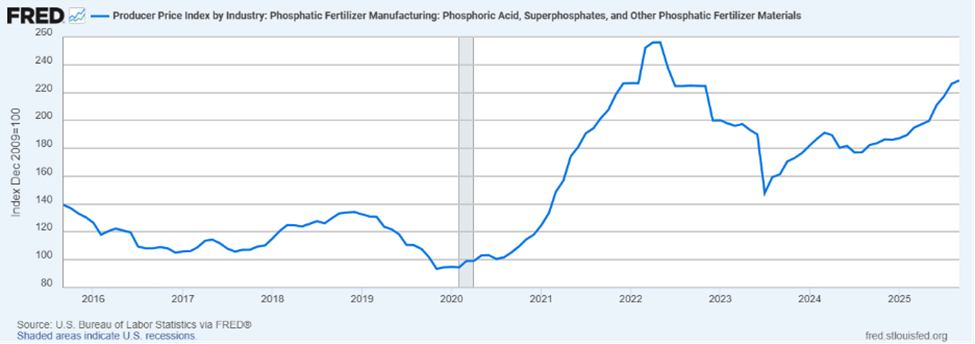
That’s why Eric is recommending shares of a particular fertilizer manufacturer that should benefit handsomely from this new bull market. It’s one of the world’s lowest-cost producers of its class, and its American production sites shield it from much of President Donald Trump’s tariffs.
Now, it’s essential to note that not every fertilizer firm will do well. Nitrogen-based fertilizer prices have struggled in comparison, due to structural weaknesses in its supply chain. Many manufacturers are also high-cost, high-debt, or both.
That’s why it’s important that you watch Eric’s latest presentation, where he identifies the exact fertilizer company to pick for 2026.
Powering the AI Revolution
Next, we have natural gas – an energy commodity that doesn’t always mirror the price of oil.
Below is a graph of Henry Hub, the standard U.S. benchmark price. Prices today are 36% higher than in 2024 and 62% higher than in 2023. Excluding the 2022-2023 price spike caused by Russia’s war in Ukraine, we’re now at the highest seasonally adjusted point since 2013.
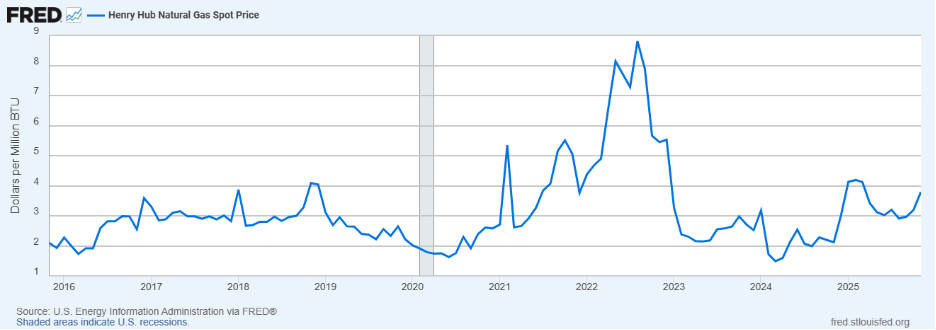
The reason for the recovery is straightforward: Supply has failed to keep pace with demand.
On the production side, American energy firms have been hesitant to drill new gas wells, given their vivid memories of the 2015 industry crash. Low oil prices have also limited the amount of natural gas collected as a by-product of oil production. (Ordinarily, more than a third of gas production is generated this way.) The U.S. Energy Information Administration (EIA) expects just a 1% increase in U.S. gas production next year.
Meanwhile, the demand side paints an even more bullish picture, thanks to the insatiable electricity needs of AI data centers. A single ChatGPT query takes 10 or more times the energy of a Google search, and creating a short AI video can use 2,000 times that figure. Analysts at Goldman Sachs forecast that AI will drive a 165% increase in data center power demand by 2030.
That’s triggered a new rush to build combined-cycle gas turbine power plants. The EIA now expects another 18.7 gigawatts (GW) of gas generation capacity to come online by 2028 in America, compared to zero in 2024.
American liquified natural gas (LNG) exports have also risen around 17% this year to 12 billion cubic feet per day (BCf/d), and the U.S. Department of Energy expects that figure to reach 26 BCf/d once U.S. LNG export projects under construction are completed. Some analysts say that U.S. gas demand could rise as much as 27% from 2024 levels by 2030.
To ride this wave, Eric has picked one specific American driller with outsized upside thanks to its low breakeven costs, high-quality assets (averaging 17 years of remaining inventory life), and an irresistible stock price. In fact, even the company’s oil assets will remain profitable until West Texas Intermediate (WTI) prices drop below $45.
To find the name of this company, click here.
Conducting the AI Revolution
Finally, one overlooked component of the AI Revolution is the raw metal needed for the wires, connectors, cooling systems, chips, and shielding needed for AI data centers:
Copper.
This raw material has been on a tear in recent months, jumping from $6,031 per metric ton in 2020 to $9,835 per metric ton in June 2025, as pictured below.
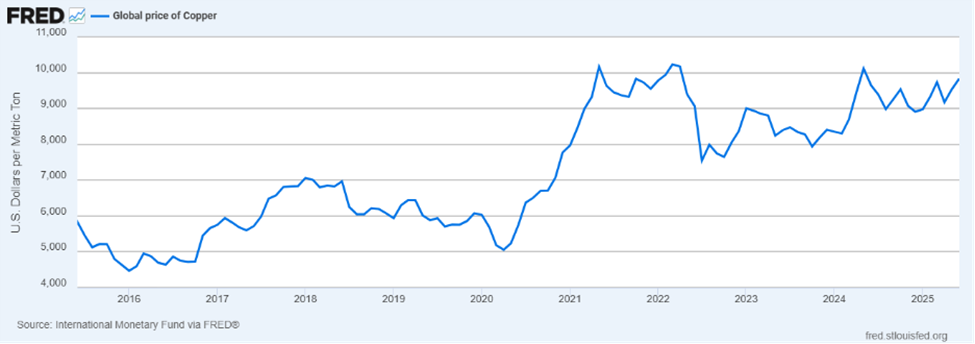
Prices have since risen further to $11,000, and one mining CEO is now warning that it could increase to $15,000 next year on supply disruptions and the lack of new production sites. Eric believes this new supercycle should flip the refined-copper balance into a deficit of roughly 150,000 tonnes next year. As he puts it in a recent Fry’s Investment Report update (subscription required):
Copper is one of the most vulnerable links in the global supply chain for the energy transition and AI build-out. Without more than $200 billion of new investment, the world simply won’t have enough copper. For context, Wood Mackenzie estimates that total copper-mining investment over the past six years reached only about $76 billion…
So, the short-term story is simple; demand is growing faster than expected, supply is growing slower than expected, and the market is already slipping into deficit.
Some copper miners have already seen price action in their shares. Southern Copper Corp. (SCCO) has risen 60% so far this year, while Hudbay Minerals Inc. (HBM) is up 125%.
But one company has yet to recover… and Eric is seeing it as a coiled spring waiting to go off. This company is a leader in global copper production and has also pioneered a cost-effective method for extracting copper from waste rock. This technology could eventually add 20% to its pretax income.
The firm also generates a significant amount of gold as a by-product of its copper mining operations. In fact, one of this firm’s mines is so rich in precious metal that the copper it produces has negative unit cash costs.
Now, you might be able to guess the name of this miner. Eric has been recommending and talking about this company since 2020. But to be sure you’re investing in the right firm, I’d highly suggest watching his presentation, where he reveals details about this pick for 2026.
“Zigging” While Everyone Else “Zags”
In the late 1990s, Eric worked at Grant’s International, a firm focused on international markets. While everyone in America was fixated on dot-com stocks, Eric was recommending foreign companies like Thailand’s Minor International Group (MNILY), Germany’s Adidas (ADS), and, of course, The India Fund.
These recommendations were made in 1999… the year dot-com mania was reaching its peak. And all three massively outperformed U.S. tech. Over the following years, each one scored 1,000% gains or more.
Today, Eric is once again warning that markets are beginning to look frothy. Investors are convincing themselves that this technological revolution is different, and that the old valuation norms no longer apply. After all, if “everyone knows” something will change the world, why shouldn’t you buy it at any price?
But much like the dot-com boom, today’s AI Revolution comes with growing risks. Stocks will likely keep going up in the medium-term… but what happens if (or when) the bottom falls out?
That’s why it’s growing equally important to buy sectors that “no one knows,” even as prices in the “everyone knows” camp keep rising. Eric covers all this, and more, in his new “AI Survivors” special presentation.
Now, before you go, please note that our office will have adjusted hours throughout the month for the holidays.
InvestorPlace offices, including customer service, will be closed on December 24 through 26 and December 31 through January 2. And our customer service team will have limited hours of 9 a.m. to 12:30 p.m. Eastern time on December 22, 23, 29, and 30.
We’ll feature “best of” Digest pieces during the holidays, and I’ll see you back here after New Year’s.
Until then,
Thomas Yeung, CFA
Market Analyst, InvestorPlace


