


Listen to the audio version of this article (generated by AI).
Hello, Reader.
Tom Yeung here with today’s Smart Money.
In 1967, then-governor of California, Ronald Reagan made a joke about his early days in office. It went like this:
One day when things looked pretty dark up there… one of the staff said to me well cheer up, things could be worse.
And so, I cheered up. And sure enough they got worse.
Almost sixty years later, the AI Revolution is having its own “it could be worse” problem.
Since peaking in July, the AI trade has broken down. Major AI indices like the Global X Robotics & Artificial Intelligence ETF (BOTZ) and iShares Semiconductor ETF (SOXX) have fallen more than 20% from their highs. Even blue-chip names like Intel Corp. (INTC) and SanDisk Corp. (SNDK) have dropped 50% or more.
It’s been a disaster for latecomers to the AI Revolution.
So, where does that leave investors to put their money?
Oil offers one way out. Energy prices are still almost 60% higher than they were at the start of the year. And healthcare is another bright spot. This segment is historically noncyclical, because diseases and skiing accidents don’t care how the economy is doing.
But there’s one area we don’t talk about as often.
So, in today’s Smart Money, I’d like visit one of the most powerful investment themes of the past century: The Great American Consumer.
Then, I’ll reveal a way to put the American consumer to work in your portfolio.
America’s Spending Machine Keeps Running
The strength of the U.S. consumer has long defied expectations. In 1945, many economists feared that the end of World War II would send America into another depression. But years of rationing had left households with large savings and a long shopping list. A baby boom and postwar spending followed.
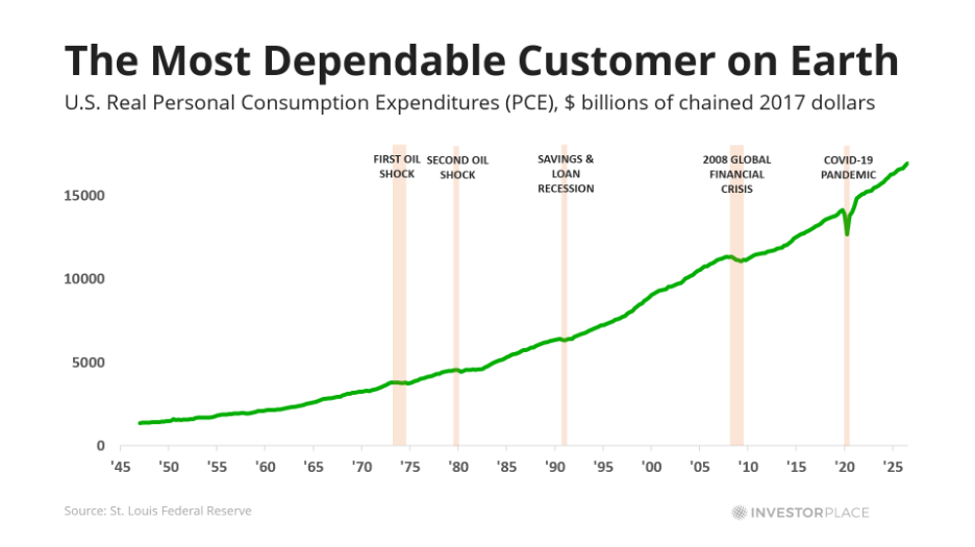
Similar fears resurfaced during the stock market corrections of the 1970s, the late 1980s, and early 2000s. American consumers shrugged off these concerns. Consumption only dipped slightly during the two oil shocks (less than 1% in real terms) and actually went up during the mild 2001 recession.
Then, during COVID-19, Americans surprised forecasters once more by continuing to spend online from home. As shown in the graph below, inflation-adjusted consumer spending has proved one of the most enduring trends of the American economy.
Much of that strength comes from America’s productive economy, which supports well-paying jobs and gives households the means to consume. Their spending encourages businesses to hire and invest, creating a self-reinforcing cycle that has set America apart from other developed economies.
There’s also a cultural factor. Some historians point to the late 1940s as the beginning of the Consumer’s Republic – a set of ideals to dramatize the superiority of capitalism over communism.
In plainer English: We like to keep up with the Joneses.
Finally, there’s personal wealth – something helped along by America’s relatively high homeownership rate and participation in the stock market. That creates what economists call the “wealth effect.” When asset values go up, households feel richer and spend more, even if their paychecks haven’t changed.
These factors have allowed the consumption engine to keep humming along. For example, in the third quarter, U.S. consumer spending grew at a 3.8% annualized rate, beating analyst forecasts of 3.5%. And we expect October’s figures to show spending holding up; Visa Inc. (V) reported that U.S. card payments volume rose 10% from a year earlier during the first three weeks of October, an encouraging sign heading into the holiday season.
To play this trend, Eric has several consumer picks. Let’s take a look at one below…
This Old-School Brand Deserves a Second Look
A shoemaker that has been in continuous operation since 1774 should, by rights, be the last stock anyone associates with modern investing themes. And yet Birkenstock Holding plc (BIRK) may be one of the clearest examples of a durable, old-economy business thriving in an AI-obsessed market.
The company’s competitive moat is not a patent or a software platform. It is 250 years of accumulated craft, a manufacturing process that remains more than 95% European, and a brand identity so strong that the same cork-soled sandal has survived the transition from “hippie” icon to luxury fashion statement without losing a step.
CEO Oliver Reichert’s description of Birkenstock’s addressable market is not an overstatement: “Every human being that walks on two feet.” The most recent quarter validated that ambition. Fiscal third-quarter revenue grew 15% in constant currency (13% as reported), despite geopolitical uncertainty and pressure on consumers. The company also raised its full-year revenue growth guidance to 15% in constant currency.
I should also note that Birkenstocks have become popular among Gen Z thanks to viral video moments (they were featured in the Barbie movie) and favor among stars like Charli XCX and Gigi Hadid. Imagine if Marilyn Monroe endorsed a shoe brand!
But strong results have not always translated into a higher stock price. After its second-quarter results, shares fell more than 14% as investors reacted to the company’s outlook and other concerns.
Meanwhile, the underlying business keeps compounding. In the third quarter, revenue in the Asia-Pacific region grew 23% in constant currency, while direct-to-consumer revenue climbed 16%. The company added 13 stores during the quarter, bringing its total to 124 company-owned retail locations.
To prepare for additional demand growth, Birkenstock continues investing in production capacity. Its fiscal 2026 capital expenditure outlook is €110 million to €130 million, funding manufacturing expansion and retail operations.
The “Boston Clog,” which is celebrating its 50th birthday this year, remains one of the hottest products in global footwear. Closed-toe styles continue gaining ground, accounting for 38% of revenue, up from 33% a year earlier. That shift is extending Birkenstock’s reach into all-weather, year-round occasions.
Birkenstock’s latest results show that investors don’t need to chase the latest AI stock to find a growing business. A 250-year-old footwear brand is still finding new customers, expanding internationally and investing to meet demand.
And that’s the kind of opportunity worth watching.
Birkenstock is just one example of the opportunities investors can find beyond the AI frenzy. At Fry’s Investment Report, Eric looks beyond the market’s hottest trends to find businesses with the staying power to thrive through whatever comes next.
Until next time,
Thomas Yeung, CFA
Market Analyst, InvestorPlace
P.S. Louis Navellier has spent nearly five decades studying what separates the stock market’s biggest winners from the rest. Now he’s putting that experience to work in a new way. He’s personally selected 25 of his highest-conviction stock recommendations for a new model portfolio, which he’ll review and update every month. And he believes this approach could be especially important as Wall Street heads into 2027. Louis will explain why — and introduce his new service — during a special presentation on November 12. Reserve your spot here.


