Listen to the audio version of this article (generated by AI).
Tom Yeung here with your Sunday Digest.
There’s a scene in Young Frankenstein, where the title character asks how things could get any worse.
“Could be raining,” Igor answers.
Suddenly, a thunderclap roars, and a heavy downpour soaks the two.
This drenching feeling has dominated markets for the past five months. After hitting their all-time highs in June, many AI stocks have dropped, and then kept going down. The iShares Semiconductor ETF (SOXX) is now down 30% from its peak, while China’s AI-heavy STAR50 Index has slumped 40%.
It’s why I wrote back in July – after the forced liquidation of the highly leveraged Situational Awareness hedge fund – that it was still too early to buy the memory-chip dip. Though companies like Micron Technology Inc. (MU) and SK Hynix Inc. (SKHY) had lost a quarter of their value or more, I believed things could still get worse. And they did.
That begs the question: When is it time to jump back in?
InvestorPlace Senior Analyst Louis Navellier has spent the past four decades answering that. By using a quantitative approach that combines fundamental performance with “smart money” flows, Louis has created his Stock Grader system that can identify not just what stocks to buy… but when.
And now, Louis has developed a new way to put Stock Grader to work, helping investors distinguish promising opportunities from stocks that could still have further to fall. He’ll explain his approach during a free presentation at 2 p.m. Eastern on Thursday, November 12. He’ll also reveal two specific recommendations: one stock to consider buying for 2027 and another to avoid. (You can reserve your spot for that free event here.)
His ratings are now flagging several key chipmaker names. And I’d like to share them with you today to showcase the kinds of insights his system can uncover.
The Chipmaking Toll Booth
KLA Corp. (KLAC) is the closest thing the semiconductor industry has to a toll booth.
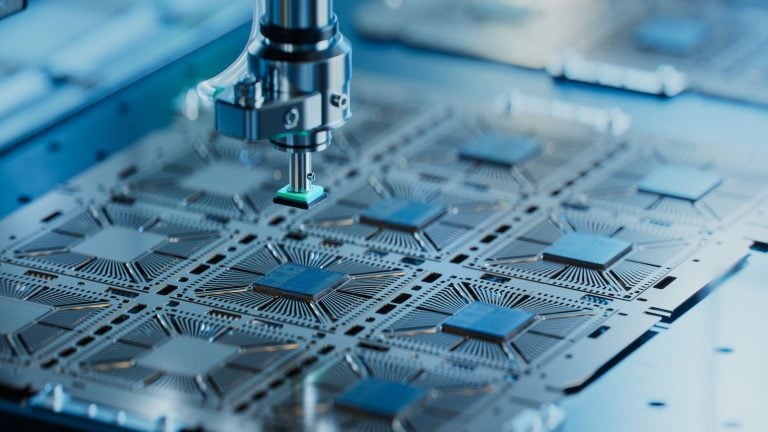
The Silicon Valley firm dominates a niche called “process control,” the machines and software used to inspect semiconductors. This helps chipmakers find and correct manufacturing mistakes, and KLA “owns” roughly 50% of the market.
The process is essential. Advanced chips are extremely difficult to make, and errors in a wafer can cause entire chips to fail early… or not work at all. A microscopic manufacturing defect is often enough to turn a $50,000 AI GPU into an expensive paperweight.
It’s why KLA earns some of the highest margins in the chipmaking industry. Operating margins are above 45% — higher than what Apple (AAPL) generates – because chipmakers are willing to pay for the best inspection machines to save costs down the line.
Now, Louis’ model has long known that KLA is a high-quality business. It awards strong fundamental grades thanks to the firm’s high sales growth, wide margins, and upward analyst revisions.
KLA is also benefiting from the insatiable demand for leading-edge AI chips, which adds more production steps. A vertically stacked 3D chip might need inspection every time a new layer is added. It’s why KLA’s fiscal 2028 earnings estimates have been revised consistently higher since 2024: Chipmakers are expanding high-end production, causing growth at KLA to accelerate.
However, KLA’s stock is an entirely different story. Since peaking at over $300 in June, shares have tumbled 50% as investors have soured on chipmakers. If chip demand is about to fall off a cliff, does it matter how good KLA’s machines are? Louis’ quantitative “follow the money” score turned bearish as well, recommending investors head for the exits.
The story has finally changed. Roughly a week ago, Louis’ model flipped KLA back to a “Buy” based on unusual buying patterns in the semiconductor industry. KLA’s latest results and a December guidance imply more than 40% growth, suggesting that demand is gaining momentum, and that slowdown fears may be overdone.
My own analysis finds that the drawdown has now gone too far. Now trading around $150, KLAC shares should be worth north of $200, and could possibly rise back to $300 in a bull case.
I should also note that KLA has historically bounced hard after reaching oversold levels. In fact, its latest steep drops (prior to this one) in October 2022, November 2024, and April 2025 came with a +40.7% rise over the following quarter.
And so, Louis’ quant signals and old-fashioned valuation are pointing in the same direction. KLA is a buy in my view, not just because smart money is jumping back in, but also because the market is pricing a toll booth like a cyclical bet.
Collateral Damage
Marvell Technology Inc. (MRVL) is one of the top makers of custom chips in the AI industry. It co-designs its “XPU” chips with customers. And because each chip is built with a set task in mind, they are exceptionally fast.
Think of it like building a drag racer. If you know the track in advance, you can build a car that does nothing else besides winning on that course.
One of Marvell’s first major AI customers was Amazon.com Inc. (AMZN), where it helped design the Trainium2 AI accelerator. It has also helped Alphabet Inc. (GOOG), Microsoft Corp. (MSFT), and other major data center firms build custom chips.
Now, four things have happened to Marvel (MRVL) in the recent past:
- The business kept accelerating. On August 27, the custom AI chipmaker said that revenues had increased 37% to $2.74 billion thanks to strong demand from AI data centers. Management raised guidance for both fiscal 2027 and 2028.
- The company announced some highly ambitious targets. During its October 6 Investor Day, management called for up to $90 billion of revenue by 2031 (7.5X this year’s revenues), and made a “$30 in ’30” target of generating more than $30 in earnings per share by 2030.
- The firm said it would buy optical communications leader Lumentum Holdings Inc. (LITE). In a deal confirmed on November 2, Marvell said it planned to purchase a “crown jewel” of the networking industry, as a TD Cowen analyst put it.
- The stock plummeted from its June peaks. Shares are now down 50% since July, despite a business that is, by most measures, in far better shape than it was last summer.
That last part is particularly notable, because Marvell now scores a top “A” grade in Louis’ quantitative score. In other words, Louis’ system suggests much of the recent selling has been technical, rather than a statement on the business.
Here’s why.
When Marvell agreed to pay $115 billion in stock for Lumentum, hedge funds immediately pounced on the chance to make money. They used a popular strategy known as “merger arbitrage,” where they would buy one share of Lumentum and sell 4.5 shares of Marvell short. If the merger comes together, they will receive 4.5 shares of Marvell for each Lumentum share they own, allowing them to close their position and pocket a roughly $80 spread. It’s a generally profitable bet because almost 90% of merger deals go through, according to asset management firm Verdad.
That’s likely why Marvell lost a third of its value in three trading sessions. A 5% to 10% selloff might have been warranted from a major dilutive merger that could add 50% more shares. But the magnitude of the drawdown suggests there were other reasons too.
There are early signs the selling might be easing. Shares have traded roughly flat since the most recent leg down on Wednesday, and the stock is now priced at just 23 times next year’s earnings – making them cheaper than Broadcom Inc. (AVGO) and Nvidia Corp. (NVDA) on that basis, despite growing faster than both.
And so, Marvell is surfacing as a compelling bet in Louis’ system. The stock has faced a significant technical selloff by hedge funds, and that drawdown is now ending.
Ground Floor, Going Up
Earlier on, I mentioned that stacked 3D chips are becoming increasingly popular among AI chipmakers.
It’s for good reason.
Think of a dense office skyscraper. Stacking floors on top of each other packs far more people into the same space while cutting travel time. No one needs to walk across town for a meeting. They just take the elevator two floors up.
Stacked chips work the same way. Memory chips that once sprawled out across a single plane can now rise hundreds of layers high. Some makers are even talking about thousand-layer chips by 2030.
For AI chips that move enormous amounts of data back and forth, cutting that distance is everything.
So, who’s building these skyscrapers?
That’s the job of Lam Research Corp. (LRCX). The 46-year-old firm builds machines that do two jobs. The first is “deposition,” which lays down each ultrathin layer of a 3D chip. It’s much like pouring concrete for each floor of a building. The second is “etching,” which carves channels through those layers, like drilling elevator shafts through a finished tower. As more layers get added to 3D chips, Lam’s machines must make more passes. And so, chipmakers need more of them.
That’s showing up in the numbers. Last quarter, Lam Research’s revenues rose 54% to $8.2 billion, and the company posted a 40% operating margin – the highest in its history. Wall Street has raised its earnings estimates for four straight quarters, and Louis’ model awards the company a solid “B” grade for its excellent growth, profitability, and institutional buying.
So, you might expect the stock to be soaring. But instead, LRCX shares are down 47% from their June peak. In fact, shares fell 12% on October 22, after Lam reported results that beat estimates.
The culprit here is supply. Lam is now growing so fast that it’s straining to keep up with orders. Many fourth-quarter deliveries are getting pushed into next year, and the company’s chief financial officer conceded that their forecasts “would have been a bit higher if not for some near-term supply chain constraints.” The company also generates a third of its sales from China, which is always one Executive Order away from an export ban.
Yet, the market priced it like a bust. Lam now trades at roughly 19 times next fiscal year’s earnings, the cheapest of the four big chip-equipment makers. The company is also in great financial shape. It has no net debt, generates over $6 billion in annual free cash flow, and is riding one of the most powerful trends of AI chipmaking technologies.
Furthermore, LRCX has a long history of bouncing after hitting oversold levels, as measured by the Relative Strength Index (RSI). Since going public in 1984, it has recovered 63% of the time, with a 10% gain in the following quarter.
And so, Louis’ system and I both expect Lam’s shares to recover. It plays an essential role in AI chipmaking, and Wall Street is pricing the firm as if the building boom were over.
Could Be Raining
Now, KLA, Marvell, and Lam Research are three interesting opportunities. But that doesn’t mean they’re right for every investor, or that their recent troubles are necessarily behind them.
And that’s an important distinction. Lam earns a “B” because risks remain, including the possibility of another U.S.-China trade war. Marvell earns an “A,” but it’s still drying off from a hedge-fund selloff. Even when the fundamentals look promising, investors need to pay attention to what the market is telling them.
That’s why I’d like you to reserve your seat for Louis’ upcoming presentation. At 2 p.m. Eastern on Thursday, November 12, he’ll explain a new way to use Stock Grader to identify promising stocks and recognize potential trouble before it gets worse. It’s an approach designed for a market where even strong companies can get caught in a downpour.
Louis will also reveal two free stock recommendations: one he believes investors should consider buying for 2027, and another he thinks they should avoid.
And there’s a bonus just for registering: You’ll get immediate access to test-drive Stock Grader yourself. Enter the symbols of stocks you own or are considering buying and see how Louis’ system grades them. You don’t have to wait until November 12 to try it.
You can reserve your free seat and start using Stock Grader here.
I’ll see you back here next Sunday.
Thomas Yeung, CFA
Market Analyst, InvestorPlace


