Kevin Warsh gets the nod for Fed Chair… the market’s reaction… precious metals finally correct – get ready to buy… new data about our ever-expanding K-shaped economy
Last Friday, President Trump nominated former Fed Governor Kevin Warsh to lead the Federal Reserve, leaving Wall Street asking …
Does this signal a meaningful shift in monetary policy once Jerome Powell’s term ends in May?
Warsh is best known as a monetary hawk who has long criticized the Fed’s aggressive rate cuts and quantitative easing over the past decade.
So why would Trump – who has been vocal about wanting lower interest rates – choose him?
Credibility.
Unlike some other rumored candidates, Warsh is widely viewed as a serious, independent monetary policy thinker – not someone who would simply rubber-stamp White House preferences. Institutional credibility matters for preserving confidence in the Fed and the strength of the dollar.
But Warsh’s reputation doesn’t mean rate cuts are off the table. In fact, his recent writings suggest he has evolved from his earlier hawkish stance.
In a Wall Street Journal column last year, Warsh argued that deregulation and spending restraint would be disinflationary, creating room for lower interest rates. Plus, he’s been outspoken about what he calls the Fed’s “bloated balance sheet.” From a recent speech:
That largesse can be redeployed in the form of lower interest rates to support households and small and medium-sized businesses.
Translation: Warsh believes lower rates should come from productivity gains and balance-sheet discipline – not from ignoring inflation risks.
Legendary investor Louis Navellier believes this ultimately means rate cuts are still coming; it’s just a question of timing and magnitude.
From his Growth Investor Flash Alert last Friday:
As far as how much Warsh will cut interest rates, he has to get a consensus on the Fed.
The bottom line is he can’t talk about that because he has to stick to the Fed’s mandate, otherwise he won’t get confirmed.
But this was a pick that calmed Wall Street down, for lack of a better word. They don’t want anybody partisan at the Fed, and he will pretend not to be partisan when he’s confirmed.
The Senate confirmation process will likely take several months.
We’ll keep tracking this story as it develops, particularly any signals Warsh gives about his policy priorities during confirmation hearings.
Meanwhile, is this a buying opportunity in metals?
Friday’s action wasn’t just a pullback – it was a forced liquidation.
Here’s how brutal it was:
- Copper: -4%
- Gold: -10%
- Palladium: -17%
- Platinum: -18%
- Silver: -27%
Part of the reason for the selloff was a knee-jerk reaction to Warsh’s nomination. Markets interpreted it as a sign the Fed may remain more disciplined than some had hoped.
But a broader macro dynamic was at play. The U.S. dollar strengthened on expectations that Warsh will prioritize price stability and Fed credibility.
This makes dollar-denominated assets, such as gold, less attractive in the short term. When the dollar rallies, gold and silver typically pull back as it becomes more expensive for international buyers.
Finally, there was one more driver behind the sharp selling pressure: leverage.
The initial drop in metals prices triggered margin calls among heavily leveraged momentum traders. Forced selling pushed prices lower, triggering more margin calls – a classic liquidation cascade.
Importantly, this wasn’t a fundamentals-driven breakdown. And Louis sees it as an opportunity, not a warning sign.
Let’s return to his Growth Investor podcast:
Gold’s a great buy right now, any of our gold stocks.
So, don’t let that bother you.
Louis holds three gold miners in his Growth Investor portfolio. I’ll draw your attention to one – Agnico Eagle Mines Ltd. (AEM), which Louis designates as a “Top 5” holding.
Though Growth Investor subscribers are up almost 140% as I write, AEM remains below Louis’ “buy below” price of $206.
Here’s the investment legend with why he remains as bullish as ever:
AEM is the third-largest gold producer in the world… In the third quarter, it produced 866,936 ounces of gold and sold 868,563 ounces of gold.
The analyst community has now revised fourth-quarter earnings estimates 24.8% higher over the past three months. Fourth-quarter earnings are now forecast to soar 108% year-over-year to $2.62 per share, compared to $1.26 per share in the same quarter last year.
In his Flash Alert, Louis also explained why gold has been on such a powerful run – and why it’s likely to continue after this correction:
The reason gold’s gone up so much is the central banks are buying it because they have a lack of credibility.
The Bank of Japan, the Bank of England and even the European Central Bank are not going to be able to pay off their debt eventually.
They’ve got a lot of problems.
Louis’ point about the central banks is crucial for investors wondering how to interpret the selling pressure
The fundamental case for gold hasn’t changed.
Central banks continue to accumulate gold at a record pace – not to speculate, but to hedge against unsustainable debt and long-term currency risk. For example, Japan’s debt-to-GDP ratio exceeds 260%. Other countries are in similar circumstances.
- Italy sits at 137%
- Greece at 161%
- The U.K. is nearing 100%
That demand doesn’t disappear because of one Fed nomination. The macro forces supporting gold – including massive sovereign debt, central bank debasement, and geopolitical uncertainty – remain firmly in place.
So, for investors (not leveraged traders), sharp pullbacks are often entry points, not exits.
To learn more about joining Louis in Growth Investor and accessing all his gold recommendations and analysis, click here.
If you’re still not convinced about metals…
I’ll remind readers what veteran trader Jonathan Rose of Masters in Trading Live told me about copper last week:
Jeff: So, what’s your timing advice for getting into a new copper trade from here?
Jonathan: Copper will pull back, and we are buyers on any pullback.
This is a structural copper thesis, not a short-term trade.
Demand is being driven by AI infrastructure, grid upgrades, electrification, and reshoring, while supply remains constrained due to years of underinvestment, long mine lead times, and geopolitical concentration in Latin America.
Use volatility and pullbacks to build exposure, size appropriately, and express the view through either stock or options depending on risk tolerance and time horizon.
For more from Jonathan on copper and which stocks he’s trading, you can revisit our 1/28 Digest here.
Bottom line: If you’ve been on the sidelines watching metals roar higher, the buying window has just opened up.
New data confirms what we’ve been warning about
Regular Digest readers are familiar with our ongoing coverage of America’s K-shaped economy.
Americans with assets are thriving today as their net worths climb. However, Americans without assets are feeling increasing financial pressure as entrenched high prices weigh on monthly budgets.
Friday brought fresh data that confirms this divide isn’t just persisting – it’s accelerating.
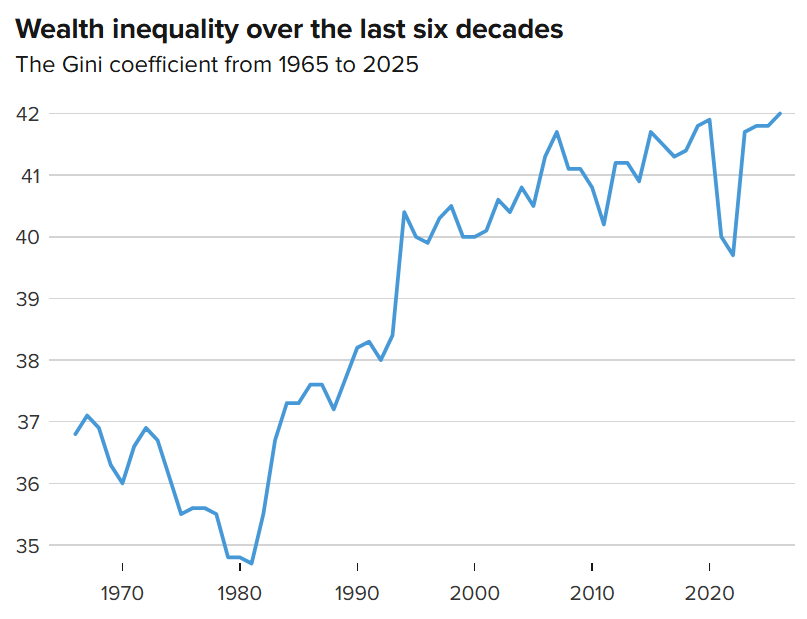
A new U.S. Bank report shows the Gini coefficient – a key measure of wealth concentration – has hit 60-year highs.
To make sure we’re all on the same page, the Gini coefficient quantifies income or wealth inequality across a population. The scale runs from 0 to 1, where 0 represents perfect equality (everyone has the same wealth) and 1 represents maximum inequality (one person has everything).
The higher the number, the more concentrated wealth is at the top. And right now, we’re at the highest reading in six decades…
Source: CNBC
While there was a temporary easing during the pandemic when stimulus checks narrowed the wealth gap, it was short-lived. As you can see above, as the decade has continued – with its massive inflation – wealth concentration resumed its climb and then accelerated.
The numbers paint a stark picture of just how concentrated wealth has become
The net worth of America’s top 1% hit a record 32% share of total wealth in the third quarter of 2025, according to Federal Reserve data. Meanwhile, the bottom 50% collectively hold just 2.5% of overall net wealth.
Think about that – half of all Americans combined own just 2.5% of the country’s wealth. Given inflation and AI, this is unlikely to reverse anytime soon.
Here’s Mark Zandi, chief economist at Moody’s Analytics:
This is not a cyclical or temporary phenomenon.
This is a structural, fundamental issue.
But here’s a striking statistic I haven’t covered yet in the Digest…
According to Bureau of Labor Statistics data, the portion of U.S. GDP going to workers in the form of compensation just hit its lowest level in over 75 years.
Translation: Even as the economy has boomed over the past 15 years, the average worker is seeing a smaller slice of the pie than at any point since the late 1940s.
And as we’ve covered many times in the Digest, AI is going to make this problem worse.
As we’ve been warning in the Digest for months, this kind of persistent economic divide doesn’t stay contained
It produces policy responses – particularly at the state and local level.
We’re already seeing it play out with the following proposals:
- California’s proposed billionaire wealth tax,
- The potential for Washington State’s first-ever income tax,
- Michigan’s prospective 5% surcharge on income over $500,000, and
- Colorado’s graduated income tax ballot measure.
At the start of this year, I predicted that 2026 would bring a wave of controversial tax proposals aimed at investment wealth. Well, with this latest Gini data showing wealth concentration at 60-year highs, I feel confident about my call.
We’ll continue tracking all these stories here in the Digest.
Have a good evening,
Jeff Remsburg


