
As I write on Wednesday, stocks are continuing yesterday’s rally, spurred on by positive geopolitical headlines.
This morning, President Trump posted on Truth Social that Iran’s president has requested a ceasefire – adding that the U.S. would only consider the proposal once the Strait of Hormuz was “open, free, and clear.”
Meanwhile, the United Arab Emirates is reportedly preparing to help open the Strait by clearing it of mines, while also encouraging neighboring Gulf states to join the effort.
Here’s The Wall Street Journal:
Emirati diplomats have urged the U.S. and military powers in Europe and Asia to form a coalition to open the strait by force…
Saudi Arabia and other Gulf states are now turning against Iran’s regime and want the war to continue until it is disabled or toppled.
Altogether, it’s enough to keep optimism high and market gains coming. The S&P 500 is up about 3.5% over the past two sessions as oil prices fall – it’s a welcome exhale after one of the roughest stretches of the year.
Let’s pull back and get some perspective
Even with this two-day bounce, as I write, the S&P remains roughly 6% below its January peak. The Nasdaq and the Dow – which both temporarily crossed into official correction territory – are still down about 9% and 7%, respectively, from their highs.
As you can see from the chart below, even after our two-day bounce, the S&P 500 is still trading below its 200-day moving average (MA).
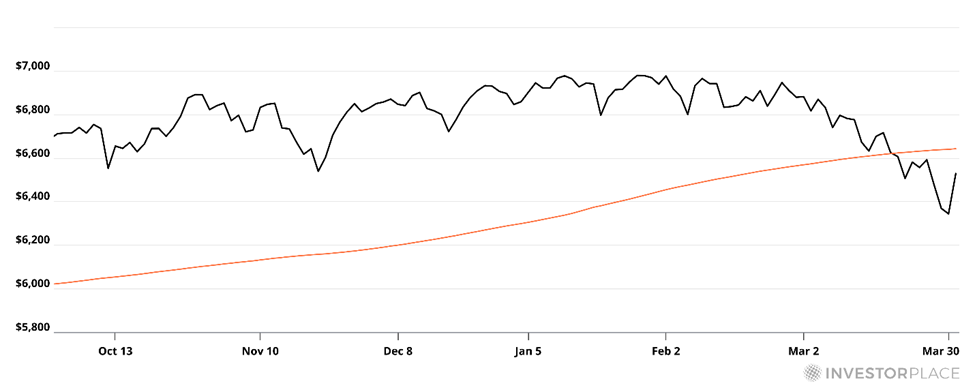
Here’s how Brian Hunt, editor of the free e-letter Money & Megatrends, described the significance of being below the 200-day MA in last Friday’s issue:
Stocks, ETFs, and indexes below their 200-day moving average are “on the wrong side of the tracks.” It’s the ugly part of town.
All the really bad things — crashes, panics, horrible bear markets — happen below the 200-day moving average.
But look back at the chart, and you’ll see that the S&P is looking to retake that key technical level.
Will the market break through and continue to strengthen? Or will the S&P get rejected and begin a deeper leg lower?
Brian points out that today’s fundamentals, valuations, and interest rates aren’t driving the recent price action in the broad market. The volatility is nearly exclusively due to Operation Epic Fury and President Trump’s social media posts.
So, he sees a simple binary that could influence this 200-day MA test:
If the war ends soon, the S&P is very likely to pop higher and get back on the right side of town.
If the war does not end soon, its constriction of critical resource supplies will seriously damage the global economy and stocks will trade lower.
Bottom line: The last two days are encouraging. But the resolution remains unclear – and as we noted in yesterday’s Digest, even a ceasefire doesn’t automatically reopen the Strait, which will have the greatest influence over oil prices and, by extension, inflation, interest rates and the rest of the tipping dominoes.
Brian publishes his free e-letter every day the market is open. If you’re interested in learning more about the megatrends that are driving the market today, sign up for Money & Megatrends right here.
Now, even amid this uncertainty, our hypergrowth expert Luke Lango, editor of Innovation Investor, is betting on a bullish outcome.
Luke’s bull case: why he thinks this rally could have real legs
Even with the market below its 200-day MA, Luke sees a compelling setup building beneath the surface – particularly for tech and AI investors.
He notes a few converging signals. First, market breadth has deteriorated to levels historically associated with correction bottoms – the kind of readings that, in past cycles, marked the zone of maximum dislocation between price and fundamental value.
Meanwhile, fear indicators are compressing from their peaks, suggesting the worst of the uncertainty may already be priced in.
And the correction math itself is encouraging. Luke’s research found that every market pullback since 1950 that was constrained to 10%-20% went on to post an average six-month return from the trough of roughly 24%.
But the most bullish piece of Luke’s argument is the valuation reset in tech specifically. Here’s Luke from his most recent Innovation Investor Daily Notes:
Tech stock valuations have reset to levels that are genuinely compelling relative to the confirmed earnings growth trajectory.
The S&P 500 tech sector’s forward earnings multiple has compressed to 20.5X — essentially a post-COVID low, and just above where tech stocks bottomed in the 2022 bear market.
Over the next three years, tech earnings are projected to grow at a 25% CAGR. So, at current levels, investors are paying 20X forward earnings for ~25% compounded earnings growth.
That’s a very attractive setup.
Luke’s takeaway is that while we may not be at the exact low, waiting for a perfect all-clear signal could mean missing the opportunity. In his words, we’re “bottom enough.”
Now, shifting from the obvious impact of the Iran war on Wall Street, there’s a new related issue that could be a black swan lurking ahead…
The new brewing risk to the AI trade
While all eyes are on oil and the Strait of Hormuz, a quieter supply chain story is developing that AI and tech investors should closely track.
Helium.
The same invisible gas that keeps party balloons aloft is also essential for cooling the machines that manufacture AI chips – and right now, roughly a third of the world’s supply is offline.
Iran’s strikes on Qatar’s Ras Laffan LNG facility earlier this month didn’t just disrupt natural gas. They disrupted helium production lines that could take up to five years to repair.
Qatar supplies about a third of global helium, and virtually all of it travels through the Strait of Hormuz – which, despite Wall Street’s two-day party, remains paralyzed.
Here’s Entrepreneur on Monday:
Without helium, leading chip makers including TSMC, Samsung and SK Hynix could struggle to keep production running.
Helium cools superconducting magnets during chip manufacturing and flushes toxic residue after wafers are washed.
The gas is irreplaceable for making chips that power iPhones and Nvidia’s AI servers.
There is no easy substitute here. Helium’s unique combination of thermal conductivity, chemical inertness and atomic size makes it irreplaceable in chip fabrication.
The Semiconductor Industry Association acknowledged this in a 2023 filing to the U.S. Geological Survey, warning that a supply disruption “would likely cause shocks to the global semiconductor manufacturing industry.”
And though some headlines cite “months” of helium reserves, the inventory picture is more precarious than it sounds. The gas is notoriously difficult to contain. As Lita Shon-Roy, president and CEO of semiconductor materials advisory firm TECHCET, told Scientific American:
Helium can leak out about 0.1 to 1 percent per month, depending on how good the gaskets are. There’s never a good gasket or fitting. It just leaks over time.
Meanwhile, roughly 200 specialized cryogenic containers used to transport liquid helium – each worth about $1 million – were stranded near the Strait when the war began.
Industry consultant Phil Kornbluth told The Wall Street Journal that repositioning, refilling, and delivering those containers alone could take months.
Here’s his overall assessment:
There is a tsunami coming, but it’s still a thousand miles offshore.
So, where might that tsunami hit?
Of the major chipmakers, Samsung and SK Hynix appear most exposed. Both are heavily dependent on Qatari supply and are critical producers of the high-bandwidth memory (HBM) inside Nvidia’s AI servers.
Taiwan Semiconductor Manufacturing Company (TSMC) carries its own exposure as the foundry behind chips for Nvidia (NVDA). Meanwhile, Micron (MU), with more diversified sourcing, looks better positioned in the near term, but still has exposure.
But the helium story also has an unexpected winner hiding in plain sight: ExxonMobil (XOM).
Its Shute Creek facility in Wyoming accounts for roughly 20% of global helium production capacity and has an 80-year reserve runway. As 24/7 Wall St. noted, the shortage “hands Exxon a low-effort margin expander at a time when chip demand for AI keeps climbing.”
For investors already holding XOM for its oil-and-gas core, the helium angle makes it even more interesting. For new money, it’s worth putting on your radar.
The key variable, as with everything right now, is time. A swift ceasefire resolves this before it becomes critical. But a prolonged conflict turns a distant tsunami into a very close wave.
We’ll keep you updated.
Finally, another round of layoffs – and a darker question for AI investors
By now, most investors are familiar with AI’s threat to jobs. It’s the story everyone is watching.
But there’s a less-discussed question starting to surface – one I’ll tackle in a deep-dive Digest soon. It goes something like this…
What if AI will eventually be just as destructive to most AI companies as it is to the workers they’re replacing?
Consider Oracle (ORCL)…
Yesterday, the software giant announced a new round of layoffs – TD Cowen estimates between 20,000 and 30,000 workers – even as it simultaneously ramps AI infrastructure spending aggressively. Oracle has committed to a jaw-dropping $455 billion in remaining performance obligations following its OpenAI agreement, all while reshaping the company around the AI buildout.
And yet ORCL is down 25% this year. Part of that reflects investor concern about cash flow amid surging capital expenditures. But another part reflects something more unsettling…
The market is beginning to ask whether generative AI threatens not just Oracle’s employees – but its core business.
This question extends well beyond Oracle
It cuts to the heart of the entire AI investment thesis…
If AI commoditizes intelligence, who actually wins?
The companies building it?
The companies deploying it?
Or, maybe, nobody?
And – perhaps most unsettling – what about the investors currently holding the companies that appear to be winning right now?
The recent answer – own the infrastructure layer, the picks-and-shovels, the Nvidias of the world – has served investors well. And it will likely continue to… for at least a while.
But that thesis rests on one assumption: that demand for AI compute will keep compounding indefinitely. However, what happens if the economics of AI start working against that assumption?
What if we’ve started a race to the bottom that eventually circles back to the infrastructure layer, too?
That’s a bigger conversation than we have room for today. But it’s coming.
For now, here’s our takeaway
Oracle slashing potentially tens of thousands of jobs while simultaneously betting $455 billion on AI infrastructure isn’t a contradiction. It’s what the AI structural reset looks like in real time.
The technology is reordering how companies are built, staffed and financed – and that process is still in its early chapters.
Yes, short-term headwinds are real…
There are potential supply shocks like helium… unresolved geopolitics… and an S&P still on the wrong side of the 200-day MA. These are meaningful speed bumps.
But as Luke reminds us, investors are currently paying 20X forward earnings for roughly 25% compounded earnings growth in tech. Whatever the road ahead looks like, that’s an attractive set-up.
Have a good evening,
Jeff Remsburg
(Disclaimer: I own MU.)


