

Listen to the audio version of this article (generated by AI).
Hello, Reader.
Remember the DeepSeek shock back in January 2025? When the Chinese AI lab DeepSeek released its DeepSeek-R1 reasoning model, it shook global markets.
The model showed that a Chinese company could compete with Silicon Valley’s best AI systems at a much lower cost.
Now, China has delivered the sequel.
On Sunday, Alibaba Group Holding Limited (BABA) unveiled a preview of its newest AI model, Qwen3.8 Max. The company says Qwen3.8 Max ranks among the world’s most powerful AI models, trailing only Anthropic’s Fable 5. Shares of Alibaba rose over 5% on Monday following the news.
The launch came shortly after Chinese startup Moonshot AI’s release of Kimi K3, another model competing with the U.S.’s top AI systems. In benchmark tests, Kimi K3 beat Anthropic’s top model and OpenAI’s GPT-5.6 Sol at some coding tasks.
U.S. companies are racing to build the smartest AI models. China is proving that AI doesn’t always need to be the best.
It needs to be “good enough”, cheaper, and easier to adopt.
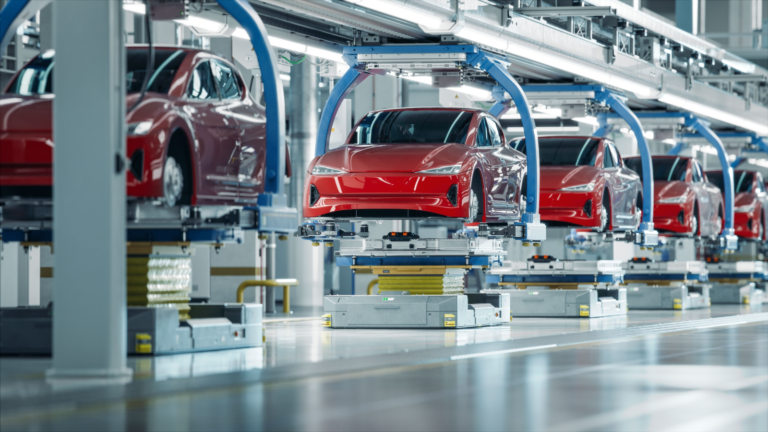
That’s the same playbook China used with electric vehicles (EVs): build products that are nearly as good, sell them much cheaper, then win global market share.
In today’s Smart Money, let’s take a look at why AI could become China’s next EV export story.
Then, I’ll share why the biggest investment opportunities may not come from the companies with the best technology – but from the companies powering it.
The EV to AI Playbook
Around 2010, well before the EV market took off, China heavily invested in the industry. This gave Chinese companies years to improve before they faced intense global competition.
Unlike the U.S., where Tesla Inc. (TSLA) became the dominant EV player, China encouraged dozens – even hundreds – of EV makers to compete.
And they competed on cost.
Chinese automakers realized that they didn’t need to build the world’s best cars. They only needed to build them good enough, and at half the price.
Once they built a strong business at home, automakers expanded overseas into markets where affordable EVs were in high demand. Today, Chinese EVs are common across Europe and other international markets. (In fact, I recently traveled to Europe, where I saw them all over the place.)
Now, China appears to be applying the same playbook to AI.
The recent Kimi K3 and Alibaba Qwen announcements are drawing attention because they suggest China’s approach to EVs could work in AI as well:
Build powerful technology. Lower the cost. Make it easier for businesses around the world to adopt.
Just a year ago, most AI discussions centered on OpenAI, Anthropic, Alphabet Inc. (GOOGL), and Meta Platforms Inc. (META). Investors now also watch Alibaba, Moonshot AI, DeepSeek, MiniMax, and Z.AI.
These companies are proving that AI does not always need to be the absolute best to win customers. Rather than beating Anthropic by a small percentage, Qwen3.8 Max and Kimi K3 are trying to be nearly as capable while being dramatically cheaper and easier to deploy.
Both Alibaba’s Qwen3.8 Max and Moonshot AI’s Kimi K3 are open-weight models, meaning businesses can download and run them locally instead of paying for access through a third-party service.
And for companies that use AI heavily, that can make them more attractive than Anthropic’s Claude or OpenAI’s ChatGPT.
We’ve been watching this “good enough” trend here at Smart Money, and now we’re really starting to see it play out. The Information reported on Monday that Microsoft Corp. (MSFT) is testing Kimi K3 inside its Copilot AI assistant. If successful, the move could save Microsoft up to $600 million by reducing its use of more expensive AI models like ChatGPT and Claude.
For many businesses, that is the key advantage.
And as more developers use Chinese AI models, they attract more users, more improvements, and more investment.
If China can build AI that is almost as good, much cheaper, and easier to adopt globally – as it did with EVs – it may capture a significant share of the worldwide AI market.
That doesn’t necessarily make U.S. AI companies losers. OpenAI, Anthropic, and others may continue to lead in performance. But it does suggest the AI world could look a lot like the EV market: premium U.S. models at the high end, and cheaper Chinese models competing on price and accessibility.
If the AI market follows a similar path, investors should remember an important lesson from the EV revolution…
Forget the Innovators. Own the Enablers.
It can be tempting to chase the companies grabbing the most attention. But history shows that revolutionary technologies often create even bigger opportunities for the companies supplying the picks and shovels.
The same lesson applied during the EV revolution. In October 2019, I took a closer look at Tesla, the EV industry’s biggest success story. I wrote to my Fry’s Investment Report subscribers:
Every automaker on the planet retools to launch EVs of its own.
The onslaught of competing EV models that is coming to market over the next two years is truly breathtaking. Tesla will struggle to repel this onslaught.
The company is an undisputed innovator, but that doesn’t mean it will survive to lead the new era it has spearheaded. “First movers” like Tesla often succumb to the creative energies they unleash.
So I say: Why not sell Tesla and buy the dynamic companies that will power and nurture the Second Electric Revolution?
I predicted that the global boom in electric vehicles could cause a major surge in copper demand. EVs require about four times as much copper as a typical internal combustion vehicle. Therefore, as they continued to gain market share, they would absorb a growing slice of the global copper supply.
That was when I recommended a picks-and-shovels play to my readers: Freeport-McMoRan Inc. (FCX). The copper company is up over 260% since then, and we’ve taken several triple-digit gains along the way.
I am playing the AI Revolution the same way.
Multiple stocks in my Fry’s Investment Report portfolio offer that sort of opportunity.
These companies include large producers of copper and aluminum, and several ETFs that hold baskets of stocks that operate in the uranium and nuclear industries… the solar industry… and the wind energy industry.
That’s just to name a few.
China may challenge U.S. AI dominance with cheaper, “good enough” models. But these pick-and-shovel plays could benefit no matter who leads the AI race.
I believe they offer compelling opportunities at their current quotes.
To learn how to access these names, simply click here.
Regards,
Eric Fry


